If you’ve ever lost marks in IB Math after doing the “hard part” correctly, it can feel unfair.
You calculate a regression equation. You press the right buttons. You get a clean number.
Then the markscheme seems to shrug and say: Nice. Now prove you understand why that number might be wrong.
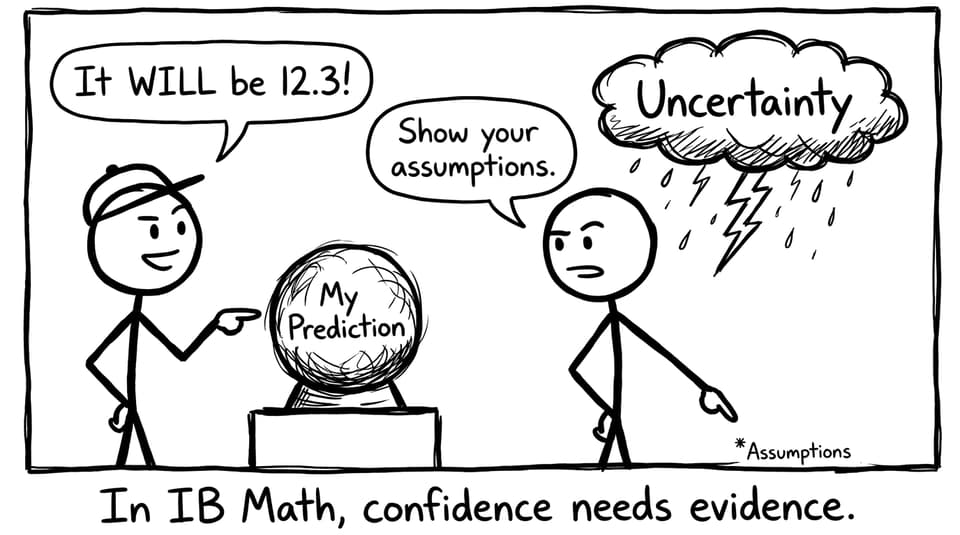
That is the quiet lesson behind many IB Math questions: predictions are not punishable because you predicted; they’re punishable when you sound certain without earning that certainty.
The quick checklist for safer predictions in IB Math
Before you write a prediction sentence in IB Math, check you’ve included:
-
A clear reference to the model you used (regression, distribution, normal approximation, etc.)
-
Conditional language: “likely,” “suggests,” “may,” “approximately,” “within this range”
-
At least one limitation: assumptions, sample size, variability, outliers, or extrapolation risk
-
A reality check: does the value make sense in context (units, time frame, constraints)?
When you practise with the IB Mathematics Applications & Interpretation Resources, aim to make this checklist a habit, not an afterthought.
Why IB Math penalises overconfident predictions
In everyday school maths, certainty is the reward: simplify, solve, done.
But much of IB Math (especially modelling, statistics, and technology-heavy questions) is built around approximation. The numbers you produce often come from a model that compresses a messy reality into something usable.
That compression has a cost.
A regression line, for example, is not a promise; it’s a summary of trend plus leftover noise. A probability model is not fate; it’s a framework based on assumptions. When you write “this will happen” or “the value will be X,” you’re claiming the model is stronger than it is.
IB examiners penalise that because it signals a misunderstanding of what you just did.
If you want to see how often interpretation is hiding in plain sight, the All IB Math posts page is a useful rabbit hole.
The trap: clean calculations create messy confidence
The most common source of overconfidence in IB Math is a perfect-looking answer.
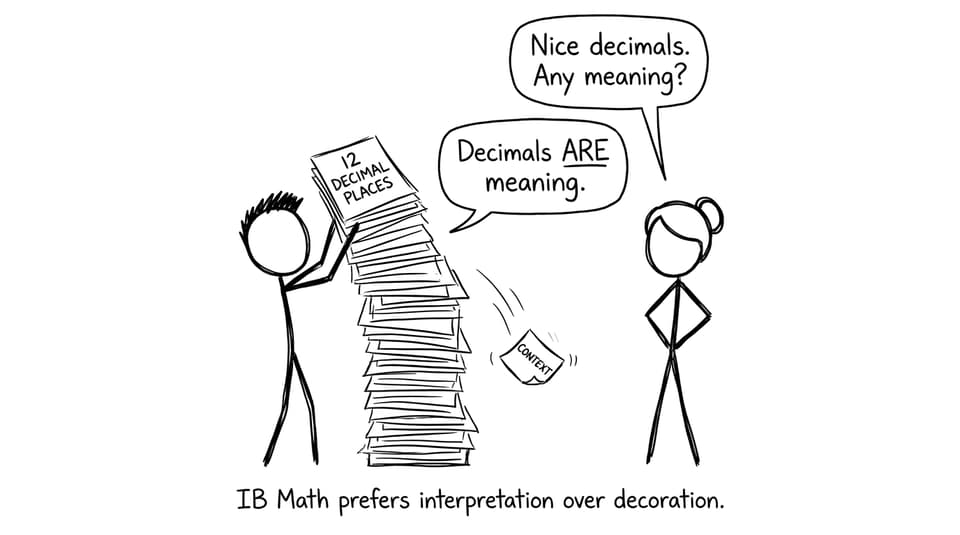
A calculator gives 12.347819.
Your brain hears: “authority.”
IB hears: “Did you confuse precision with reliability?”
In modelling questions, you can be computationally correct and still conceptually careless. That’s why targeted practice matters: the How to Use the Questionbank for Targeted Math Revision approach helps you drill not just answers, but examiner-style explanation.
Where overconfidence gets punished most: regression and extrapolation
Regression questions are basically a confidence test disguised as algebra.
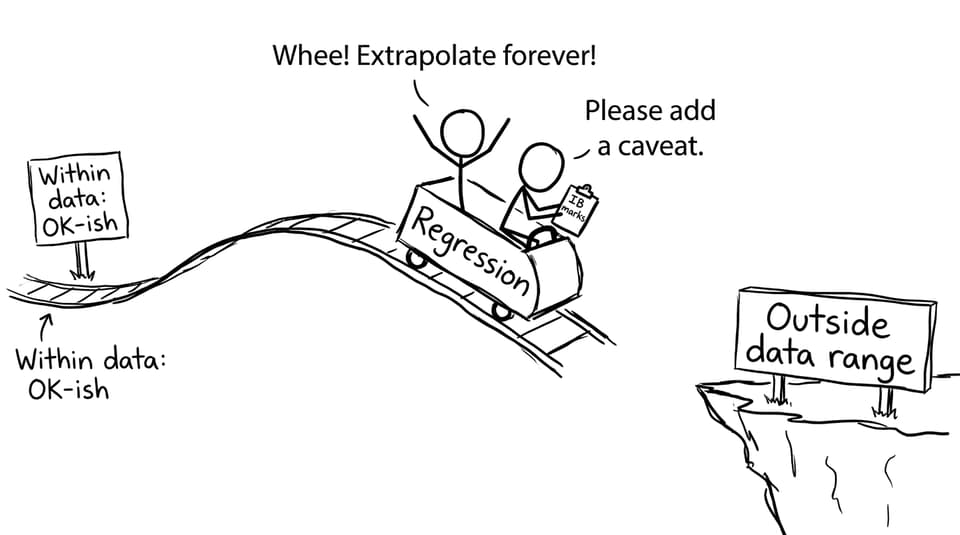
Even with strong correlation, predictions have uncertainty. And if you extrapolate outside the data range, uncertainty usually grows fast.
That’s why IB Math rewards students who say something like:
“Using the linear regression model, the value is estimated to be… however this is less reliable because it is outside the observed range and assumes the trend continues.”
If regression feels like a frequent mark-loss zone, revise the reasoning behind it with Why Do Regression Models Never Fit Perfectly in IB Maths? and Why Regression Predictions Become Less Reliable Over Time.
RevisionDojo habit: learn like an analyst, not a fortune-teller
A strong IB Math student isn’t the one who sounds most certain. It’s the one who is most responsible with certainty.
RevisionDojo is built for that.
Use Study Notes to learn the idea, then the Questionbank to practise writing conclusions that match markschemes. Convert recurring “caveat sentences” into Flashcards (yes, you can memorise the language of good uncertainty). When you’re stuck, AI Chat can help you rewrite an overconfident conclusion into an examiner-friendly one. Then lock it in with timed Mock Exams and Predicted Papers like the Mathematics Applications & Interpretation Predicted Papers (Free).
For Paper-specific strategy, pair this mindset with Ace IB Math Applications and Interpretation Paper 2.
Conclusion: the real upgrade in IB Math is judgement
The shift that unlocks higher scores in IB Math is subtle: from “prove I can calculate” to “show I can judge.”
When you stop writing predictions like a headline and start writing them like an analyst, your marks become more stable.
Build that skill with RevisionDojo’s Study Notes, Flashcards, AI Chat, Grading tools, and exam simulation via Mock Exams and Predicted Papers. Your predictions will sound less dramatic, and score more marks.