

The moment your “perfect” answer loses marks
It’s a familiar IB Math moment: you do the calculation cleanly, your numbers look sensible, and then the markscheme asks for “a comment on the sampling limitations.” Suddenly, your confident conclusion feels like it’s standing on a floor made of paper.
That discomfort is the point. In IB Math, statistics is not only about processing data; it’s about judging how much trust the data deserves. A sample can be computed correctly and still be a shaky foundation for a real-world claim. Sampling limitations are how IB checks whether you can tell the difference.
Quick checklist: what IB wants you to notice
When an IB Math question hints at sampling, scan for these high-yield limitations:
-
Who is missing? (undercoverage)
-
Who chose to join? (voluntary response)
-
How were people found? (convenience sampling)
-
How many were sampled? (small sample size, unstable results)
-
What made answering hard? (non-response bias)
To practise these quickly, build short drills from the Statistics and Probability Questionbank and ask RevisionDojo’s AI Chat to mark your evaluation sentences, not just your calculations.
Why IB Math keeps coming back to sampling limitations
Because IB is policing overgeneralisation
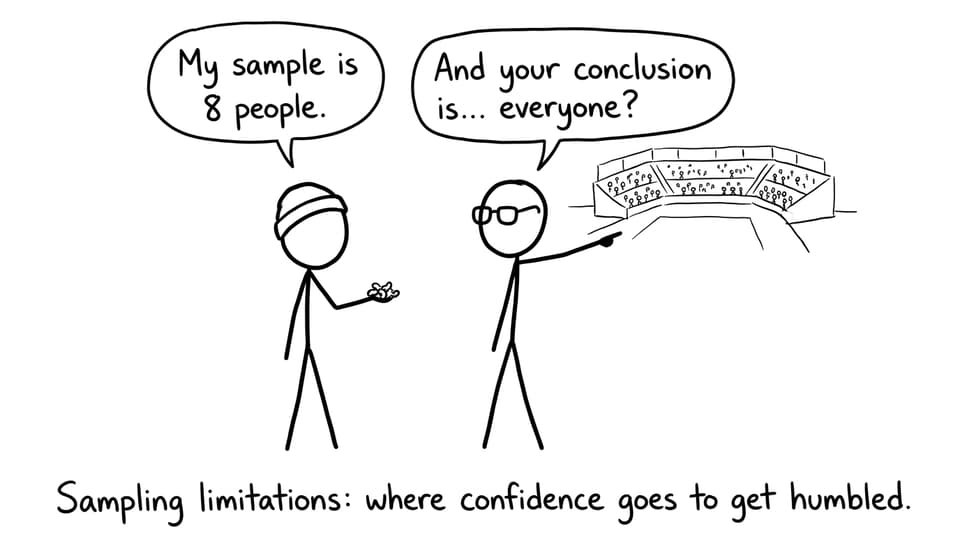
Most weak conclusions in IB Math have the same hidden flaw: they quietly jump from “this sample” to “everyone.” Examiners reward students who restrict claims to the group actually studied, or who explicitly state that the results may not be representative.
If you want a deeper refresher on what representativeness really means, RevisionDojo’s notes for Concepts, reliability and sampling techniques are a fast way to rebuild the vocabulary IB expects.
Because limitations reveal reasoning quality
Two students can get the same mean, the same regression line, the same p-value. The difference is the student who notices that the method of sampling was questionable. In IB Math, that’s what separates “I can compute” from “I can think statistically.”
This is also why interpretation often outscoring calculation isn’t an accident. If that still feels unfair, read Why is interpretation graded more than calculation in IB statistics and you’ll see the logic behind the mark allocation.
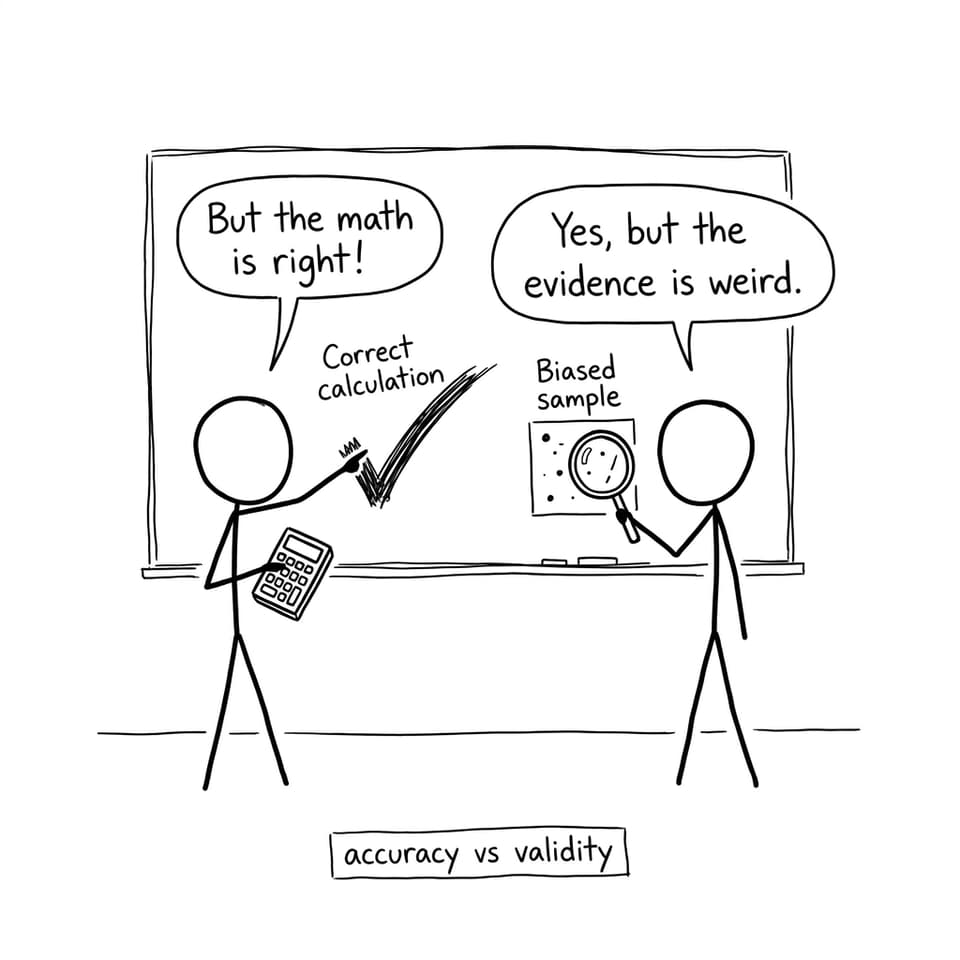
Because IB is testing validity, not just accuracy
A calculation can be accurate and still be invalid evidence. A biased sample doesn’t become trustworthy because your calculator behaved.
This matters constantly in IB Math AI, where technology can produce impressive outputs quickly. RevisionDojo’s guide on How to interpret data in IB Math AI using technology pairs well with timed practice from Mock Exams and Predicted Papers because it trains you to narrate what the numbers can (and cannot) support.
Because “cautious language” is a marking skill
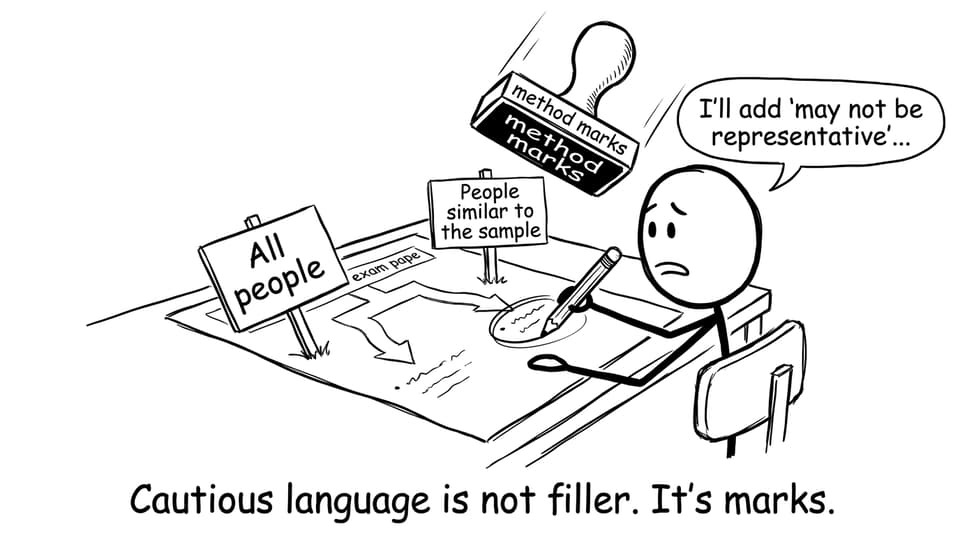
Students sometimes worry that mentioning sampling limitations makes an answer sound weak. In IB Math, it makes your answer sound realistic.
Try phrases like:
-
“The sample may not be representative of the population because…”
-
“This conclusion is limited to students similar to those surveyed…”
-
“Non-response could bias results if…”
That kind of wording is often what unlocks the final interpretation marks.
How to write a high-scoring limitation in 2 sentences
A reliable IB Math template:
-
Name the limitation (bias, small sample, non-response, undercoverage).
-
Explain the effect on the conclusion (less representative, weaker generalisation, possible skew in mean/proportion, reduced validity).
If you want more context on why “random” is often messier than it sounds, see Why random sampling is so hard to achieve in practice.
Closing: treat limitations as the difference between math and judgment
Sampling limitations aren’t obstacles in IB Math; they’re how you prove you can think like someone who uses data responsibly. The best answers don’t sound louder, they sound truer: careful claims, realistic scope, and clear reasoning.
If you want to turn that into consistent marks, use RevisionDojo to practise end-to-end: targeted Study Notes, timed Mock Exams, Predicted Papers, instant feedback in the Questionbank, and on-demand support from Tutors. In IB Math, that combination is what turns “I got the right number” into “I earned the interpretation marks.”