
If you ask ten IB students which math is harder, you’ll get ten confident answers and at least one dramatic sigh.
That’s because “hard” in IB Math isn’t a single thing. Sometimes it’s the moment algebra turns into a maze. Sometimes it’s the quiet panic of interpreting a regression output you’ve seen before… but can’t explain in words under time pressure. And sometimes it’s simply the weight of knowing your choice will echo into university prerequisites.
So let’s make this practical: a detailed comparison of IB Mathematics: Analysis and Approaches (AA) vs Applications and Interpretation (AI), with the real question underneath it all: which one is harder for you?
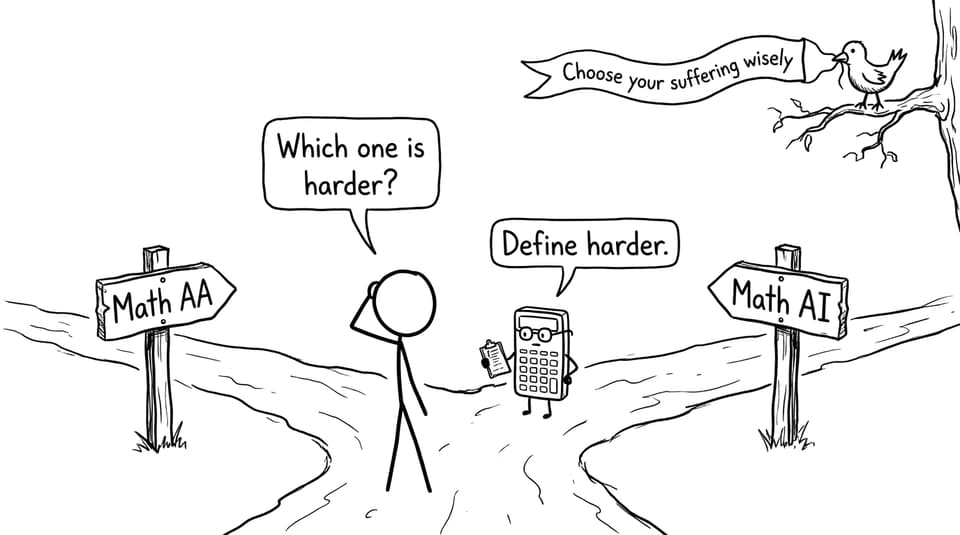
Quick checklist: how to decide which IB Math feels harder
Use this as your fast filter before we go deeper. In IB, clarity beats guessing.
-
If you enjoy algebraic structure, proofs, and calculus mechanics, AA often feels more “natural.”
-
If you enjoy context, technology, statistics, and modeling messy reality, AI often feels more “natural.”
-
If you dislike writing mathematical reasoning clearly, both courses will feel hard (because exams reward communication).
-
If you rely on intuition but avoid consistent practice, AA HL will punish that faster.
-
If you can compute but struggle to interpret results in context, AI HL will punish that faster.
For targeted practice once you’ve chosen, start from the course hubs: IB Mathematics Analysis and Approaches Resources and IB Mathematics Applications & Interpretation Resources.
The honest answer: “harder” depends on what kind of thinking you resist
A useful way to think about IB Math difficulty is to ask: What do you avoid when you study?
AA tends to expose avoidance of algebraic fluency. AI tends to expose avoidance of interpretation and modeling. Both expose avoidance of disciplined practice.
In other words, AA and AI are not “easy” and “hard.” They are two different mirrors.
IB Math AA: why it feels harder (and when it doesn’t)
Mathematics AA is the IB course that leans into pure mathematics. Even when questions are applied, the heart of the subject is still algebraic reasoning, functions, calculus, and precise manipulation.
The core difficulty of IB Math AA is depth and abstraction
AA questions often feel like they’re asking you to:
-
Hold multiple algebraic steps in your head without dropping one
-
Move between forms (exact, simplified, rearranged) calmly
-
Justify methods, not just produce answers
At Higher Level, the depth ramps up. Topics stretch further, and the expectation becomes: you don’t only know the method, you can adapt it.
If you want a concrete example of what students wrestle with, look at the way calculus becomes a full language in AA. RevisionDojo breaks it into manageable parts with notes, videos, and practice in IB Mathematics AA Calculus and targeted drills in the AA Calculus Questionbank.
IB Math AA exams reward clean method under pressure
AA exams can feel unforgiving because small algebra slips compound quickly. You can understand the concept and still lose marks because the working gets messy.
Two resources that reduce the chaos:
-
The IB Mathematics AA Data Booklet so you’re not wasting energy hunting formulas
-
AA practice sets built to exam style in IB Mathematics Analysis and Approaches (AA) Predicted Papers
The AA Internal Assessment is “simple” only if your math is coherent
The IB Math IA in AA is an exploration, which sounds friendlier than it feels. The challenge is choosing a focused idea and writing it in a way that shows real mathematical thinking.
If you want exemplars to calibrate what “good” actually looks like, use IB Mathematics Analysis and Approaches (AA) Exemplars and guidance from the IB Mathematics AA IA Guide.
IB Math AI: why it feels harder (and when it doesn’t)
Mathematics AI is the IB course built for application: statistics, probability, technology, modeling, and interpreting outcomes.
Some students assume this automatically makes it easier. Then they meet an exam question that demands clear reasoning about data, assumptions, and limitations, and they realize the difficulty is just wearing different clothes.
The core difficulty of IB Math AI is interpretation, not computation
AI often asks you to:
-
Translate a real situation into a mathematical model
-
Use technology efficiently (not randomly)
-
Explain what your results mean in context
-
Evaluate whether a model is appropriate
That last point is what makes AI deceptively tough. You can get a correct calculator output and still lose marks if your explanation is vague.
To strengthen your foundation, RevisionDojo’s topic pathways help you revise in layers. For example, IB Math AI Number and Algebra builds the core skills AI relies on, and the Number and Algebra Questionbank lets you practise with feedback.
IB Math AI exams test whether you can communicate decisions
AI papers can feel like reading comprehension plus mathematics. You’re not only solving; you’re choosing methods.
If Paper 2 is where you lose marks, this guide is worth reading slowly: Ace IB Math Applications and Interpretation Paper 2. The skill isn’t speed. It’s control.
The AI Internal Assessment can be very scoring-friendly (if your story is real)
In IB Math AI, the IA often works well when students model something meaningful: sports data, economics, biology, psychology, personal habits. But the trap is doing something “cool” that you can’t evaluate properly.
When you’re stuck, use strong samples to see how evaluative writing sounds: Mathematics Applications & Interpretation (AI) Exemplars.
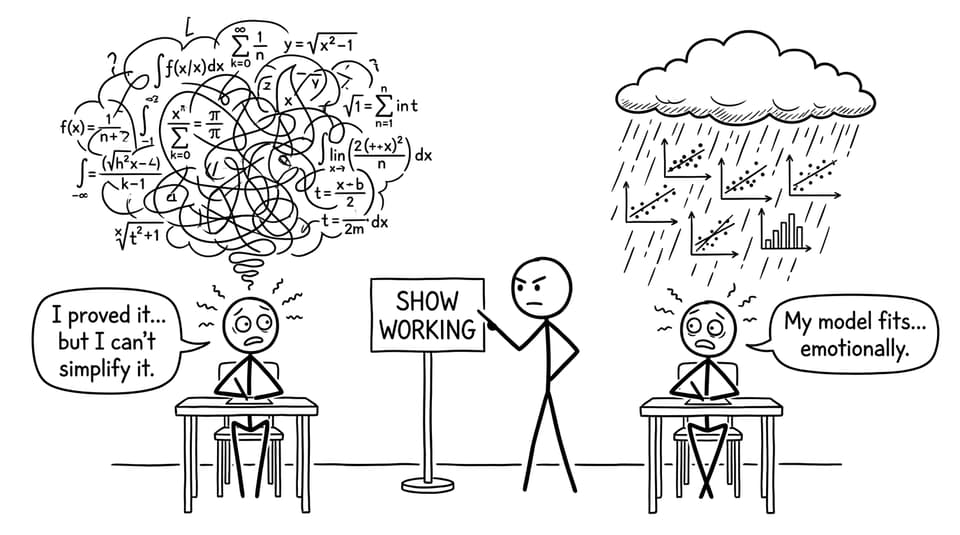
AA vs AI: a detailed comparison of what actually feels hard
Depth vs breadth (and why both can hurt)
-
IB Math AA tends to go deeper into fewer ideas, especially at HL. If you miss an early algebra skill, later topics become heavier.
-
IB Math AI tends to spread across more applied skills: statistics, modeling, interpretation, tech use. If you dislike switching contexts, revision can feel scattered.
Mistake types are different
AA mistakes often look like:
-
algebra slips
-
misapplied calculus steps
-
not completing a proof or justification
AI mistakes often look like:
-
choosing the wrong model
-
failing to interpret results
-
forgetting assumptions/limitations
-
calculator fluency problems
Workload is not just content; it’s revision style
Some students find AA harder because it needs repeated skill drilling. Others find AI harder because it demands writing and evaluation, which can’t be memorized.
This is where a system matters. RevisionDojo is built for IB practice loops: learn with Study Notes, lock it in with Flashcards, then apply it through the Questionbank with instant feedback and Grading tools.
Which IB Math is harder at HL?
In most schools, the common perception is:
-
AA HL is “the hardest” because of its abstract depth and algebraic intensity.
-
AI HL is “hard in a different way” because it combines advanced content with demanding interpretation and technology.
The more useful framing is prerequisites:
-
If you’re heading into engineering, physics, or math-heavy degrees, AA HL is often the safer IB choice.
-
If you’re heading into fields that prize statistics, modeling, medicine, social sciences, or business, AI HL can be a powerful fit.
But difficulty is personal. The course that matches your strengths often becomes the one you can practice consistently without dread.
How to train for either course (without burning out)
A calm IB math plan is boring on purpose. Here’s a loop that works for both AA and AI:
Build understanding first
Use the course hub notes and videos to make the topic feel predictable. Then test that understanding with a small set of questions.
Practise with feedback, not just answers
The fastest way to improve in IB Math is to find your error patterns and fix them.
RevisionDojo’s Questionbank gives you exam-style practice and immediate explanations. When you’re stuck mid-question, AI Chat can walk you through the same concept from a different angle, without waiting for a next lesson.
Simulate exam pressure early
When your skills feel decent, start practicing in full-paper conditions. That’s where stamina and decision-making are built.
Use: IB Predicted Papers by IB Examiners (Free) and the subject-specific paper pages like Math AI Papers. Then follow up by drilling weak areas with Flashcards and targeted Questionbank sets.
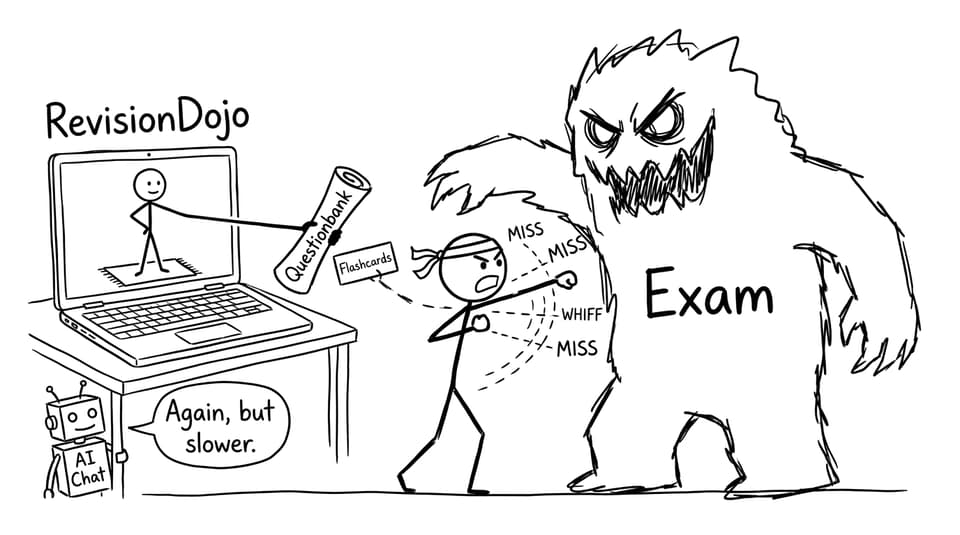
The takeaway: the harder IB Math is the one that fights your habits
If you want the clean headline: AA is usually harder for students who fear algebra and abstraction; AI is usually harder for students who fear interpretation and messy real-world modeling.
But the deeper truth is more helpful: IB Math gets easier when your practice becomes predictable.
Pick the course that aligns with your goals, then build a simple loop: Study Notes for clarity, Flashcards for recall, Questionbank for skill, and timed papers for confidence. If you want the most direct starting point, open your hub today: IB Math AA or IB Math AI. Then let RevisionDojo carry the structure while you do the thinking.