


If you have ever opened your phone to check one message and resurfaced 45 minutes later, you already understand the course problem.
The digital world is not just “technology” in the background. It quietly edits what you notice, what you believe is normal, and what you think you chose freely. That is exactly why the IB introduced IB Digital Society: not to teach you how to build apps, but to teach you how to see the systems you already live inside.
For IB students preparing for exams, this matters because IB Digital Society rewards a specific kind of thinking: calm analysis, ethical evaluation, and evidence-based judgment. The subject is basically a map for a world that keeps updating.
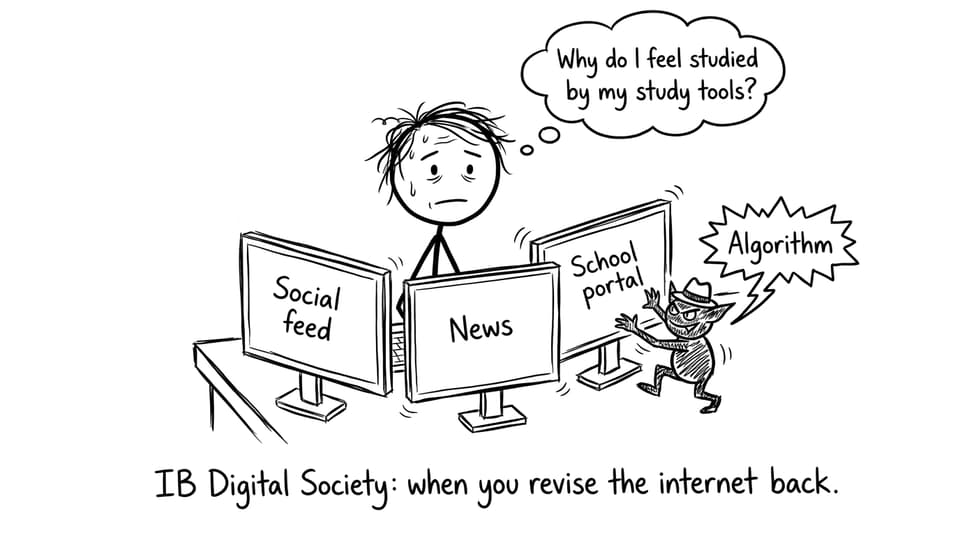
The quick reason IB created IB Digital Society
Here is the exam-friendly summary. The IB introduced IB Digital Society because digital systems now shape:
-
Information (what gets amplified or buried)
-
Power (who can influence, monitor, or profit)
-
Participation (who is included or excluded)
-
Identity (how people present themselves and are categorized)
-
Ethics (what harms become “normal” through convenience)
If you want a clear course overview before revising, start with the IB Digital Society resources hub.
What problem IB Digital Society is trying to fix
Before IB Digital Society, lots of students were “digitally fluent” but not digitally critical. We could use platforms smoothly while missing the bigger questions:
-
Why does the feed feel personal when it is optimized?
-
What data is collected, and who controls it?
-
How do digital systems influence elections, culture, or mental health?
-
Why do different communities experience the same tool differently?
The course exists because the stakes grew faster than school syllabi. As digital systems expanded into education, finance, healthcare, policing, and politics, the need was no longer technical competence. It was understanding consequences.
A useful RevisionDojo pairing here is reading about key course lenses like change in Understanding Change in Digital Society, then drilling the concept with exam-style prompts in the Questionbank.
The big shift: from “using tech” to understanding digital systems
A common misconception is that IB Digital Society is a softer version of computer science. It is not. The IB introduced IB Digital Society to move students from passive use to active evaluation.
Instead of rewarding you for knowing the newest tools, it rewards you for asking structured questions:
-
Who designed this system, and what does it optimize for?
-
Who benefits most, and who pays the hidden costs?
-
Which values are embedded in the design?
-
What trade-offs are treated as acceptable, and by whom?
If you want the course framed clearly, Key Themes in IB Digital Society Explained is a strong checklist-style anchor.
The skills IB Digital Society trains (and why examiners care)
The IB built IB Digital Society around transferable skills that show up in markbands. If you aim to improve fast, revise these as “habits” rather than content lists.
Critical thinking you can actually score with
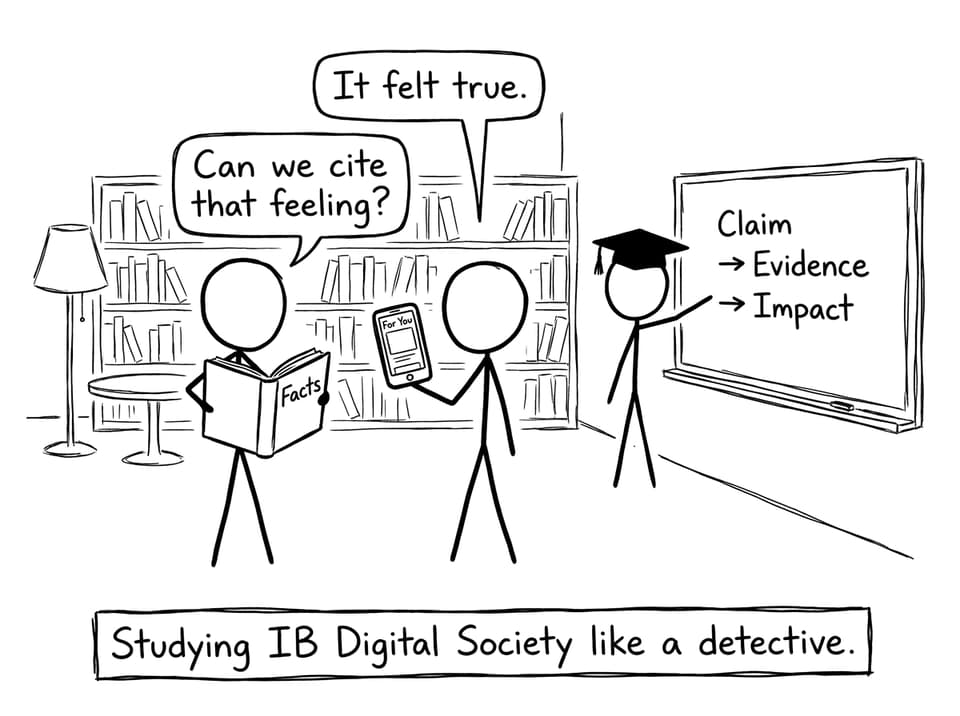
In exams, “critical thinking” means you can separate:
-
Claim vs evidence
-
Correlation vs causation
-
Intended outcomes vs unintended impacts
-
Short-term benefits vs long-term consequences
Revision tip: use the IB Digital Society Topic 3: Content area to review a concept quickly, then do a timed set in the Questionbank and annotate your answers with: claim, evidence, impact, evaluation.
Ethical reasoning without sounding like a rant
Ethics in IB Digital Society is not “this is bad.” It is “this is complex, here is why.” You are expected to weigh competing values (privacy vs security, innovation vs harm reduction, free expression vs misinformation control).
If ethics is where you lose marks, read Ethics in IB Digital Society: How Students Should Approach It and then practice writing one paragraph that ends with a justified judgment.
Inquiry and research that stays focused
The course trains you to define a digital system precisely, choose a real context, and evaluate impacts. That is why the Internal Assessment can feel hard at first.
Use How to Write a Strong IB Digital Society IA Research Question to tighten your scope, then lean on RevisionDojo’s AI Chat to test whether your question is evaluative or descriptive.
Communication and argumentation under time pressure
For exam prep, IB Digital Society is partly a writing subject. Your best ideas still need structure.
RevisionDojo’s ecosystem helps here: use Study Notes to keep concepts accurate, Flashcards to make definitions automatic, and the Grading tools to see whether your evaluation actually earns marks.
For daily recall practice, the Digital Society Flashcards are a fast way to keep vocabulary precise.
How to revise IB Digital Society effectively (simple workflow)
A calm plan beats a heroic plan.
-
Start with one topic overview from the contexts notes area
-
Make 10 flashcards: concept definitions + one real example each
-
Do 15--25 exam-style questions in the Questionbank
-
Use AI Chat to unpack mistakes you keep repeating
-
Once a week, simulate pressure with Mock Exams or Predicted Papers
If you feel unsure what the subject expects, Common Misconceptions About IB Digital Society Explained is a fast reset.
Closing: why IB Digital Society matters now
The IB introduced IB Digital Society because the digital world stopped being a separate “topic” and became the environment everything else happens in. Once you see that, the subject feels less like homework and more like a useful lens.
If you are preparing for exams, build your routine around RevisionDojo’s full loop: Questionbank for exam practice, Study Notes and Flashcards for quick clarity and recall, AI Chat and Grading tools for feedback, and Predicted Papers plus Mock Exams for realistic rehearsal. Start at the IB Digital Society resources hub and make your revision feel as structured as the systems you are studying.
