



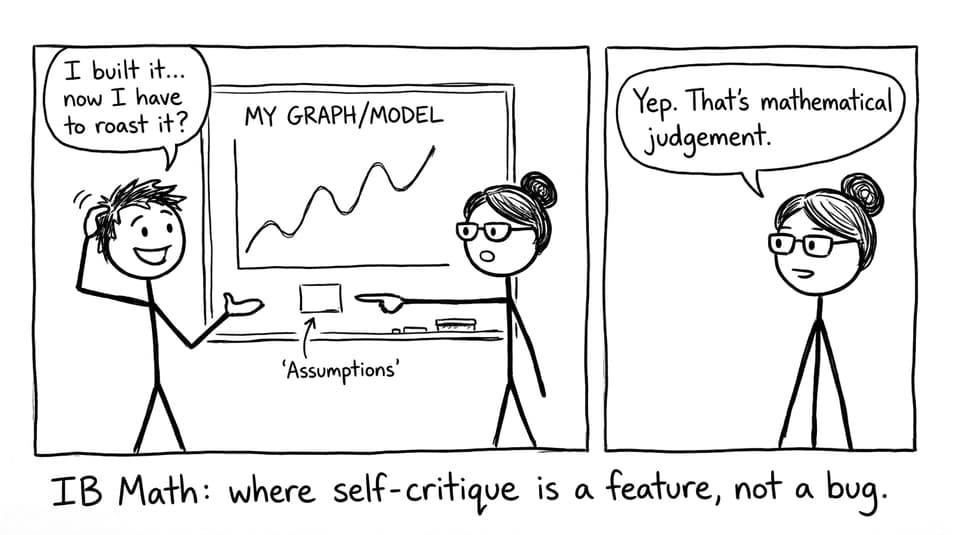
You finish the modelling question, look at your neat equation, and feel a tiny spark of pride. Then the prompt hits: evaluate your model.
For many IB students, that line feels like being asked to clap and boo at the same time. But in IB Math, critique isn’t an apology. It’s the moment you prove you understand what modelling actually is: a useful simplification, not a flawless copy of reality.
The IB Math reason critique is built into the marks
In IB Math, modelling is judged on judgement. The IB isn’t only asking, “Can you calculate?” It’s asking, “Can you tell when your calculation stops being trustworthy?”
A model is a tool. Tools have limits. A ruler can’t measure wind, and a regression line can’t capture every real-world factor. When you critique your model, you show the examiner that you see the gap between mathematics and the situation.
If you want a deeper foundation on why assumptions shape results, see Why Assumptions Matter More Than Formulas in Modelling.
A quick critique checklist (copy this into your exam brain)
When IB Math asks you to evaluate, aim for 2-4 sharp sentences that do three things:
-
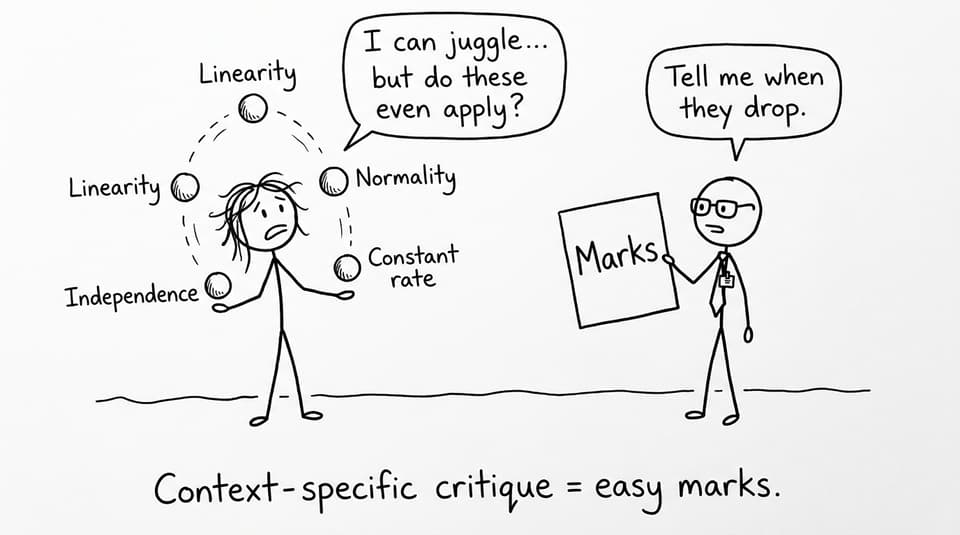
Name a key assumption (linearity, constant rate, independence, normality, representative sample).
-
Explain why it might fail in this context.
-
State the impact: over/underestimation, weak prediction, unreliable extrapolation, limited time window.
This is exactly the kind of reflection skill that also powers strong IAs. If you’re working on coursework too, How to Reflect on Model Limitations in the IB Math IA gives clean phrasing you can reuse.
What examiners are really testing in IB Math
You understand assumptions, not just steps
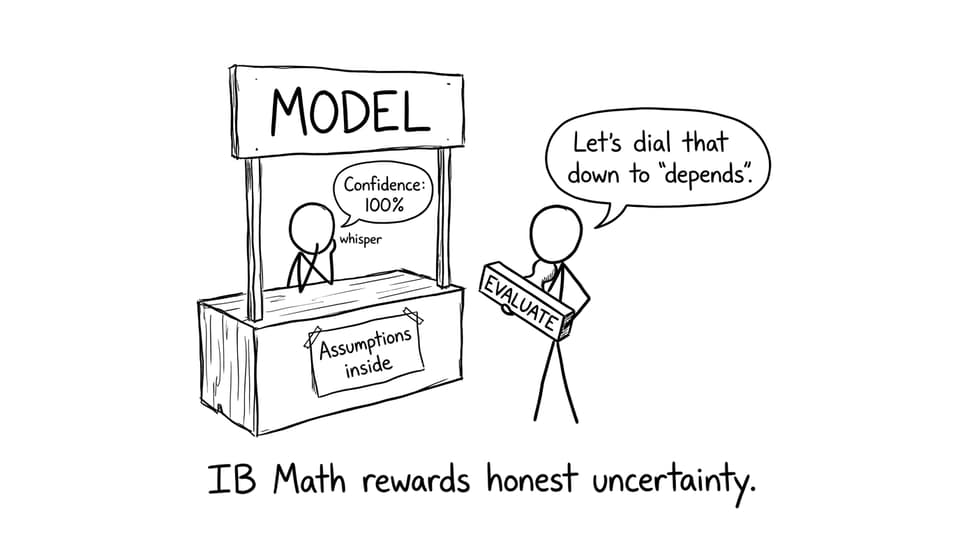
Every model has hidden scaffolding. In IB Math, your marks rise when you point at that scaffolding and say, “Here’s what I assumed, and here’s what that means.”
A strong companion read is Why Real-World Models Always Have Limitations, because it frames limitation-writing as mathematical maturity.
You control your conclusions
Uncritiqued models produce overconfident statements. Critique teaches you to write conclusions with the correct level of certainty: “This suggests…” “This is reliable within…” “Beyond this range, accuracy decreases…”
If you struggle with the idea of validity ranges, Why Does Domain Matter More in Real-World Functions in IB Maths? is a fast way to make your evaluation more specific.
You won’t lose marks by being honest
Students worry that criticising a model cancels earlier work. It doesn’t. In IB Math, a simpler model with clear evaluation often beats a complex model defended like it’s perfect.
To strengthen modelling instincts across tasks, How to Build Mathematical Models for the IB Math IA and How to Avoid Common Mistakes in IB Math IA Modeling both show what “examiner-friendly” reasoning looks like.
How RevisionDojo makes IB Math critique feel automatic
The fastest way to get comfortable critiquing is to practice questions where evaluation is expected, then compare your phrasing to what earns marks.
RevisionDojo helps you do this efficiently using its Questionbank for targeted modelling practice, Study Notes for assumption language, and Flashcards to make evaluation prompts stick. When you want feedback on wording, AI Chat and Grading tools help you turn “vague limitation” into “context-specific limitation.” And when you want pressure training, Mock Exams plus Predicted Papers help you rehearse the full IB Math experience.
Start from the hub: IB Mathematics Applications & Interpretation Resources.
Closing: critique is the point, not the penalty
In IB Math, critiquing your own model is the moment you step from “student who can compute” into “student who can judge.” That’s why the IB keeps asking for it.
If you want this to become a repeatable skill, use RevisionDojo to drill modelling questions in the Questionbank, sharpen language with Study Notes and Flashcards, and get feedback through AI Chat and Grading tools. The goal isn’t to build a perfect model. It’s to build a model you can trust, and explain exactly why.