


The surprising reason your “right answer” can still lose marks in IB Math
You finish the question. Your calculator agrees. You circle the final value like it’s a trophy.
And then the markscheme takes it away.
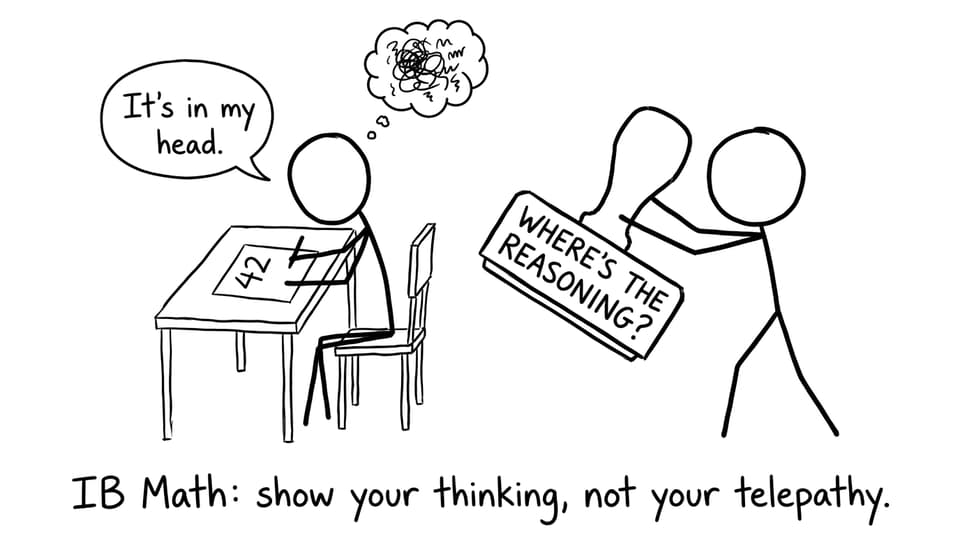
In IB Math, that moment is not bad luck. It’s the course telling you what it has always cared about: mathematical communication. Not essays. Not fancy wording. Just visible thinking that an examiner can follow, reward, and trust.
A quick checklist: what “communication” actually means in IB Math
Use this as your default template when time is tight:
-
Define variables and units (once, clearly)
-
State what you’re trying to find (goal line)
-
Show method steps (the decision steps, not every tiny arithmetic move)
-
Use correct notation (no ambiguous symbols)
-
Interpret the result in context (what the number means)
-
Conclude with a final sentence that answers the question asked
If you want examples of examiner-friendly phrasing, borrow structure ideas from How to Explain Calculations Clearly Without Losing Depth.
IB Math is assessing thinking, not just arithmetic
A quiet truth about IB Math is that the curriculum is built to measure reasoning under constraints. In many questions, the calculation is the easy part; the hard part is choosing the approach, justifying it, and interpreting what your output implies.
This matters even more in applied contexts. When you model, regress, estimate, or test a claim, the examiner is asking: Do you understand what your result says about the situation? That’s why students doing Math AI often feel the emphasis most strongly (and why guides like How to Score 7 in IB Math AI SL focus so much on finishing the thought).
Communication makes marking fair (and reliable)
Examiners can’t award marks for logic that stays hidden.
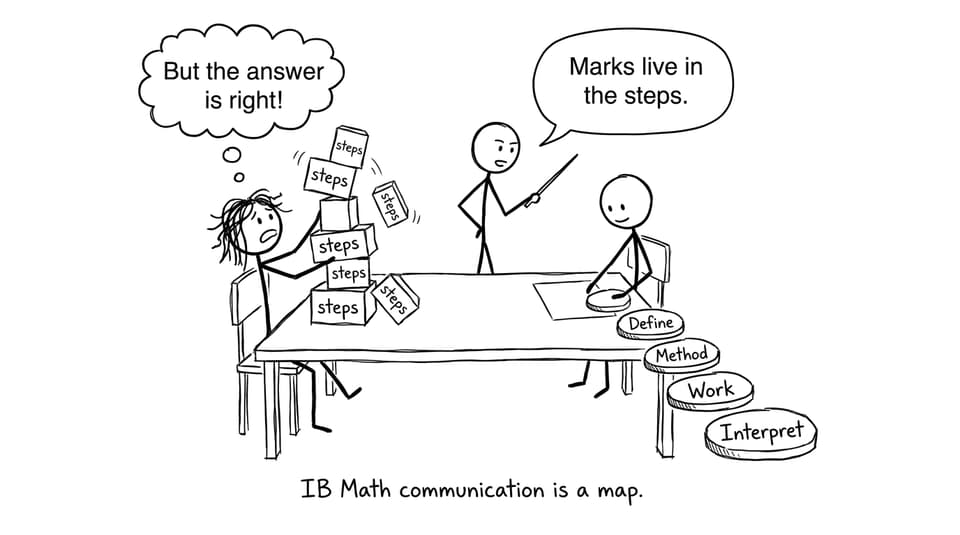
You might see the whole path instantly. But IB Math has to be markable across thousands of scripts, by different examiners, in different time zones, with consistent outcomes. Clear working is what makes that possible.
This is also why neat structure often “creates” marks you didn’t know were available: it helps the examiner locate method and reasoning credit quickly.
Communication proves control: you can drive the math, not just ride it
When you define assumptions, justify steps, and choose precise language, you’re showing you’re in control of the ideas.
That control shows up everywhere:
-
In probability, when you state independence (or don’t)
-
In calculus, when you interpret derivatives as rates, not decoration
-
In statistics, when you describe what correlation can’t prove
For IA-style expectations, the language and notation standards are spelled out clearly in How to Use Mathematical Language and Notation Correctly in the IB Math IA and in the rubric breakdown Criterion B: Mathematical Communication.
The exam-specific reason: interpretation marks are real marks
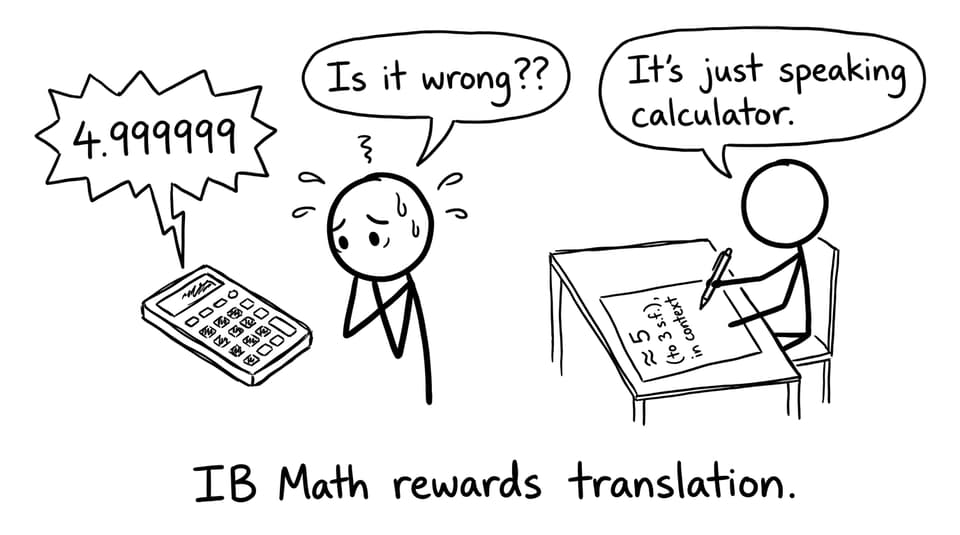
Many IB Math questions are built with “hidden” marks that live after the computation: units, reasonableness, rounding, context, and limitations.
That’s why translating calculator output into mathematical meaning is a scoring skill.
To train this under pressure, use timed practice and feedback loops: do questions, write the interpretation line, then check what the examiner expected. RevisionDojo’s Math AA Predicted Papers and the wider IB Predicted Papers hub are designed for that kind of rehearsal.
How to build communication fast with RevisionDojo
Good communication is a habit, not a personality trait. The easiest way to build it is repetition with immediate correction:
-
Use the Questionbank (e.g., Math AA Calculus Questionbank) to drill “show your reasoning” patterns.
-
Use Study Notes to learn the clean wording you should default to.
-
Turn common sentence starters and definitions into Flashcards (see How to Use RevisionDojo Flashcards for Formula Mastery).
-
Use AI Chat to ask: “What interpretation line would score here?”
-
Use Grading tools to spot where your reasoning disappears.
-
Use Mock Exams and Predicted Papers to practise writing under time.
-
If you’re stuck, use the Coursework Library for exemplars, or book Tutors for targeted feedback.
If you’re choosing your course path, Should I Take IB Math AA or AI? A Realistic Breakdown helps you understand where communication shows up differently.
Conclusion: in IB Math, clarity is part of the mathematics
The IB isn’t asking you to become a poet. It’s asking you to be accountable for your thinking.
In IB Math, communication is how you turn understanding into marks: your reasoning becomes visible, your interpretation becomes creditable, and your solutions become easy to reward.
If you want that to feel natural before exam day, build the loop on RevisionDojo: Study Notes for clean phrasing, Flashcards for recall, Questionbank for repetition, AI Chat and Grading tools for feedback, and Predicted Papers and Mock Exams for timed performance. That’s how clear mathematical communication stops being a “nice extra” and starts being your advantage.