



If you’ve ever typed something into your calculator, stared at 12 digits, and thought, If I round this, will I lose marks?. you’re not alone.
In IB Math, approximate answers are accepted so often that it can feel like a trick. But it’s not. It’s a design choice. The IB is quietly training you to think like someone who uses mathematics in the real world: someone who knows when precision helps, and when it just adds noise.
The quick rule: approximation is fine when it’s honest
Use this fast checklist in IB Math (especially AI, but also in many AA contexts):
-
The question uses measurement, data, or a model
-
Your method reasonably leads to decimals
-
Different valid methods could give slightly different values
-
You state the rounding and keep it consistent
-
You interpret the result in context (not just “answer = 5.0139”)
If you want targeted practice on this exact skill, start with SL 1.6: Approximating and estimating and the matching Approximating and estimating notes.
Real-world contexts make exact answers unrealistic
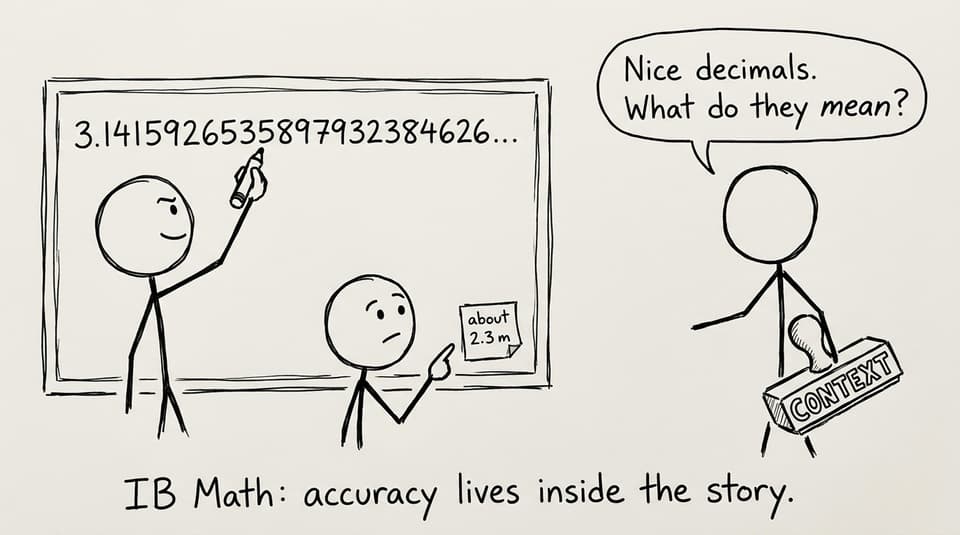
A lot of IB Math questions are built from situations where numbers are already rounded: lengths, times, exchange rates, survey data, regression output, even “given to the nearest…” statements.
If the inputs are approximate, an “exact-looking” output can be misleading. The IB would rather reward a student who understands uncertainty than one who produces a long decimal that pretends the world is perfectly measured.
This is why topics like bounds, sig figs, and sensible rounding show up repeatedly. If that’s a weak area, read Why students confuse significant figures with decimal places in IB maths and drill the concept with rounding notes.
Different methods can lead to different (but reasonable) numbers
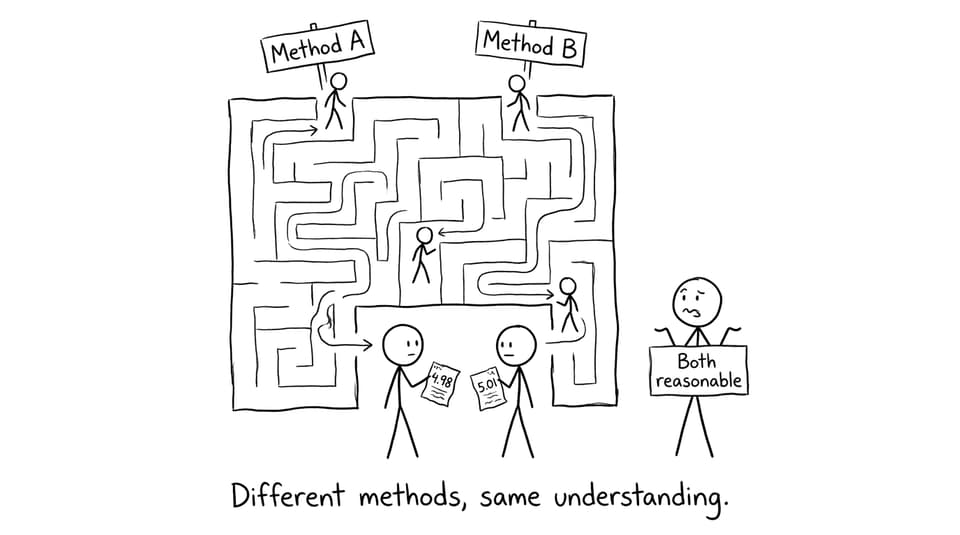
In IB Math, especially in modelling and technology-heavy questions, two correct approaches can land on two slightly different numerical answers.
One student might do a regression and read a value from the calculator. Another might interpolate from a table. Another might use a formula rearrangement with earlier rounding. If the reasoning is sound, examiners avoid punishing harmless variation.
To see this in exam-style practice, use the AI SL 1.6 Questionbank and compare solution paths.
Modelling topics naturally produce approximations
Some IB Math tools are built for “good enough”:
-
Trapezoid rule (numerical integration)
-
Normal distribution calculations
-
Expected value and simulation
-
Euler-style methods
-
Regression and correlation
These are approximation machines by design. The mark scheme cares most about whether your steps match the model and whether your interpretation makes sense.
Try a modelling-heavy skill like SL 5.8: Trapezoid rule questionbank, then reflect on what the approximation means.
What to write to protect marks (the one-sentence habit)
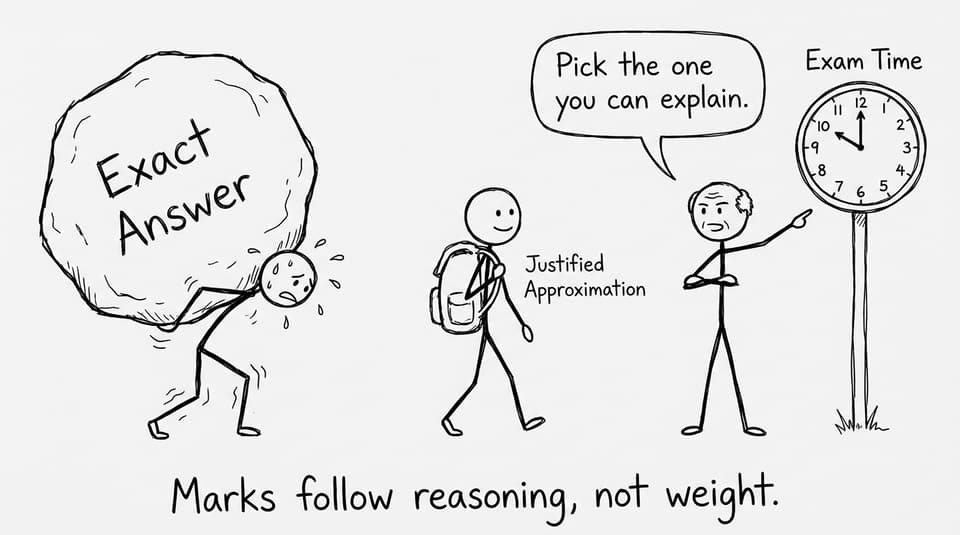
A strong IB Math student doesn’t just round; they justify.
Add a simple line such as:
-
“Answer rounded to 3 s.f. due to measurement accuracy.”
-
“Using calculator regression, value is approximate.”
-
“Differences are due to rounding during intermediate steps.”
That one sentence often protects interpretation marks.
Bring it back to your exam strategy
The hidden lesson is simple: IB Math isn’t a contest for the longest decimal. It’s a test of judgement.
If you want to get consistently comfortable with rounding, modelling, and interpretation, build a loop with RevisionDojo: learn the idea in Study Notes, drill it in the Questionbank, lock in habits with Flashcards, and use AI Chat when you’re stuck on “why is this acceptable?” Then pressure-test everything with Mock Exams and Predicted Papers, and tighten your explanations with the Grading tools. When approximation stops feeling like risk, it starts feeling like control.
For a broader plan, use How to revise IB Math AA and AI effectively and browse all IB Math posts.