



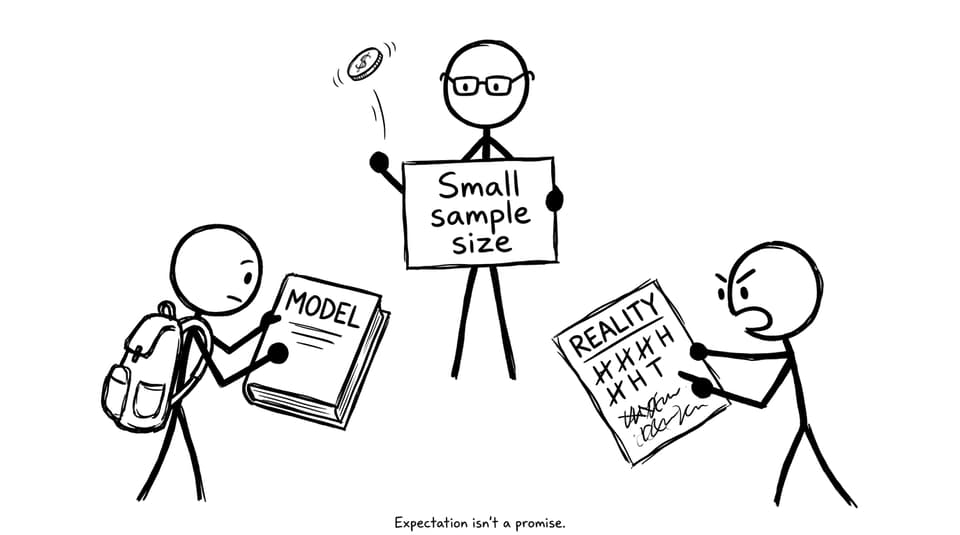
When you run a quick experiment and the numbers refuse to match your calculation, it can feel personal. In IB Math, you’re trained to trust clean fractions and exact rules. So when you compute (P(\text{head})=0.5) and then flip a coin ten times to get eight heads, your brain whispers: “I did something wrong.”
But probability isn’t a promise. It’s a model of expectation. And the gap between experimental probability (what happened) and theoretical probability (what should happen in an ideal world) is exactly where examiners expect you to think.
Quick checklist: what to say in IB Math answers
If a question asks you to compare experimental and theoretical probability in IB Math, hit these points:
-
Random variation is normal, especially with few trials
-
Larger sample sizes reduce fluctuations (long-run behavior)
-
Theoretical probability assumes a perfect model (fairness, independence)
-
Real-world experiments can introduce bias and measurement error
-
The goal is explanation, not forcing the results to “match”
For targeted practice, the Statistics & Probability hub is a good place to review the full topic map.
Theoretical probability in IB Math is a clean model
Theoretical probability is what you calculate before anything happens. In IB Math, it’s built from assumptions: a fair die, a balanced coin, outcomes equally likely, and repeated trials that don’t affect one another.
That’s why theoretical results feel authoritative. They’re exact inside the model.
If you want to refresh the core rules that power these calculations, use How to Solve IB Math Probability Problems Step-by-Step alongside your class notes.
Experimental probability lives in the messy world
Experimental probability is what you observe:
In IB Math, you’re expected to treat this as data: it’s evidence, not “wrong working.” Small datasets jump around. Two groups can run the same experiment and get different results. That’s not failure. That’s randomness doing its job.
If you’re in Math AI, the AI Statistics and Probability section is especially aligned with interpreting outcomes and real contexts.
The main reason results differ: sample size (law of large numbers)
Here’s the quiet truth: most “surprising” experimental results are just too few trials.
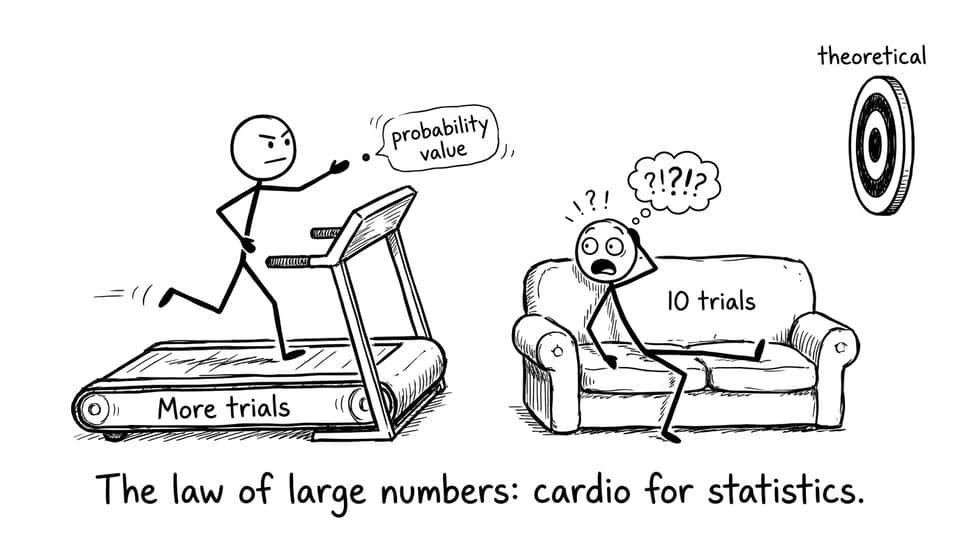
With 10 coin flips, getting 8 heads is unlikely, but not shocking. With 10,000 flips, 8,000 heads would be a crisis.
This is the law of large numbers in plain language: as trials increase, experimental probability tends to move closer to the theoretical probability.
To connect this idea to expected value and long-run reasoning, see SL 4.5 Probability concepts, expected numbers.
Another reason: bias and broken assumptions
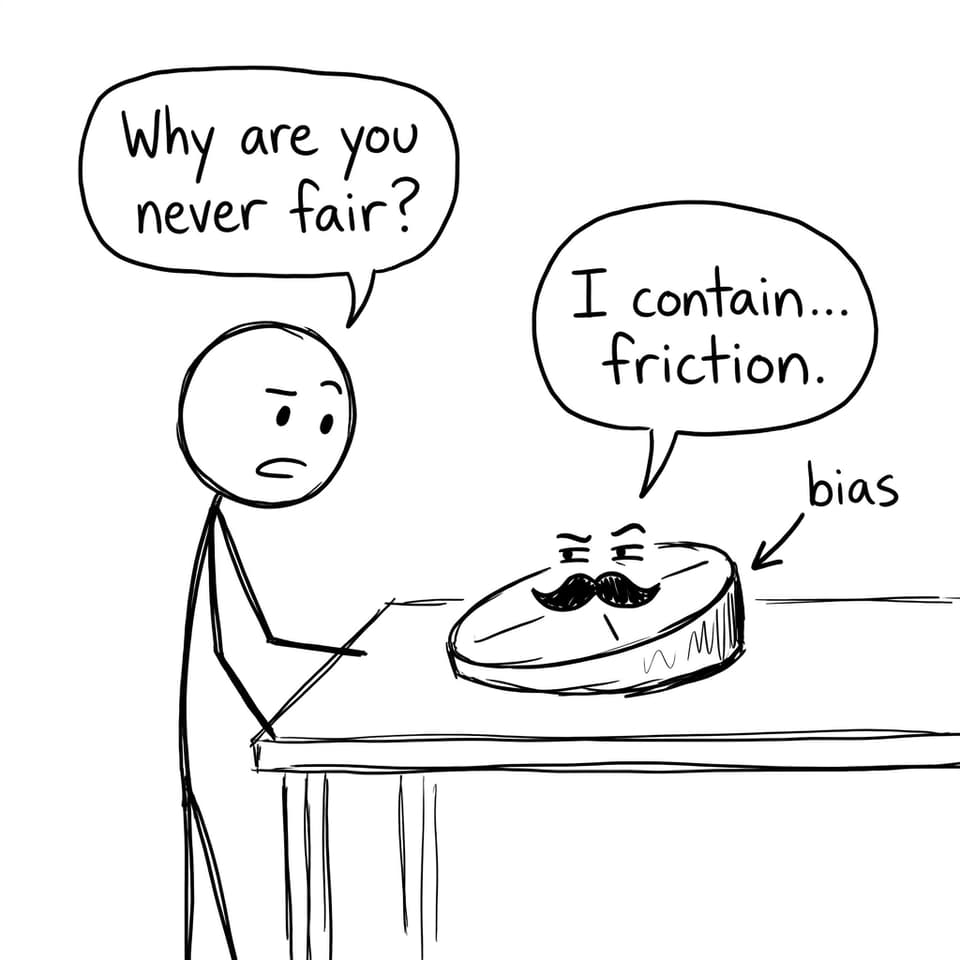
Sometimes the experiment isn’t random in the way the model assumes.
-
Coins can be uneven or flipped in a consistent way
-
Spinners can have friction or poor balance
-
Dice can be worn
-
Humans are famously bad at “random” choices
In IB Math, naming the assumption you’re breaking is often worth more than extra calculations.
If a problem involves independence, mutually exclusive events, or diagrams, revise with Combined, mutually exclusive, conditional, independence probability diagrams.
How to turn this into marks in IB Math exams
When you’re asked to compare results, don’t write “they are different” and stop. A strong IB Math explanation sounds like:
-
“The experimental probability differs due to random variation and a small sample size.”
-
“As the number of trials increases, the experimental result should approach the theoretical probability.”
-
“The theoretical probability assumes a fair process; any bias in the equipment would shift experimental outcomes.”
Then practice writing that explanation under time pressure. RevisionDojo makes this easier because you can drill the exact skill:
-
Use the Statistics and Probability Questionbank for Math AI to see recurring question styles.
-
Pair it with the Statistics & Probability notes to tighten definitions.
-
Use RevisionDojo’s Flashcards to memorize phrasing like “assumptions,” “random variation,” and “long-run behavior.”
-
Use AI Chat to ask, “Is this explanation examiner-friendly?” and refine it.
Closing: the gap is the lesson
In IB Math, the space between theoretical probability and experimental probability is not an error message. It’s the syllabus in action: models, assumptions, evidence, and explanation.
If you want to turn that understanding into consistent exam marks, build a tight loop with RevisionDojo: Study Notes for clarity, Questionbank for repetition, Grading tools for feedback, and Predicted Papers plus Mock Exams for timed realism. The more you practice explaining the “why,” the less those mismatched numbers will shake you.