



If you have ever run a tiny probability experiment and felt personally betrayed by your calculator, you are not alone. In IB Math, expected value sounds like a promise: this is what you should get. Then you do five trials, the outcomes swing wildly, and expected value suddenly feels like a scam.
The problem is not your arithmetic. It is your timeline.
What expected value actually means in IB Math
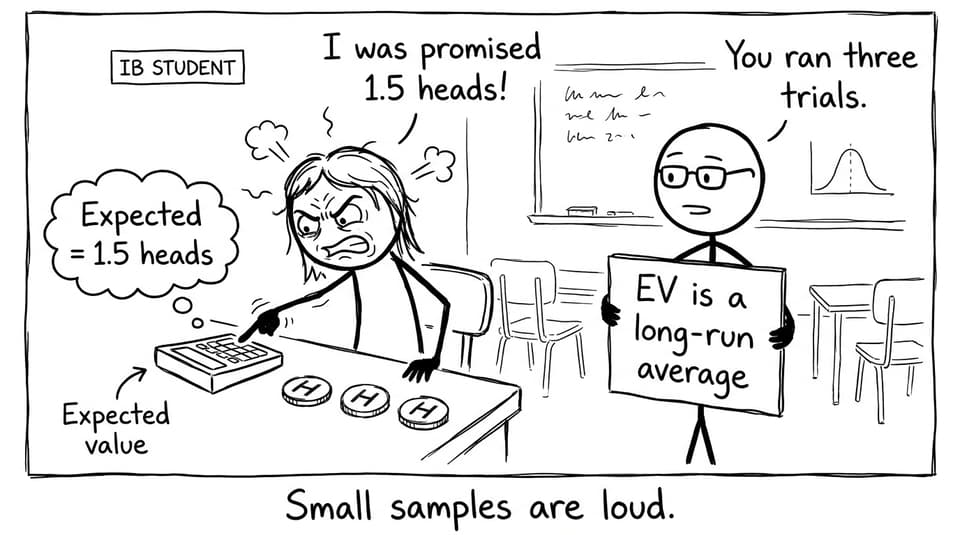
Expected value is a long-run average. It describes what would happen if you repeated the same random process over and over, not what must happen in your next few attempts.
In IB Math, this matters because exam questions love to separate calculation from interpretation. You can compute an expected value perfectly and still lose marks if you treat it like a short-term prediction.
If you want a clean refresher, use RevisionDojo’s topic page on Finding the expected value of outcomes of random variables and then test yourself on SL 4.7: Discrete random variables Questionbank.
A quick checklist for small experiments
When expected value feels misleading, run this mental checklist (it is also how you earn interpretation marks):
-
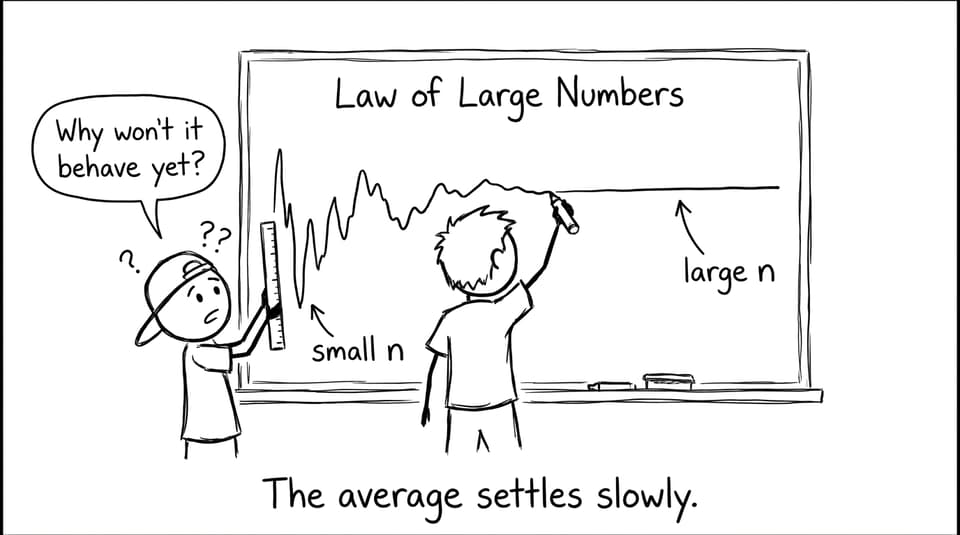
Sample size is small: not enough trials for the average to stabilise.
-
Random variation dominates: early results are naturally noisy.
-
Variability matters: spread can overwhelm the mean in the short term.
-
Emotion biases judgement: streaks feel unfair even when they are normal.
-
Conclusion needs caution: expected value informs decisions but does not remove risk.
For broader probability context in IB Math, keep How to Master Probability and Statistics in IB Math open while you revise.
Why small experiments make expected value look “wrong”
Small experiments are basically a spotlight for randomness. If you flip a coin 10 times, getting 8 heads is not shocking. But if you expected 5 heads because the expected value is 5, the outcome feels like the formula failed.
What actually happened is simpler: with a small number of trials, extreme outcomes have more influence. One unusual streak does not get “diluted” by dozens of normal outcomes.
This is why IB Math examiners often ask whether expected value is a reliable guide in a given situation. The correct answer is rarely “yes” or “no.” It is usually: it is useful long-term, unreliable short-term.
Expected value hides variability (and variability is the real villain)
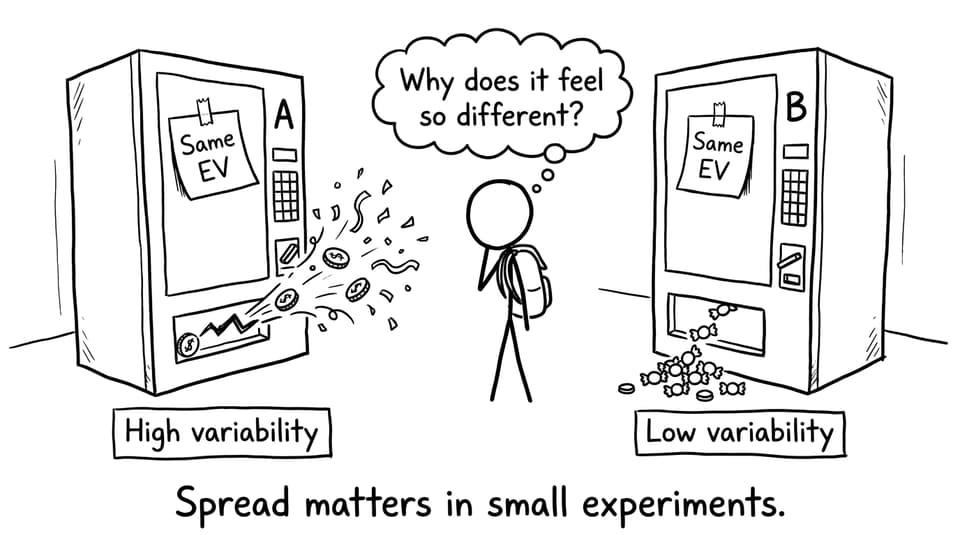
Two games can share the same expected value and still feel completely different to play.
-
Game A: you often lose, but occasionally win big.
-
Game B: you win small amounts most of the time.
Same expected value. Totally different experience.
In small samples, variability can dominate the story. This connects directly to the wider stats toolkit in IB Math, where you are expected to talk about spread, not just centre. RevisionDojo’s Statistics & Probability notes for IB Math AA and Statistics & Probability Questionbank are ideal for building that interpretation language.
The exam phrasing that earns marks in IB Math
When a question asks whether expected value is a “good guide,” you are being graded on judgement.
High-scoring comments usually include:
-
“Since the number of trials is small, results may not reflect the expected value.”
-
“Random variation is significant in the short term.”
-
“Expected value does not show the variability/spread, so outcomes can differ greatly.”
-
“A decision should consider risk, not just the mean outcome.”
If interpretation is where you drop marks, read Why Is Interpretation Graded More Than Calculation in IB Math Topic 4.
Conclusion: expected value is not a promise, it is a horizon
In IB Math, expected value feels misleading when you expect it to behave quickly. Small experiments are noisy, emotional, and heavily influenced by variability. But once you treat expected value as a long-run guide and learn to write the right limitations, it becomes one of the most reliable ideas in the course.
To make this exam-ready, use RevisionDojo as your full loop: revise with Study Notes, practise with the Questionbank, lock in timing with Mock Exams and Predicted Papers, and polish explanations using AI Chat, Flashcards, and Grading tools. That is how expected value stops feeling unfair and starts becoming easy marks.