

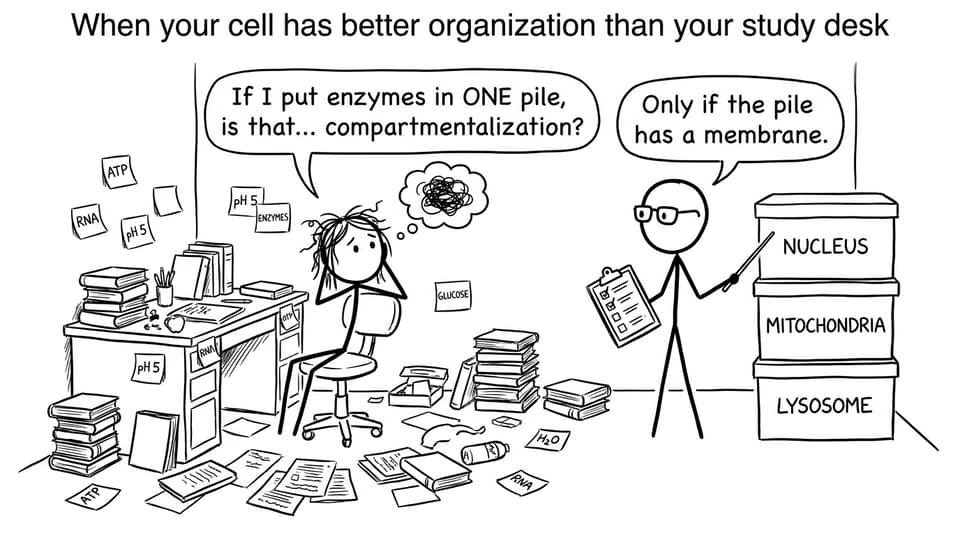
Compartmentalization is what happens when life stops trying to do everything in one room.
If you have ever attempted to revise IB Biology with your notes open, flashcards scattered, and a half-finished worksheet under your laptop, you already understand the core problem: important tasks compete for space. Eukaryotic cells face the same challenge, just at a molecular scale. They solve it with membranes, organelles, and carefully separated micro-environments that let reactions run fast, safely, and under control.
IB Biology exam checklist: what to say about compartmentalization
When a question asks why eukaryotes need compartmentalization, hit these points:
-
Specialized conditions inside organelles (pH, enzymes, substrates)
-
Separation of incompatible reactions (protects the cell)
-
Increased membrane surface area for key pathways
-
Better regulation and transport (vesicles, gradients)
-
Extra gene control because nucleus and cytoplasm are separated
For syllabus wording and examples, see B2.2 Organelles and Compartmentalization.
IB Biology: organelles create the “right conditions” for the right job
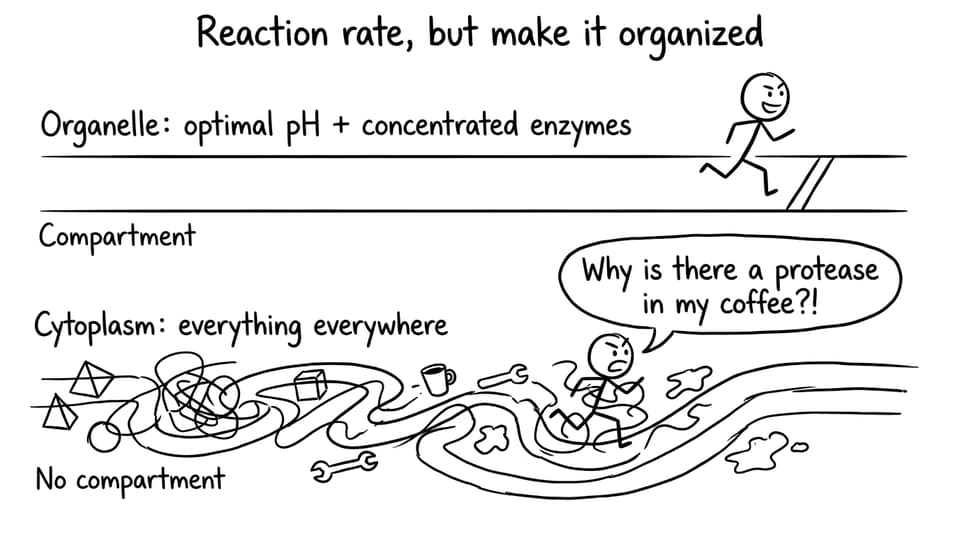
Eukaryotic cells are larger and more complex than prokaryotes, so “one shared cytoplasm” becomes a bottleneck. Compartmentalization fixes that by letting each organelle tune its own conditions.
A classic IB Biology example is the lysosome. It maintains an acidic pH, ideal for hydrolytic enzymes. That acidity would be disruptive elsewhere, but inside a membrane-bound compartment, it becomes useful instead of dangerous. The same idea applies to mitochondria, where enzymes and membranes are arranged specifically for ATP production. If you want a clean organelle overview to revise from, use A2.2 Cell structure alongside Eukaryote cell structure notes.
IB Biology: separating reactions prevents interference (and accidents)
Some reactions simply should not meet.
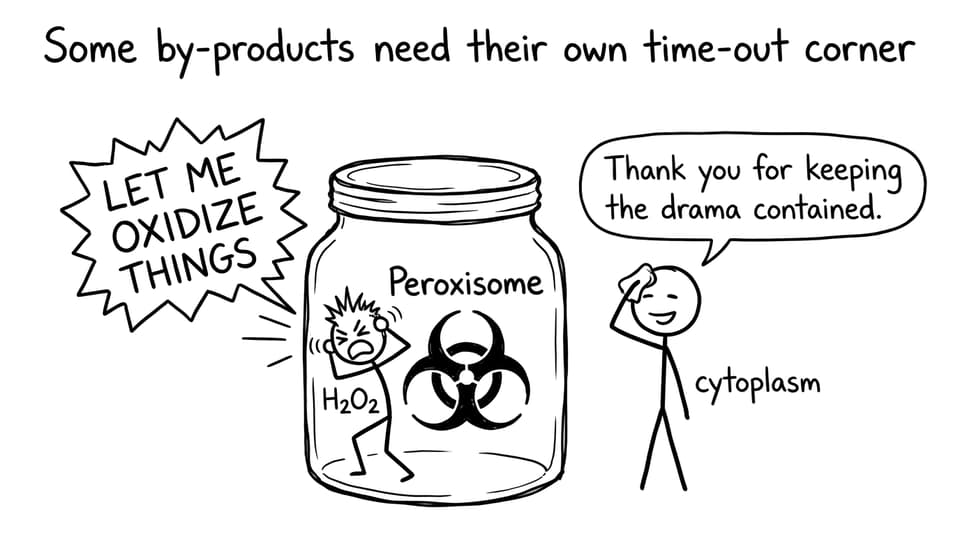
Digestive enzymes belong in lysosomes, not drifting through cytoplasm. Oxidative reactions in peroxisomes produce hydrogen peroxide, which is toxic and must be controlled. Compartmentalization is basically the cell’s safety policy: keep risky chemistry in a sealed, supervised space.
This is also an exam-friendly way to phrase it in IB Biology: membranes prevent interference between incompatible metabolic pathways and reduce cellular damage. For more precise wording, B2.2.1 Organelles as discrete subunits is a strong reference.
IB Biology: more membranes = more surface area = more ATP (or glucose)
Eukaryotes don’t just add rooms; they add folded walls.
Mitochondria have cristae, and chloroplasts have thylakoid membranes. These folds increase surface area, giving more space for electron transport chains, ATP synthase, and light-dependent reactions. In IB Biology terms, surface area boosts the rate of membrane-bound processes because more protein complexes can operate at once.
If you want practice questions that force you to explain this clearly (like the exam does), use the B2.2 Questionbank and the broader Cell Biology Questionbank.
IB Biology: the nucleus-cytoplasm split adds an extra layer of gene control
A eukaryotic cell keeps transcription in the nucleus and translation in the cytoplasm. That physical separation creates checkpoints: RNA can be processed (capping, polyadenylation, splicing) before it reaches ribosomes.
This matters because it increases the precision of gene expression and supports specialization in multicellular organisms. It is also a frequent IB Biology short-answer target. Review the exact advantage statements in B2.2.2 Separation of nucleus and cytoplasm notes.
A focused way to revise this in RevisionDojo
If compartmentalization feels like a list of organelles, you are one step away from exam-ready understanding. Turn it into explanations.
Use RevisionDojo’s Study Notes for clear wording, the Flashcards for definitions you can retrieve under pressure, and the Questionbank to practice writing full IB Biology explanations. When you get stuck, AI Chat can help you untangle confusing markscheme phrasing, and Grading tools can sharpen your responses into what examiners reward. Add Mock Exams and Predicted Papers to simulate timing, and use the Tutors and Coursework Library when you need feedback beyond self-marking.
Compartmentalization is the cell choosing order over noise. And for IB Biology, it is one of the simplest ways to show examiners you understand how structure creates function, not just that you memorized parts of a diagram.