


A hook you’ve felt before
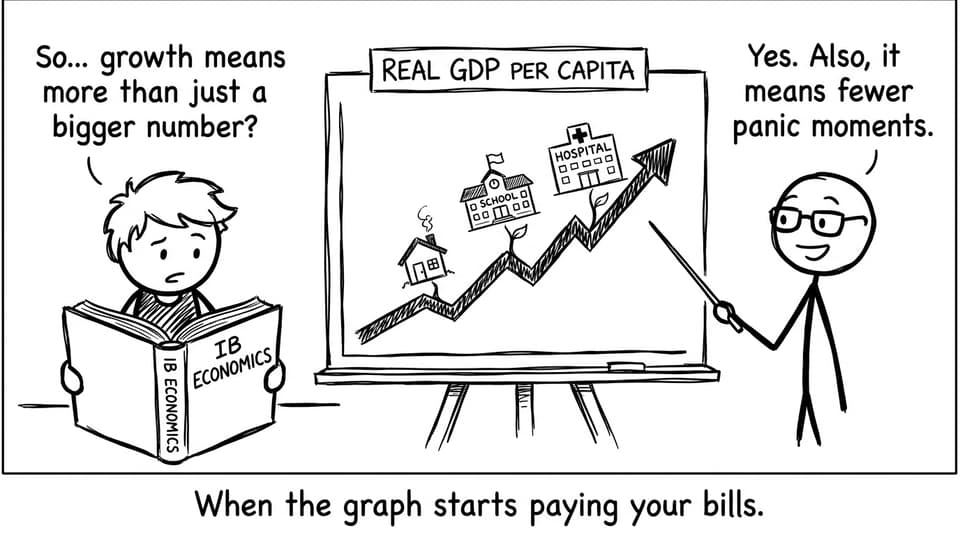
Your phone gets faster, travel gets cheaper (sometimes), and your school’s Wi‑Fi finally improves. None of that feels like “GDP.” Yet in IB Economics, this is the point: economic growth isn’t just a bigger number on a chart. It’s often the quiet reason everyday life becomes safer, healthier, and more comfortable over time.
Economic growth means an economy produces more real output. When real output rises faster than population, real GDP per capita tends to rise, and that’s one of the simplest ways to connect growth to living standards. But for exams, you need the channels: how does growth turn into better lives?
Quick exam checklist (use this in Paper 1/2)
-
Define growth: rising real GDP over time
-
Use living standards proxy: real GDP per capita (and mention limits)
-
Explain channels: productivity, innovation, tax base, jobs and mobility
-
Evaluate: distribution, inflation, environment, sustainability
For definitions and diagrams, keep these open while revising: 3.3.1 Economic growth (topic hub) and Economic growth notes.
Productivity: the “same effort, more life” channel in IB Economics
In IB Economics, productivity is the bridge between growth and higher real incomes. If workers can produce more per hour, firms can afford higher wages without simply raising prices. At the same time, more efficient production can lower unit costs, improving consumer welfare through better quality and affordability.
This is a strong Paper 1 paragraph because it links growth to both incomes and prices. If you want to connect it to the syllabus language, frame it as improving productive capacity (LRAS shifting right in the long run). For extra structure, revise the macro foundations in IB Economics macroeconomics notes.

Innovation: growth funds the next wave of “better”
A growing economy usually gives firms more incentive (and ability) to invest in R&D, new processes, and new products. Over time, innovation raises efficiency and creates industries that didn’t exist before. That’s why long-run growth is so often tied to technological progress.
If you need a high-quality example bank for this line of evaluation, pair your notes with What drives long-term economic growth? and the broader context in IB Economics macroeconomics guide.
Public services: a bigger tax base without higher tax rates
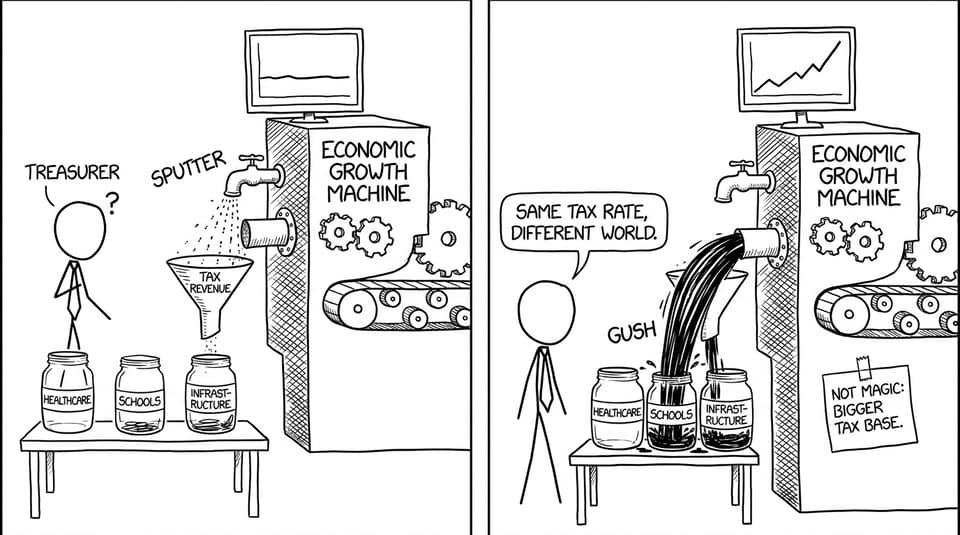
One underrated exam argument: growth can increase government revenue even if tax rates stay unchanged, because incomes and profits rise. That helps fund healthcare, education, transport, and digital infrastructure. Those services raise living standards directly and also build human capital that supports future growth.
This fits neatly with development content too. If you’re mixing growth and development in an essay, compare single indicators and broader welfare measures using The multidimensional nature of economic development.
Mobility: growth expands options (but doesn’t guarantee fairness)
Economic growth can increase employment opportunities, improve access to education, and widen the range of careers people can realistically pursue. Over time, that supports social mobility and reduces persistent poverty for many households.
But IB Economics also expects you to evaluate: if growth is uneven, some groups may not benefit. You can signal this with one sentence: “Growth can raise average living standards, but distribution matters.” If you want policy angles, see Strategies to promote economic growth and economic development (Topic 4.10).
Final takeaway: turn growth into marks
When you write about why economic growth raises living standards in IB Economics, think like an examiner: define it, measure it (real GDP per capita), explain the channels (productivity, innovation, public revenue, mobility), then evaluate (distribution and sustainability).
To lock this into exam performance, use RevisionDojo’s Study Notes and Flashcards, then test your timing with the Questionbank at 3.3 Macroeconomic Objectives Questionbank. Add AI Chat to refine explanations, and use Mock Exams, Grading tools, Predicted Papers, the Coursework Library, and Tutors when you want feedback that feels like a real marking scheme. That’s how IB Economics revision becomes calm, structured, and high-scoring.
