


Why vector geometry can feel like a different subject in IB Math
The first time vector geometry shows up, it can feel like you walked into the wrong classroom.
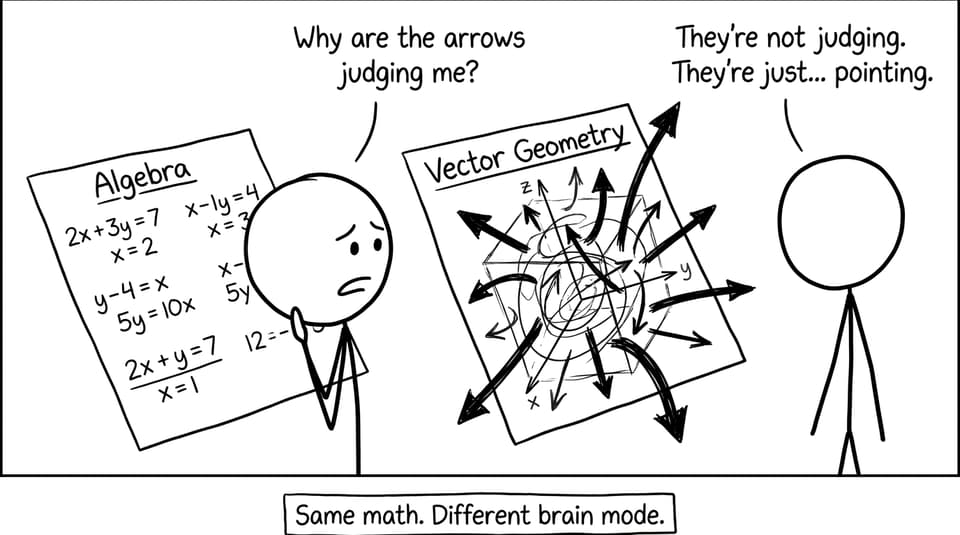
Algebra in IB Math is familiar: you simplify, solve, and end with a tidy value. Vector geometry asks something else. It wants you to think in movement. You are no longer only manipulating symbols; you are describing where something is, where it goes, and what direction it faces. That subtle shift is why even confident algebra students suddenly slow down.
It is not that vectors are “harder.” It is that the exam is testing a different kind of certainty: not just “can you compute?” but “can you interpret?” That difference matters a lot when marks depend on method and meaning.
Quick checklist to stop vectors feeling weird
Use this quick loop before you do any IB Math vector geometry question:
-
Name what each vector represents (position, direction, displacement)
-
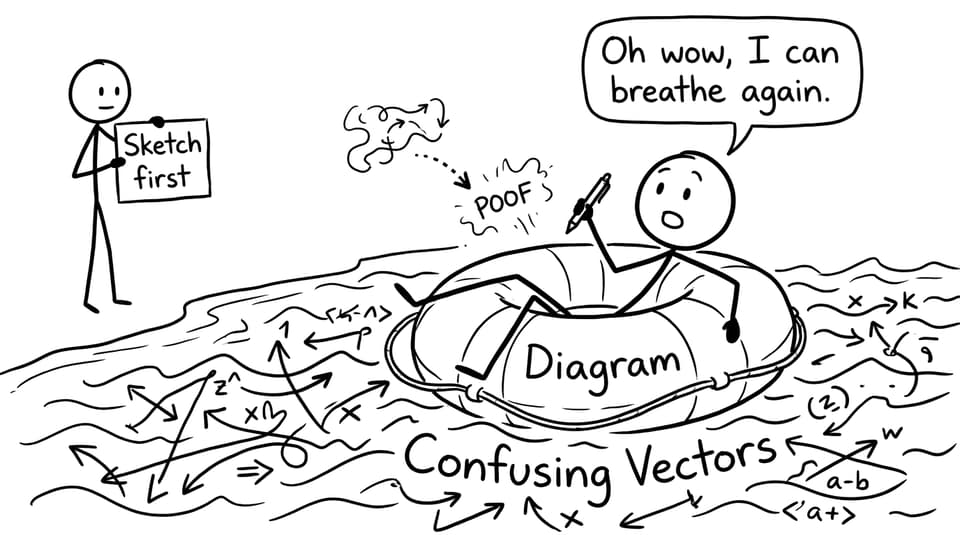
Sketch a rough diagram, even if it is ugly
-
Track direction carefully (signs are geometry, not just arithmetic)
-
Translate vector equations into “set of points” language
-
Only then do the component algebra
If you want a structured place to practise this loop, start from the IB Math AA hub on RevisionDojo: IB Mathematics Analysis and Approaches Resources.
Algebra vs vector geometry: same tools, different job
Algebra in IB Math is usually point-focused: find x, find the roots, find the maximum. You hunt a specific target.
Vector geometry is often set-focused. A vector equation of a line or plane is not a single answer. It is a compact description of infinitely many points. That is why vector work feels “conceptual” even when the algebra is straightforward: you are constantly switching between calculation and interpretation.
A great way to build that bridge is to work through an explanation that explicitly connects the two mindsets: How to Connect Vectors and Geometry in IB Math AA.
Direction is why your usual instincts misfire
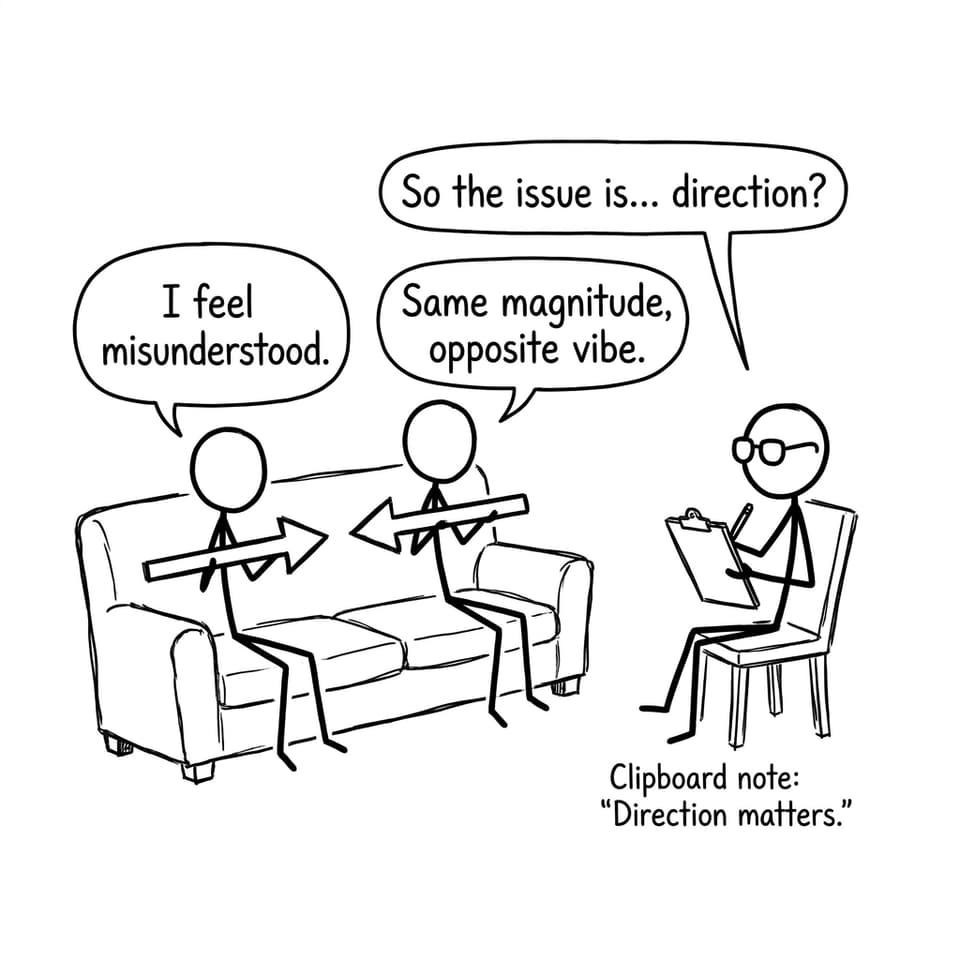
In algebra, a negative sign is often just a number being smaller. In vector geometry, a negative sign can mean “the arrow is facing the other way.” Those are emotionally different ideas.
Direction changes everything: parallel vs anti-parallel, acute vs obtuse angles, whether two lines actually intersect in 3D, whether a parameter makes sense. IB Math examiners lean on this because it reveals who is reasoning geometrically and who is only pattern-matching.
If vectors keep feeling slippery, read a broader walkthrough first, then return to questions: Understanding Vectors in IB Math HL: A Complete Guide.
Why vector equations feel “unfair” at first
A line like (\mathbf{r}=\mathbf{a}+\lambda\mathbf{b}) can annoy you because it looks unfinished. Where is the final value?
But in IB Math, that equation is the final value: it is a story.
-
(\mathbf{a}) is “a starting point”
-
(\mathbf{b}) is “a direction”
-
(\lambda) is “how far you travel”
Once you read it that way, intersections stop being mystical. They become “two stories describe the same point,” which is why you set them equal and compare components.
For targeted practice on the dot product (where interpretation often breaks), try: AHL 3.13: Scalar (dot) product Questionbank.
Diagrams are not optional (even when nobody says that)
Vector geometry punishes students who keep everything in their head. Not because you are “bad at spatial thinking,” but because working memory is fragile under time pressure.
A 15-second sketch gives you:
-
a direction check (did I flip a vector?)
-
an angle reality check (acute or obtuse?)
-
a sanity check for intersection claims
If you want a clean refresher on the geometry tools that show up alongside vectors, use: Geometry and Trigonometry Notes (IB Math AI).
How IB Math typically tests vector geometry
Across AA and AI pathways, IB Math vector geometry questions often revolve around:
-
vector equations of lines and planes
-
intersections (line to line, line to plane, plane to plane)
-
dot product for angles and perpendicularity
-
distances and projections in 3D
To build fluency, combine quick concept refreshers with timed application. RevisionDojo is built for that loop: Study Notes for clarity, Flashcards for retention, Questionbank for volume, AI Chat when you are stuck, and Mock Exams plus Predicted Papers for pressure training.
For video-based reinforcement, see: Geometry & Trigonometry Videos (IB Math AA).
A closing thought (and a practical next step)
Vector geometry feels different because it asks you to be bilingual: fluent in algebra, but also fluent in space. In IB Math, that bilingual skill is exactly what turns messy-looking questions into routine ones.
If you want to make vectors feel normal before exams, build a simple routine inside RevisionDojo: read a short section of Study Notes, drill a tight Questionbank set, turn your recurring mistakes into Flashcards, and pressure-test with Mock Exams and Predicted Papers. Start here: IB Mathematics Analysis and Approaches Resources, then work outward topic by topic until the arrows stop feeling personal.