


Why the quotient rule feels like a trap (even if you know it)
In IB Math, the quotient rule has a special talent: it looks manageable until you actually write the first bracket. The product rule at least feels like teamwork, two parts, add them up, move on. But the quotient rule feels like you’re carrying the same two parts while walking down stairs in the dark, and someone keeps moving the minus sign.
That dread isn’t a sign you’re “bad at calculus.” It’s a sign the quotient rule concentrates three common exam risks in one place: structure, negatives, and algebraic cleanup. The good news: those risks are predictable, which means they’re trainable.
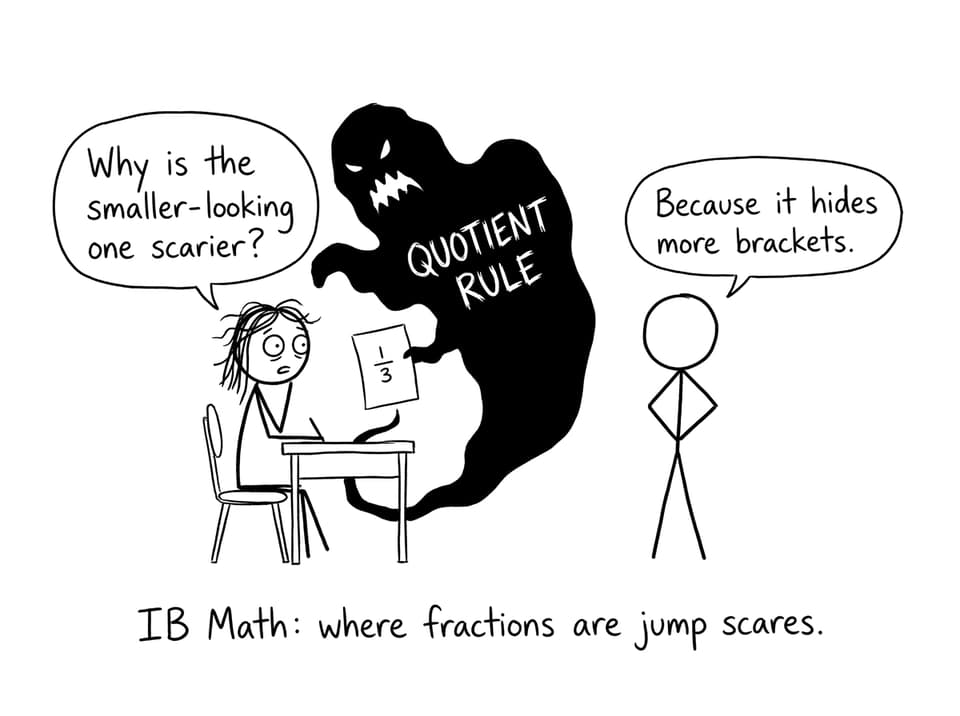
Quick checklist: make quotient rule feel less awful
Before you differentiate anything in IB Math, run this short checklist:
-
Confirm it’s truly a quotient: both numerator and denominator depend on x.
-
Write the quotient rule template first (blank boxes), then substitute.
-
Put brackets around every multi-term expression.
-
Only simplify after the derivative is correctly formed.
-
Do a 5-second “denominator squared?” check.
For targeted practice, you can drill quotient-rule setups in RevisionDojo’s Chain, Product and Quotient Rules hub and then reinforce the exact form with the matching notes on derivative rules.
What the quotient rule is really doing in IB Math
In IB Math, the quotient rule isn’t just a formula to memorize. It’s measuring how a ratio changes when both parts change.
If you have (y=\frac{u(x)}{v(x)}), the quotient rule accounts for two competing effects:
-
the numerator increasing (or decreasing)
-
the denominator increasing (or decreasing), which can shrink or stretch the whole ratio
That’s why the structure matters: you’re tracking interaction, not just differentiating “top then bottom.” If you want more exam-style exposure to that exact idea, RevisionDojo also breaks it into question types like learning to apply the quotient rule on derivatives in fraction form.
Why the quotient rule feels worse than the product rule
The order-and-minus problem
The product rule’s biggest mistake is forgetting one term. The quotient rule’s biggest mistake is flipping the order and changing the sign of everything.
In IB Math, that single reversal can turn a fully correct method into an answer that looks “almost right” but loses accuracy marks. The rule punishes autopilot.
Brackets multiply faster than confidence
Most quotient-rule functions are not neat single terms. They’re polynomials, trig expressions, exponentials, or logs stacked into a fraction. That means your working suddenly fills with brackets, and every bracket is a chance to drop a negative.
If you want a separate refresher on how rule-mixing causes errors, pair this with why the product rule causes so many errors in IB Maths to see how IB questions are designed to test structure recognition.
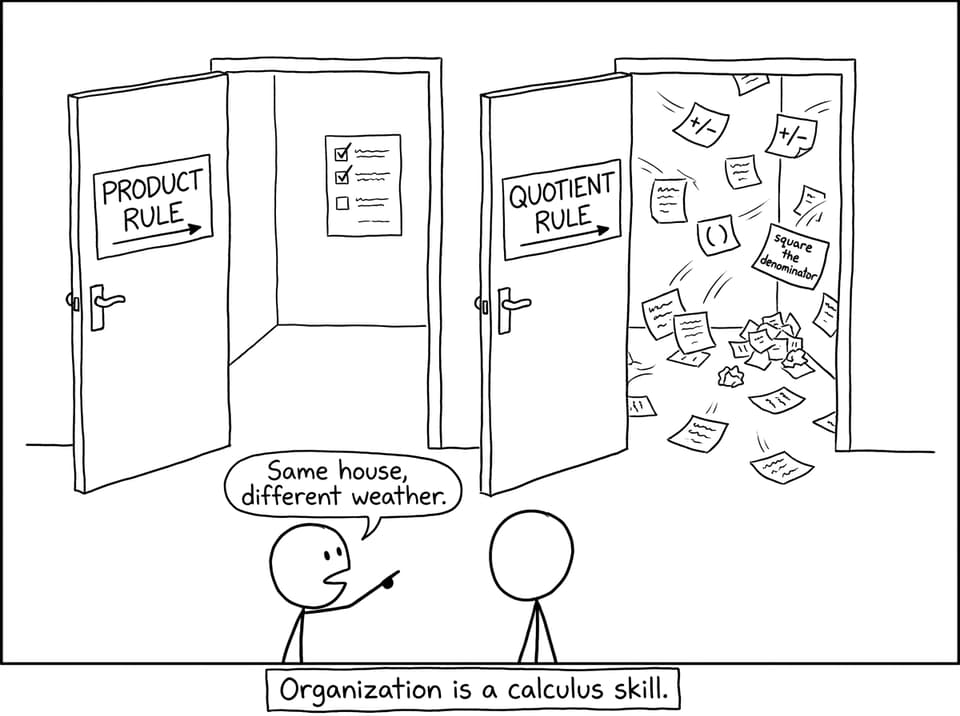
Algebra cleanup is where marks leak
The quotient rule often produces a correct derivative that still looks messy. Then students rush simplification, and tiny slips become expensive:
-
a missing bracket
-
a lost negative
-
a denominator that isn’t squared
This is why RevisionDojo’s workflow helps: do the setup cleanly, then use the Grading tools (and AI Chat) to find the exact step where your algebra drifted. You can also practice simplification-heavy calculus with the IB Math AA calculus questionbank and reinforce definitions with calculus flashcards.
How it shows up on exams (and what to do)
In IB Math, quotient rule questions often appear as:
-
rational functions (classic)
-
trig fractions
-
exponential/log ratios
-
optimization or modeling, where you differentiate then interpret
-
“combo” questions that add chain rule on top
A good strategy is to practice it in the same conditions you’ll face later: timed, mixed, slightly annoying. RevisionDojo’s Questionbank feature lets you repeat the exact patterns until they stop feeling like surprises, and you can build stamina with custom IB mock exams by topic.
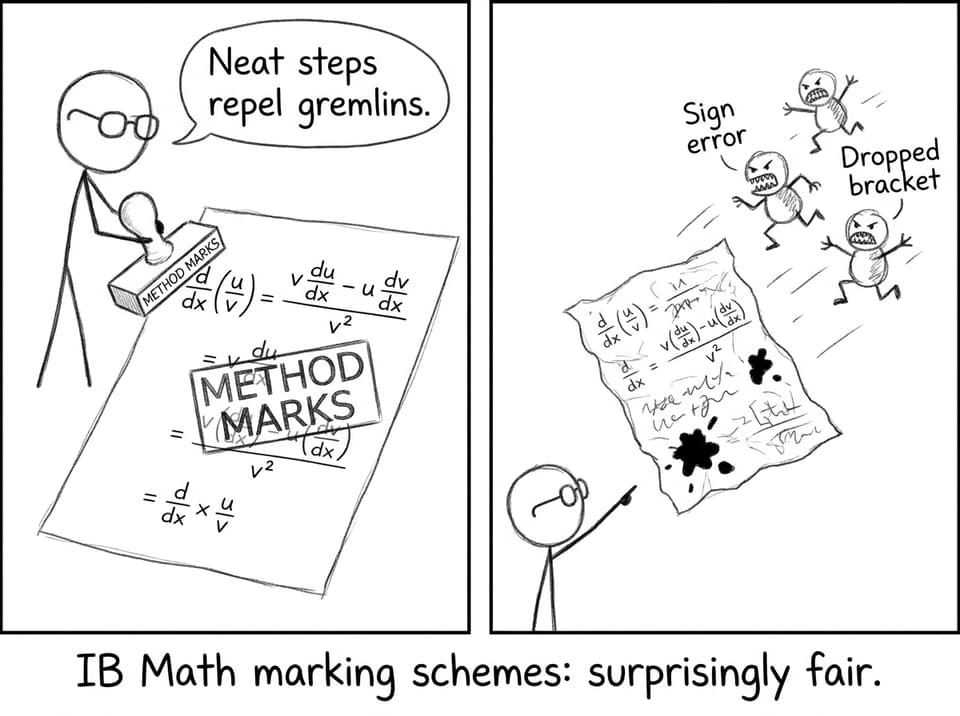
The real reason it feels worse (and how to flip it)
The quotient rule feels worse in IB Math because it exposes messy thinking. It’s less about calculus difficulty and more about whether your structure survives stress.
If fractions keep costing you marks, make your practice boring and repeatable: drill the setup with the SL 5.6 chain/product/quotient resources, reinforce with notes and flashcards, then pressure-test yourself with timed Questionbank sets and Mock Exams and Predicted Papers on RevisionDojo. When the quotient rule stops feeling “worse,” it’s usually because your layout became automatic, and that’s exactly what exam confidence is.