



A tiny slip that costs big marks
In IB Math, the product rule is one of those topics that feels “easy” right up until it isn’t. You see a familiar expression, your pen moves fast, and then the markscheme quietly takes away a chunk of your points for one missing term. The frustrating part is that the mistake usually isn’t deep misunderstanding. It’s pressure, structure, and the brain doing what brains do: simplifying the story to something manageable.
The product rule punishes shortcuts because it’s the first differentiation rule where you must track two moving parts at the same time. And in IB exams, two moving parts is where attention tends to slip.
Quick checklist: the “no lost term” routine
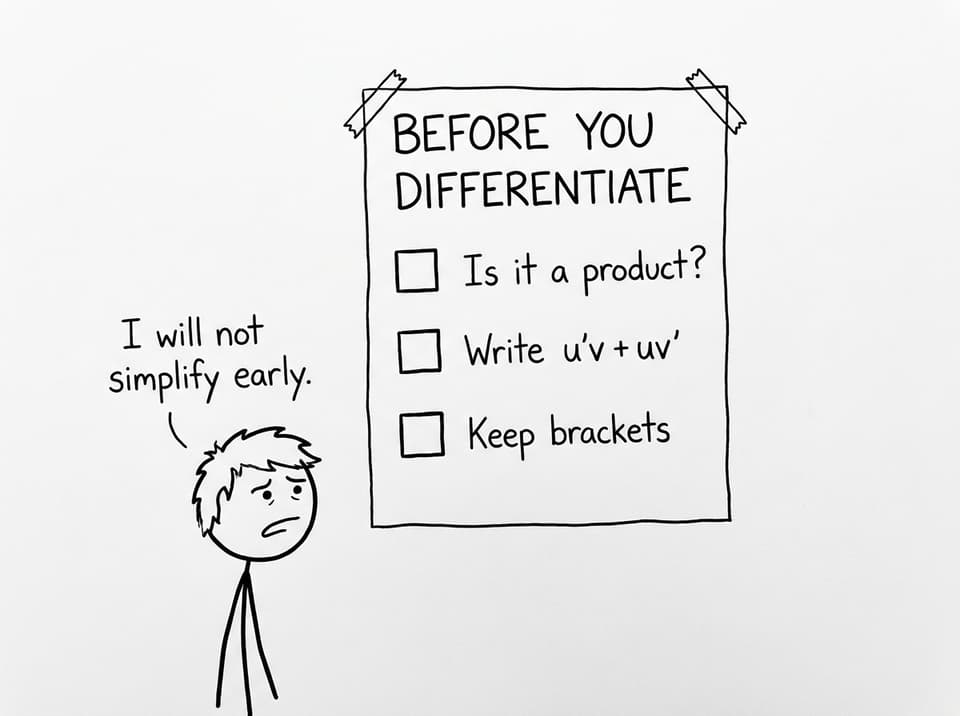
Use this every time you see multiplication in IB Math calculus:
-
Identify the two factors: set (u(x)) and (v(x)).
-
Write the structure first: ((uv)' = u'v + uv').
-
Differentiate one factor at a time.
-
Keep brackets until the very end.
-
Only then simplify.
If you want targeted practice on exactly this skill, the SL 5.6 differentiation topic hub is built for repetition without randomness.
What the product rule is really testing in IB Math
Conceptually, the product rule is simple: when (u) and (v) both depend on (x), the rate of change of (uv) includes two contributions:
-
(u) changes while (v) stays “as is”
-
(v) changes while (u) stays “as is”
In exam conditions, many students treat the rule like a formula to recall, not a story to follow. That’s why it helps to revisit the meaning inside your Calculus revision using the IB Math AA Calculus notes and the Calculus videos when it starts to blur.
Why students forget half the rule
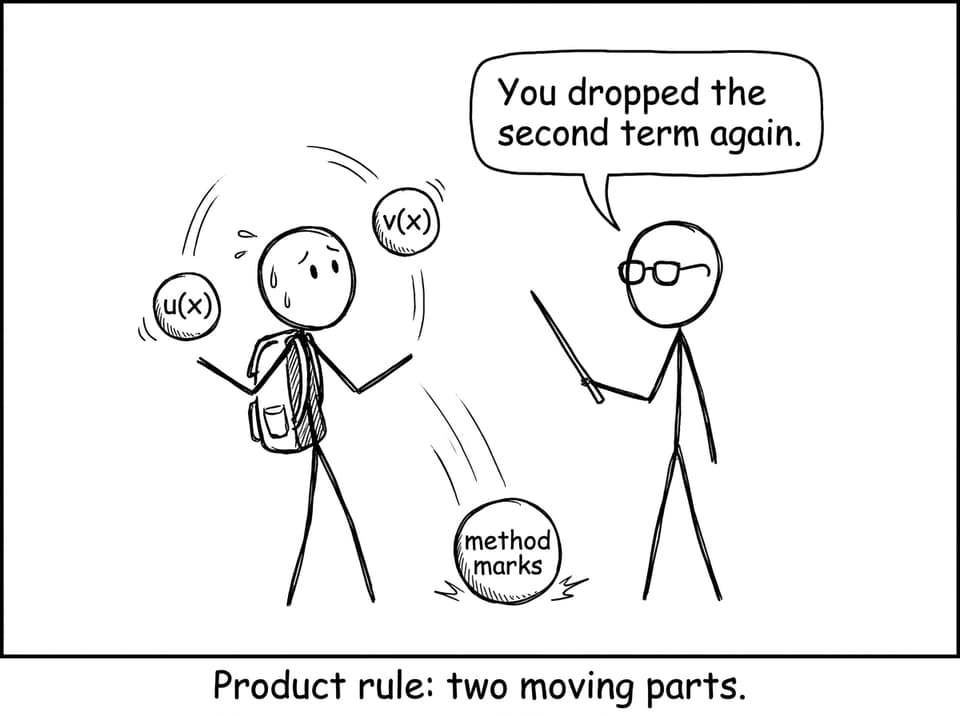
The most common product rule error in IB Math is painfully consistent: students write only one term.
Why it happens:
-
The brain sees “multiply” and wants a single streamlined action.
-
Students rush to simplify early and lose track of what stayed constant.
-
They memorize (u'v + uv') but don’t expect two terms in the final form.
A practical fix: after differentiating, do a two-second scan and ask, “Do I see a plus sign splitting the derivative into two parts?” If not, you’re probably missing a term.
To make this automatic, drill it in an exam-style environment like the SL 5.6 Questionbank, where you can build the habit under time pressure.
Product rule vs chain rule confusion (the brackets trap)
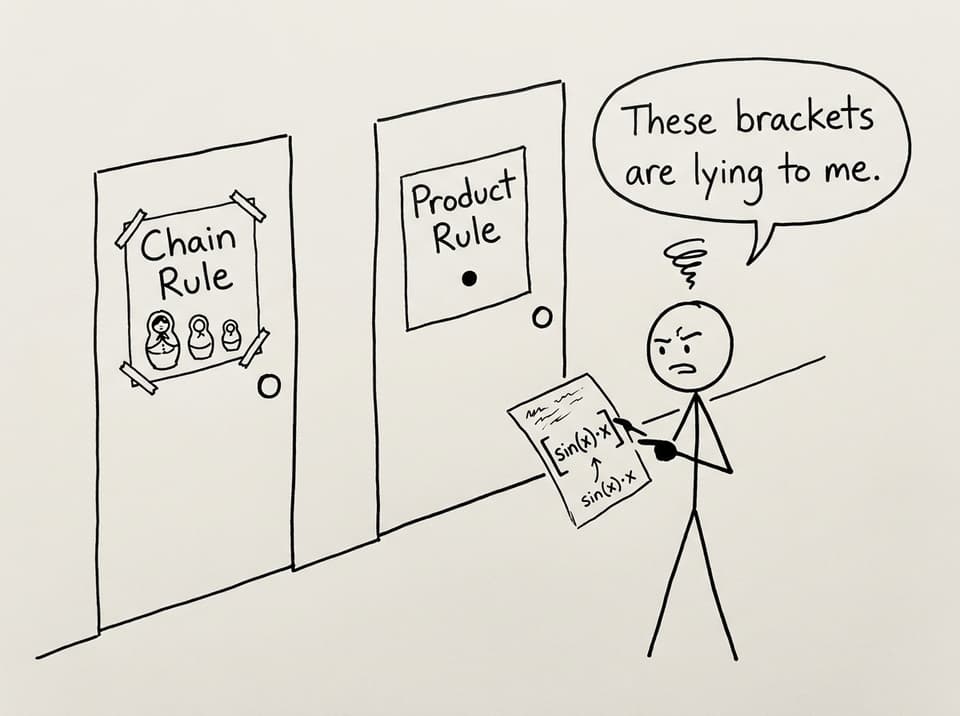
Another classic IB Math issue is misreading structure. Brackets don’t always mean “chain rule.” Sometimes they’re just there for grouping.
-
Chain rule: composition, like (\sin(3x^2))
-
Product rule: multiplication, like (x\sin(x))
Students often see brackets and assume nesting, even when the expression is clearly a product. That’s why IB questions love mixed forms: they’re not testing brutality, they’re testing whether you can name what you’re looking at.
If derivative rules still feel like magic tricks instead of logic, this reflection helps: Why Do Derivative Rules Feel Like Magic in IB Maths?
Where the product rule shows up (and why it’s harder there)
In IB Math, the product rule rarely appears alone. It’s commonly embedded inside:
-
polynomial × trig (e.g., (x^2\cos x))
-
exponential × algebraic (e.g., (xe^x))
-
optimization and modelling setups
-
multi-step derivative chains (product + chain + simplification)
When it’s combined, students tend to skip writing (u) and (v), then the work becomes fragile. A steadier approach is to use RevisionDojo’s ecosystem: learn the method in IB Math AA Calculus, memorise structure with Calculus flashcards, then pressure-test yourself in the Calculus Questionbank.
The calm method that earns method marks
When students lose marks in IB Math, it’s often not because the final answer is wildly wrong. It’s because the solution is too compressed to reward. Try this:
-
Define (u) and (v).
-
Write (\frac{dy}{dx} = u'v + uv') on its own line.
-
Substitute carefully with brackets.
-
Simplify last.
That structure is also how RevisionDojo’s Grading tools and AI Chat tend to explain mistakes: they reward clear method, then coach precision.
Closing: make the product rule boring
The product rule causes errors in IB Math because it’s a test of attention more than intelligence. It asks you to hold two changing parts, write a two-term structure, and stay patient when your brain wants to sprint. Make it boring: same setup, same brackets, same check for two terms.
If you want that boredom to become automatic, RevisionDojo is built for it: Study Notes for clarity, Questionbank for repetition, AI Chat and Grading tools for feedback, plus Flashcards, Mock Exams, a Coursework Library, and Tutors when you want a human to spot what you keep missing. Your goal isn’t to remember the product rule under pressure. Your goal is to make it impossible to forget.