



It usually happens in the same quiet moment: you learn integration as “area,” differentiation as “slope,” and then someone says they’re actually inverses. In IB Math, the Fundamental Theorem of Calculus can feel like finding a hidden door in a house you thought you already knew. Suddenly, the map changes.
And that’s exactly why it feels both important and confusing.
The one sentence that explains why IB Math cares
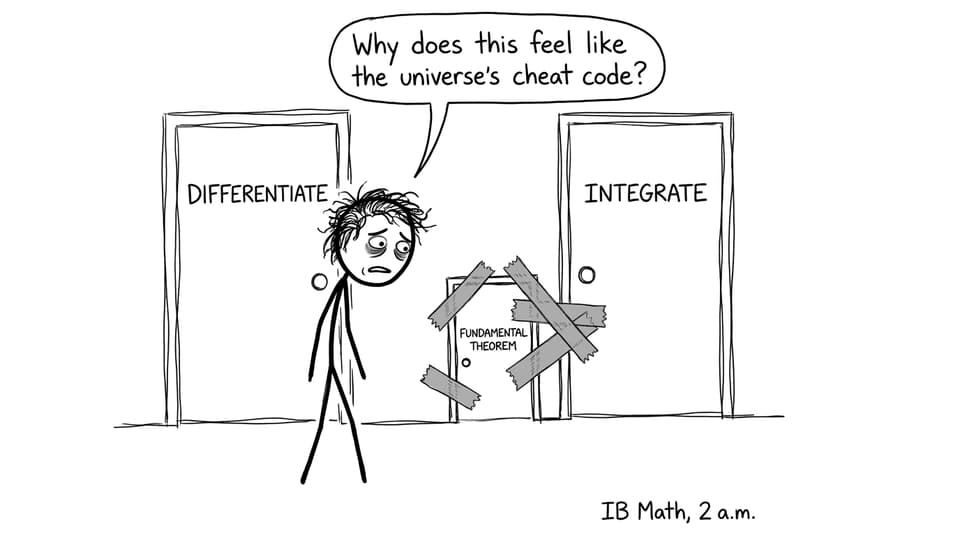
In IB Math, the Fundamental Theorem of Calculus (FTC) matters because it turns integration from a geometric idea into a fast, reliable calculation tool. It doesn’t just say “here’s a method.” It explains why the method is allowed.
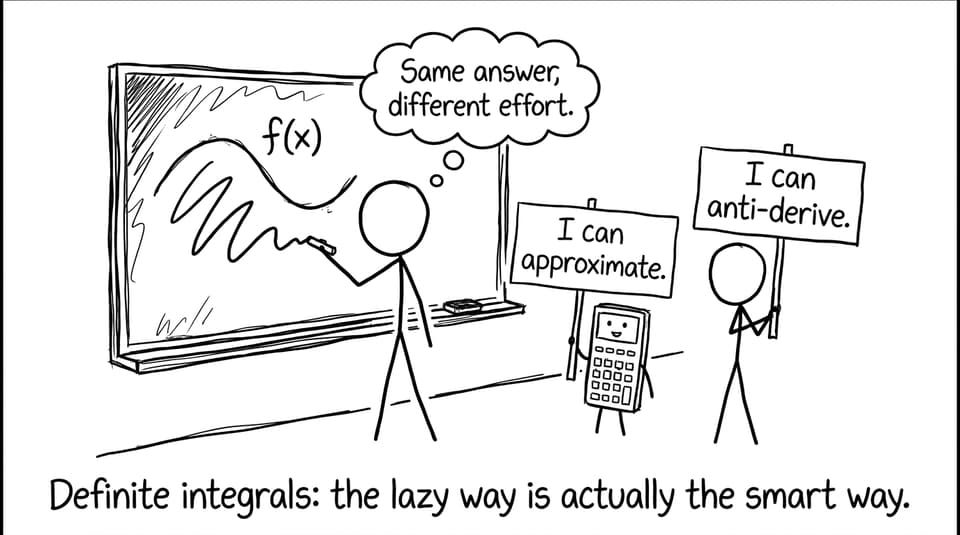
Before FTC, finding a definite integral is basically: “approximate the area under a curve.” After FTC, it becomes: “find an antiderivative and subtract.” That shift is enormous in exam conditions.
If you want a clean syllabus-aligned path through the surrounding skills, start from IB Mathematics Analysis and Approaches Calculus and keep the theorem as the connecting thread rather than a standalone fact.
Quick checklist: what to remember for exams
-
A definite integral is accumulated change (often net area).
-
An antiderivative is a function whose derivative returns the original function.
-
FTC links these: accumulation can be computed by antiderivatives.
-
IB Math questions often test interpretation, not just execution.
-
Your explanation should mention “accumulation,” “rate of change,” and “bounds.”
For extra conceptual grounding, How to Interpret Integration as Area and Accumulation is a useful refresher.
What the Fundamental Theorem actually says (without the fog)
There are two familiar faces of the FTC, and IB Math expects you to realize they’re the same story told from different angles.
The “evaluation” idea
If (F'(x)=f(x)), then
Meaning: the net accumulated change from (a) to (b) can be computed by taking an antiderivative and subtracting its values at the bounds.
The “accumulation function” idea
If (G(x)=\int_a^x f(t),dt), then (G'(x)=f(x)).
Meaning: if you build a function out of “how much has accumulated up to now,” its derivative gives you the original rate.
Students often learn these as two separate rules. But they’re really one loop: accumulation creates a function; differentiating that function reveals the rate again. That loop is the heart of IB Math calculus.
Why it feels like a big deal (because it is)
The FTC is one of the rare points in math where two units of content stop being neighbors and become a single system. It’s like realizing that reading and writing are not separate skills but a feedback cycle: reading improves writing, writing improves reading.
In IB Math, this matters because so many applications depend on switching viewpoints quickly:
-
Motion: velocity as a derivative, displacement as an integral.
-
Graph interpretation: “slope information” vs “area information.”
-
Modelling: rates become totals, totals become rates.
RevisionDojo is built around that switching skill. The IB Mathematics AA Calculus Questionbank forces you to move between interpretation and computation, and the AI Chat can help you translate a markscheme-style explanation into your own words.
Why it’s confusing in IB Math (three common reasons)
You learn the shortcut before the meaning
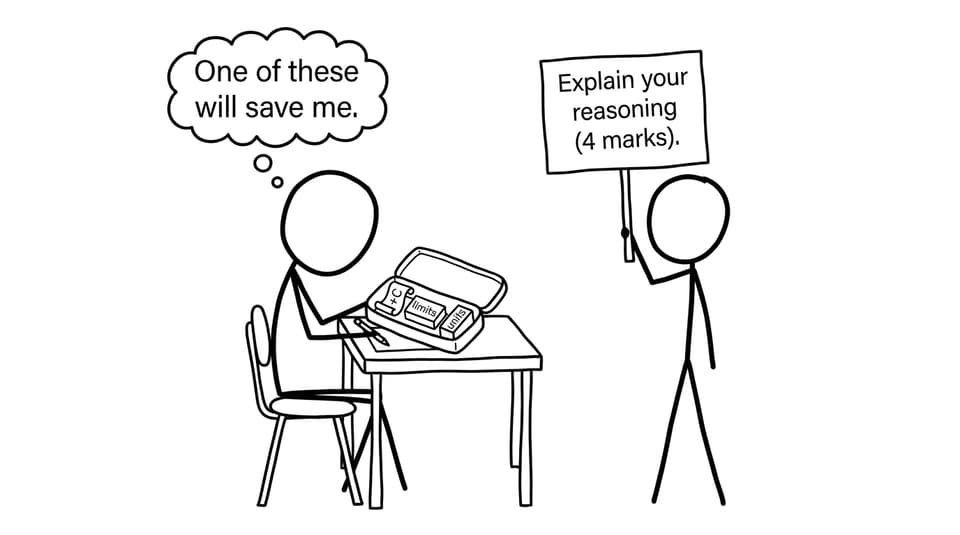
A lot of students meet FTC as a procedure: “find antiderivative, plug in limits.” The brain stores it as button-pressing, not reasoning. Then an explanation question appears and everything feels missing.
The notation hides the story
(\int_a^b) looks like a decorative bracket until you treat (a) and (b) as a time window, a distance window, a probability window, or a “from here to there” window.
Small mistakes feel like concept mistakes
Mixing up indefinite vs definite integrals, forgetting (+C), or mishandling bounds can make you think you don’t understand the theorem, when you really need cleaner process habits.
A practical way to build those habits is to review questions in categories. Use How to Review Complex Calculus Problems Systematically and track which step fails: setup, antiderivative, evaluation, or interpretation.
How IB Math tends to assess the FTC
Expect FTC to appear as:
-
Straight definite integral evaluation
-
“Interpret the integral as accumulated change” prompts
-
Linking graphs of a function and its derivative
-
Kinematics and modelling explanations
-
Variable upper limit differentiation (HL more often)
Make the formula booklet work for you under time pressure using IB Mathematics Analysis and Approaches Data Booklet, especially to check standard integrals and derivative rules quickly.
Bringing it home (and making it click)
In IB Math, the Fundamental Theorem of Calculus feels important because it is the bridge that turns “shapes and slopes” into “totals and rates,” all inside one consistent system. It feels confusing because the bridge is taught like a shortcut, and shortcuts are hard to trust until you’ve walked the long way at least once.
If you want that trust before exam day, build the loop: read the notes, drill targeted questions, then explain your reasoning out loud. RevisionDojo ties that together with Study Notes, Flashcards, a syllabus-matched Questionbank, AI Chat, Grading tools, Predicted Papers, Mock Exams, a Coursework Library, and Tutors, so the theorem stops being mysterious and starts being useful when it matters most.
For more IB Math reading, browse the IB Math tag.