



In IB Math, there’s a moment almost everyone remembers: you’re calmly counting successes in a binomial question, then the next problem asks for “area under a curve” and suddenly your brain feels like it switched subjects. Same chapter. Same word “probability.” Completely different vibe.
That uneasy feeling is actually useful. It’s your intuition noticing that the binomial and the normal distribution don’t just use different formulas; they ask you to think in different ways.
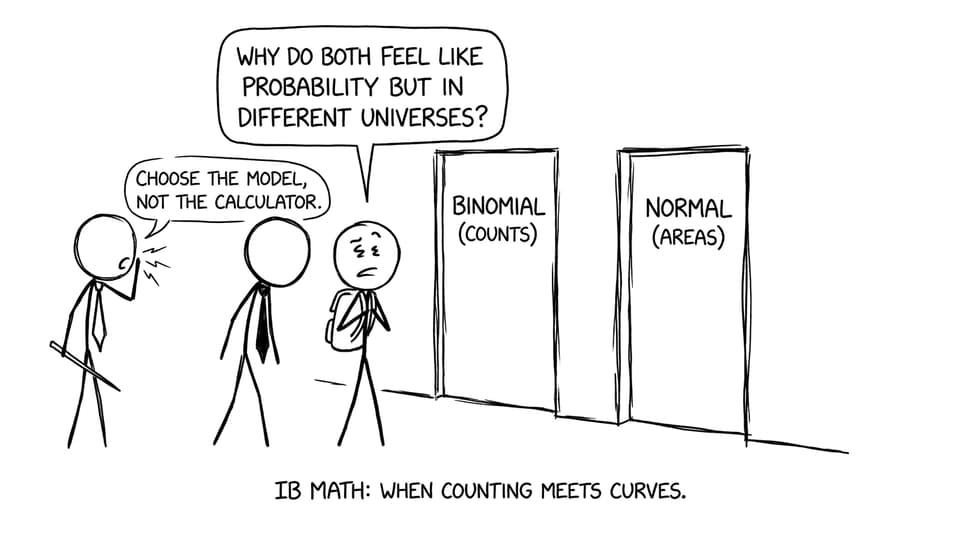
A quick IB Math checklist: which distribution am I in?
Before you calculate anything in IB Math, run this fast check:
-
Am I counting successes? (0, 1, 2, 3, …), so the answer is binomial
-
Is there a fixed number of trials n, with constant probability p?, so the answer is binomial
-
Am I measuring something on a scale? (time, height, mass, error), so the answer is normal
-
Does the question talk about a mean μ and standard deviation σ?, so the answer is normal
-
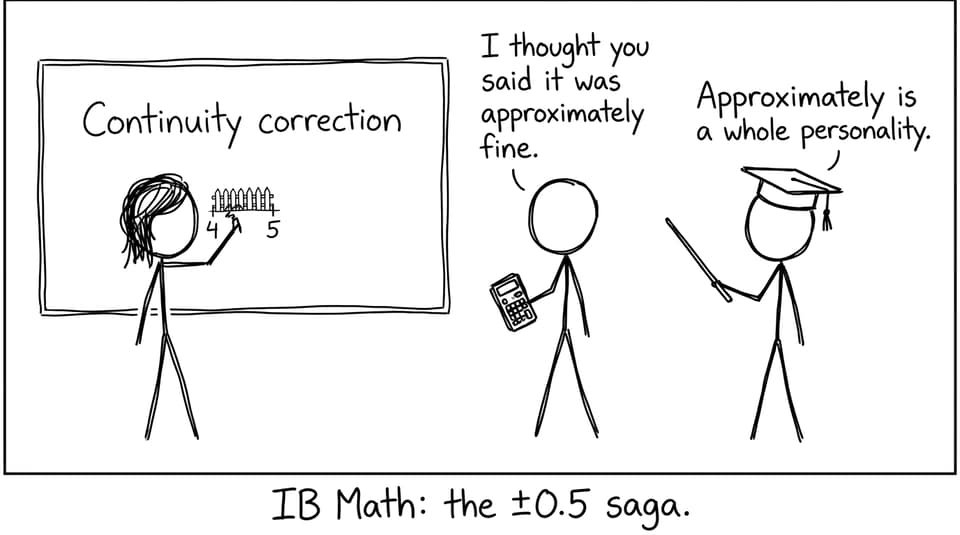
Am I approximating a binomial with a normal?, so check conditions + continuity correction
If you want a clean topic map for where these skills sit, start from Statistics & Probability in IB Math AA.
Discrete vs continuous: why your intuition protests
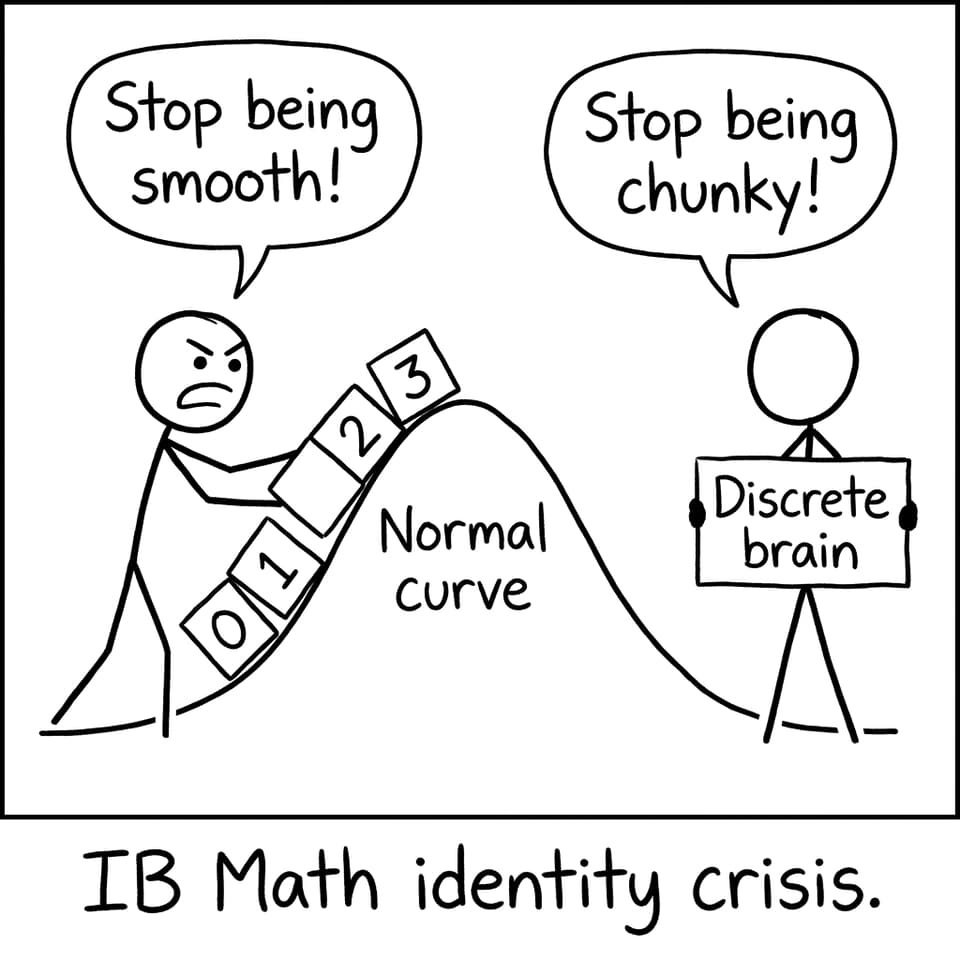
The binomial distribution is discrete. It lives on whole numbers because it models a count: “How many successes?” In IB Math, that usually means you can point at specific outcomes like X = 7.
The normal distribution is continuous. It models a measurement that could, in theory, take infinitely many values between two numbers. You don’t really ask “What is P(X = 7)?” in the same way, because a single point has zero area.
That’s the psychological shift: binomial probability feels like picking marbles. Normal probability feels like shading regions.
If binomial is still fuzzy, revise the definition and structure in Binomial Distribution Notes (AA SL 4.8).
Why binomial feels “more concrete” in IB Math
Binomial questions often hand you the story in a tidy package: fixed n, two outcomes, independent trials, constant p. That’s like a locked box with a label.
So early on, IB Math students trust binomial more because it matches everyday counting. Even when you use technology, it feels direct: “Give me P(X \le 6).”
But IB exam questions raise the difficulty by changing what they ask you to interpret.
-
“At least” vs “at most” becomes a reading test.
-
Cumulative probabilities can hide off-by-one errors.
-
The meaning of “success” can shift mid-question.
Practice those tricky interpretations with Binomial Distribution Questionbank (AA SL 4.8).
Why normal feels “more abstract” in IB Math
Normal distribution questions often feel indirect: you convert to z-scores, or you use normalcdf/invNorm, and you’re trusting a curve you can’t “count.” That’s why it feels like the calculator is doing something mysterious.
In IB Math, the key idea is that probability is area under the curve. A range like P(40 < X < 60) is meaningful because it represents a slice of area, not a list of outcomes.
To make that feel less slippery, anchor yourself in the parameters: μ is the center, σ is the spread. Then every question becomes “Where is this value relative to the center?”
For structured review, use Normal Distribution and Calculations (AA SL 4.9) and the companion Normal Distribution Notes.
When IB Math connects them: normal approximation to binomial
IB Math loves the moment where two ideas meet. The normal approximation to the binomial is exactly that: you start with a discrete model, then borrow a continuous one to estimate.
This can feel unfair at first, because approximation is not just computation; it’s judgment.
-
You must check whether approximation conditions are reasonable.
-
You must remember the continuity correction.
-
You must interpret the result as “close to,” not “equal to.”
If you want a broader probability strategy that ties these topics together, read How to Master Probability and Statistics in IB Math.
The practical takeaway (and how RevisionDojo helps)
The binomial distribution feels different from the normal distribution in IB Math because they model different worlds: counts vs measurements, points vs areas, exact outcomes vs continuous ranges. Once you name that difference, a lot of confusion disappears.
If you want this to become automatic before exams, use RevisionDojo like a tight loop: learn the concept in Study Notes, drill it in the Questionbank, lock in definitions with Flashcards, and use AI Chat to sanity-check your model choice. Then add Mock Exams, Predicted Papers, and Grading tools to train exam decisions under time pressure. If you need a human to spot your blind spots, RevisionDojo Tutors can help you fix the one step you keep repeating.
Keep asking the simple question first: “Am I counting, or am I measuring?” In IB Math, that’s often the whole game.