


Why standard form feels like busywork (until it doesn’t)
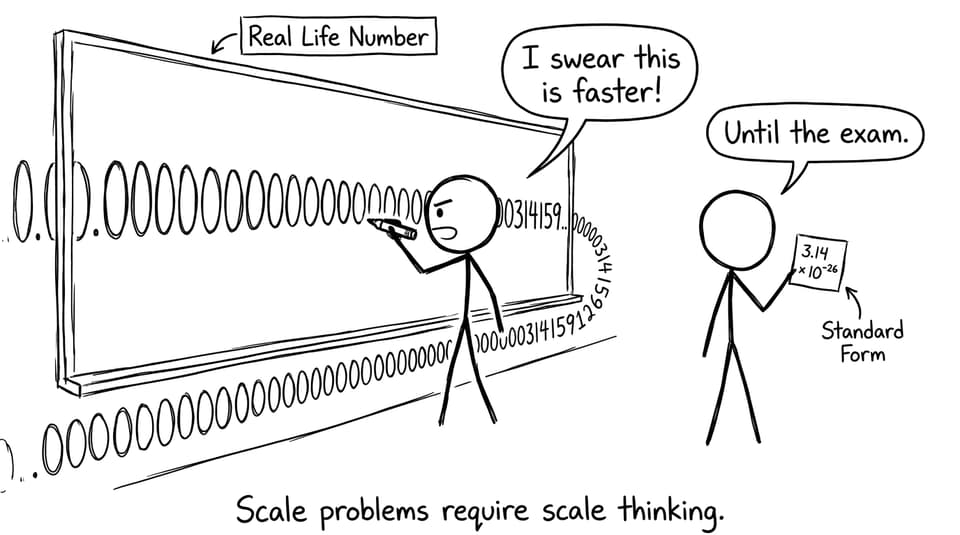
The first time you learn standard form, it can feel like a weird tradition adults invented to keep teenagers humble. You already have a calculator. You can already write decimals. So why are we spending precious revision time turning 0.000045 into (4.5\times10^{-5})?
Then IB Math exam questions arrive and quietly change the rules. Suddenly, standard form isn’t “formatting” anymore. It’s the difference between understanding a model and misreading it. Between comparing two quantities correctly and losing marks because your brain treated (10^6) as “just a big number.”
Quick checklist: what standard form is really testing in IB Math
-
Can you see magnitude quickly (powers of ten before digits)?
-
Can you compare scales without drowning in zeros?
-
Can you interpret what a value means in context?
-
Can you use technology responsibly (and explain it clearly)?
-
Can you avoid rounding too early in modelling chains?
If you want a clean refresher before drilling questions, use SL 1.1: Using standard form (AA) alongside the SL 1.1 notes.
The real reason IB Math cares: scale is part of the meaning
In IB Math, standard form is a thinking tool. It forces you to separate a number into two truths:
-
the size (the exponent)
-
the detail (the leading digits)
That’s exactly what real scenarios demand. Population, micro-measurements, finance growth, decay, error bounds, regression parameters, they all live on different scales. Standard form makes those scales visible.
This is especially loud in Math AI, where interpretation is the entire point of many questions. The broader course hub for targeted resources is here: IB Math AI resources.
“But my calculator already shows E notation” (and that’s the trap)
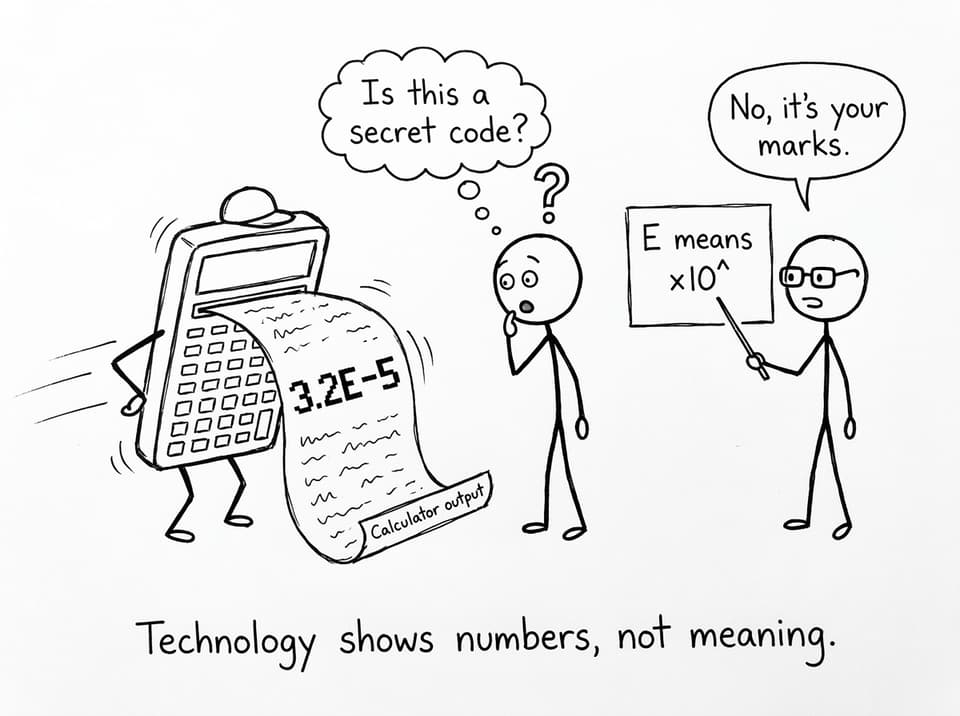
A calculator can display (3.2E-5), but it can’t tell you whether you understand it.
In IB Math, examiners regularly see students:
-
copy calculator notation incorrectly
-
confuse (E-5) with (\times10^{5})
-
compare two values by digits while ignoring the exponent
And the worst part: the working often looks “confident” while being completely wrong.
If you need repetition with feedback, RevisionDojo’s Questionbank is built for this: start with Math AI standard form Questionbank or zoom out and practise the whole topic with Number and Algebra (AI) Questionbank.
Why standard form matters most in modelling chains
Modelling questions don’t fail because one step is hard. They fail because one small mistake multiplies.
If you round too early, misread an exponent, or treat scale like decoration, your final conclusion can be off by a factor of ten, a thousand, or a million. In IB Math, that’s not “close enough.” It’s a different reality.
So standard form becomes a safety rail. It keeps your calculations honest as they move through multiple steps (and multiple interpretations).

To build exam habits around this, pair practice with structure: use How to Use the Questionbank for Targeted Math Revision and then simulate pressure with RevisionDojo Mock Exams and Predicted Papers via Math AI papers or the dedicated Math AI Predicted Papers.
The mistakes IB Math students keep repeating
Here are the patterns that show up again and again:
-
flipping the sign of the exponent (tiny becomes huge)
-
rounding the mantissa before the final step
-
writing standard form without units or context
-
assuming the calculator output is automatically “exam-ready”
A fast fix is to practise one micro-skill at a time. For example, if negative values are your issue, drill that specifically using Converting negative numbers to standard form.
Closing: make standard form your advantage, not your chore
Standard form feels pointless when it’s treated like handwriting practice. In IB Math, it’s closer to financial literacy: a way to see scale, avoid bad assumptions, and communicate clearly under pressure.
If you want that confidence to show up on exam day, use RevisionDojo as your system: drill standard form in the Questionbank, lock in the idea with Study Notes and Flashcards, ask AI Chat when your interpretation feels shaky, then test yourself with Mock Exams, Predicted Papers, and grading tools that tell you exactly where marks are being lost. That’s when standard form stops being a rule and becomes a shortcut.