


Sampling feels like the quiet beginning of a statistics story. No flashy calculator work. No dramatic graphs. Just a decision about who gets counted.
And that’s exactly why it matters so much in IB Math.
In exam questions, the numbers are often fine. The mean is computed correctly, the correlation is stated, the test is performed. Then the conclusion collapses because the sample was pulled from the wrong place, at the wrong time, with the wrong people missing. In IB statistics, sampling is the part that decides whether the rest is trustworthy.
A quick sampling checklist for IB Math
Use this mini-checklist whenever you see a sampling setup:
-
Define the population clearly (who are we really talking about?).
-
Name the sampling method (random, convenience, stratified, etc.).
-
Spot who gets excluded (undercoverage is usually hiding there).
-
Decide what bias might occur (and why it occurs).
-
Judge representativeness, not just sample size.
If you want the syllabus-aligned definitions in one place, keep the IB Math stats hub open while you revise: Statistics & Probability.
What sampling is really testing (and why IB loves it)
Sampling is the process of selecting a subset of a population to make a claim about the whole group. That sounds simple. But IB examiners aren’t testing your ability to repeat that line.
They’re testing whether you can think like someone who doesn’t want to be tricked by data.
A sample can be numerically large and still misleading. A sample can be random and still produce unusual outcomes. A sample can look “fair” until you notice who wasn’t asked. In IB Math, that reasoning is the difference between a vague comment and a high-mark evaluation.
To build this skill fast, practice questions that force you to explain sampling decisions in context: Statistics & Probability Questionbank (AA) and Statistics and Probability Questionbank (AI).
Why bias is so hard to spot in IB Math questions
Bias rarely announces itself. It sneaks in wearing “reasonable” clothing.
A school surveys students at lunch. A fitness app polls its own users. A study recruits volunteers. None of these scream “wrong.” But each one quietly overrepresents certain groups and underrepresents others.
In IB Math, you score well when you move from labels to mechanisms:
-
Not just “convenience sampling” but because it only includes students who were available.
-
Not just “voluntary response bias” but because those with strong opinions are more likely to answer.
-
Not just “undercoverage” but because a subgroup had no chance of selection.
When you need extra language for this, RevisionDojo’s IB Mathematics Analysis and Approaches Statistics & Probability Notes are structured around the exact reasoning the markschemes reward.

Random sampling: not perfect, just fair
IB emphasizes random sampling because it reduces systematic bias. Every individual has an equal chance of selection, so you’re less likely to “stack the deck” without noticing.
But here’s the subtle point IB Math wants you to say: random sampling doesn’t guarantee representativeness in a single sample. It guarantees fairness in the selection process.
That distinction helps you write balanced evaluation sentences like:
-
“Random sampling reduces selection bias, but the sample may still be unrepresentative by chance.”
-
“The method is fair, although practical constraints may limit true randomness.”
For targeted practice on sampling techniques and reliability language, use the wider topic pages as a revision base: Statistics & Probability and SL 4.1 Introduction to Statistics (AI).
Sample size vs sampling method (the exam trap)
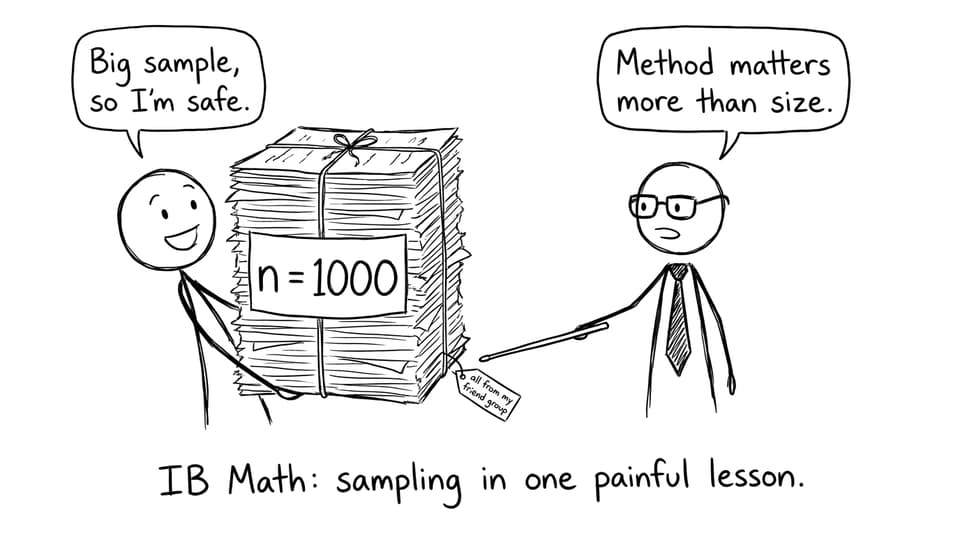
A bigger sample can reduce random error. But it cannot wash away bias.
If you only survey your friends, collecting 1,000 responses just gives you a more precise measurement of your friend group.
That’s why IB Math questions love to tempt you with big numbers. Examiners want to see if you’ll chase the comfort of “large n” or if you’ll defend the more important idea: selection matters more than volume.
To sharpen this exact skill, read: Why IB Questions Emphasise Sampling Limitations.

How to earn the explanation marks in IB Math sampling
Most sampling questions are not “spot the keyword.” They’re “justify your judgment.”
A strong IB-style answer usually includes:
-
the sampling method,
-
the specific bias,
-
the direction of distortion (who is over/underrepresented),
-
and the impact on conclusions (limited generalisation).
If you keep losing marks on writing, RevisionDojo’s AI Chat can help you rewrite your evaluation in examiner tone, while the Grading tools show what a full-mark explanation looks like. Then you can reinforce it with Flashcards for definitions, and grind it into instinct using the Questionbank.
Bring it home: make sampling your advantage
Sampling is not the boring intro to statistics. In IB Math, it’s the moment where your entire argument either becomes credible or quietly collapses.
If you want sampling to become a source of easy marks, build a simple loop in RevisionDojo: learn the definitions in Study Notes, drill the wording in Flashcards, test your reasoning in the Questionbank, then use AI Chat and the Grading tools to polish your explanations. When exams arrive, you won’t just calculate correctly. You’ll conclude correctly, too.


