



The moment IB Math stops being “just numbers”
You’re halfway through a finance question. The balance increases. The percentages behave. Your calculator agrees. Then the prompt adds one quiet phrase: “in real terms.”
That’s usually when IB Math students feel the floor tilt.
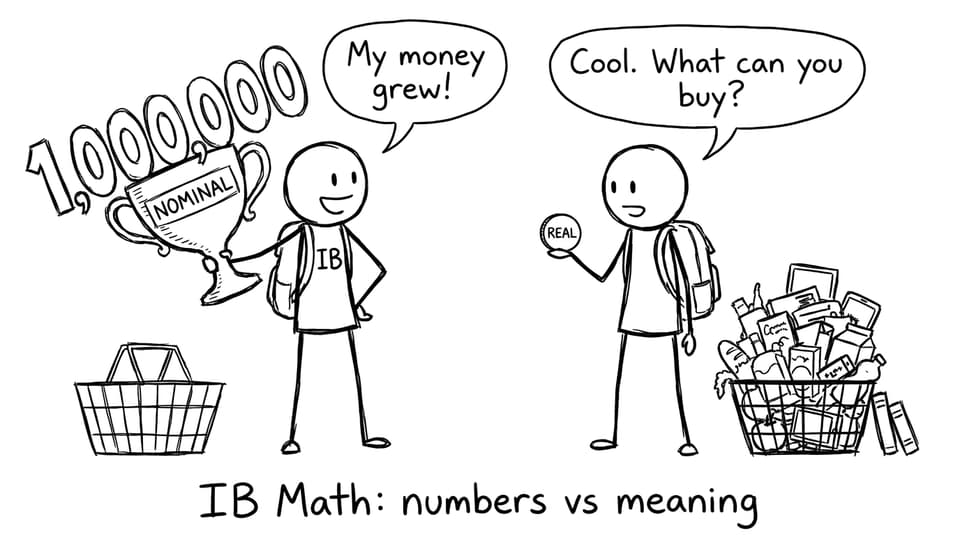
Nominal value feels like a clean photograph: a number at a time, no commentary. Real value feels like a story you have to interpret: what that number can actually do in a world where prices move underneath it. And in IB Math, examiners love the moment you stop calculating and start thinking.
Quick checklist: decide real vs nominal in 20 seconds
Before you touch your GDC, run this mini-checklist (it saves marks in IB Math):
-
If the question mentions purchasing power, cost of living, or “in today’s money”: think real value.
-
If it asks for an account balance, salary figure, or price as stated in that year: think nominal value.
-
If inflation is given and the question asks “better off / worse off”: real value is usually the point.
-
If you’re unsure, write one sentence: “Nominal is the number; real is what it buys.”
For more finance-style practice, start from the Mathematics Applications & Interpretation hub and work topic by topic.
What nominal value really is (and why it feels easy)
Nominal value is the amount written on the page at the time it’s measured. No adjustments. No “but what about prices?”
That simplicity is exactly why it feels comfortable in IB Math. The steps look familiar: apply a growth factor, compound interest, depreciation, and you’re done. If you want to drill those mechanics, the Number and Algebra Questionbank is built for repeated, exam-style reps.
But nominal value answers only one question:
How much money is there?
It doesn’t answer the question IB often cares about more:
Does this money improve your life compared to before?
What real value measures (and why it feels harder)
Real value adjusts for inflation so you can compare across time fairly. It translates money back into purchasing power.
This is why real value feels harder in IB Math: you’re not just computing. You’re choosing a lens.
A quick mental model:
-
Nominal: the headline number.
-
Real: the headline number after you’ve asked, “What changed in the world?”
When inflation exists, money is moving on two conveyors at once: your value might go up, but prices might rise too. Real value forces you to separate growth from the rising “price floor.”
If inflation modelling specifically trips you up, revise the judgement part using When should inflation be included in IB financial modelling questions?.
The hidden reason students lose marks: IB Math is testing meaning
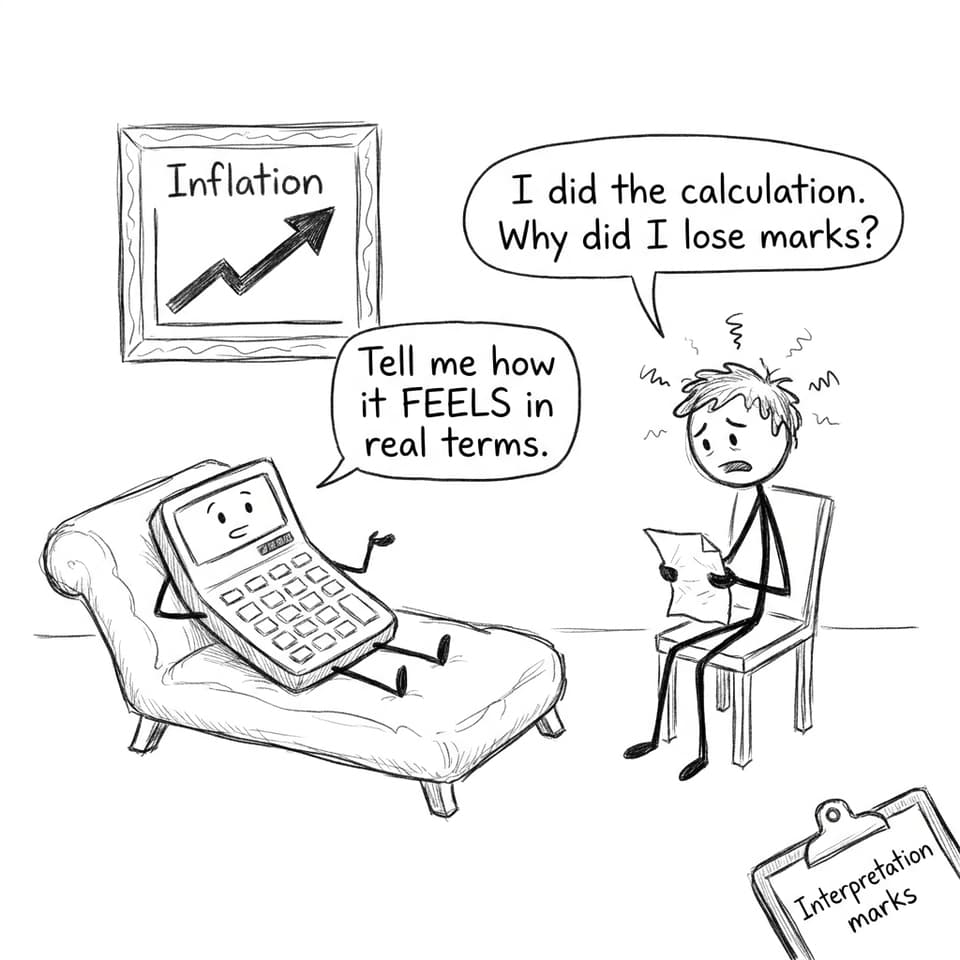
Most real vs nominal errors aren’t arithmetic errors. They’re reading and interpretation errors.
Common patterns:
-
You compute nominal growth, then write a real-world conclusion (mismatch).
-
You apply inflation once, but the model needs consistency across years.
-
You treat “increase” as “improvement,” even when inflation is larger.
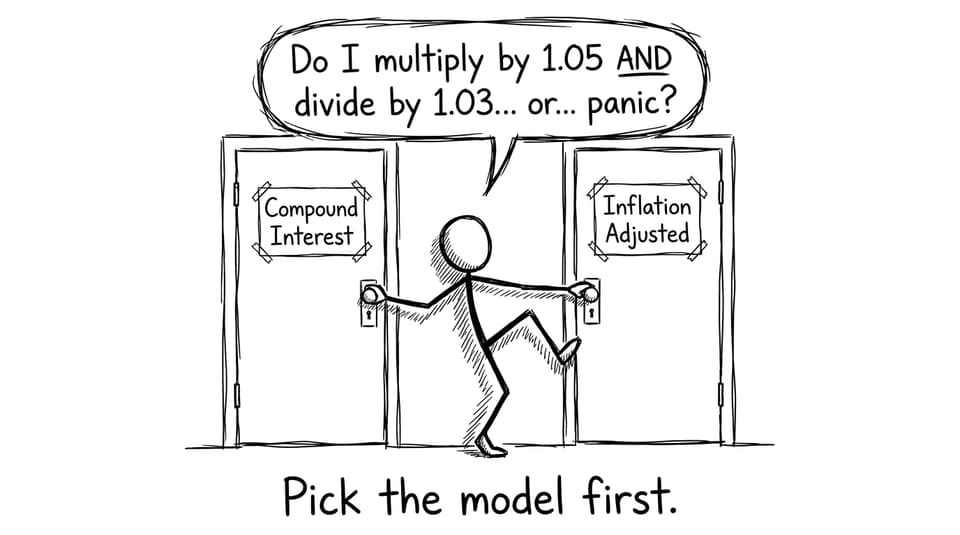
To fix this, train yourself to pick the model before you calculate. RevisionDojo’s AI Chat is perfect here: paste your setup and ask, “Is this nominal or real, and why?” Then use the Grading tools to see whether your explanation would earn communication marks.
Also worth revising: students often confuse rates and growth factors, which makes inflation adjustments messier than they need to be. See Why do students misinterpret growth factors in IB finance problems?.
Why real value shows up so much in Math AI
In IB Math AI, you’re rewarded for modelling choices and interpretation, not just clean algebra. Real value is a perfect examiner tool because it forces you to state assumptions and explain outcomes.
If you want targeted practice that mirrors this style, use the AI SL 1.7 Loan repayments and amortization Questionbank and the SL 1.4 Financial applications topic page. Pair it with Flashcards for the definitions (nominal vs real, inflation, growth factor), and lock in the formula familiarity using the IB Math AI data booklet.
Bring it home: turn “hard” into a repeatable habit
Real value feels harder than nominal value in IB Math because it asks you to do something rarer than calculation: separate the number from its meaning. Once you treat it as a two-step habit (choose the lens, then compute), it becomes predictable.
If you want that habit to stick, build a loop: Study Notes for the concept, Flashcards for definitions, Questionbank for practice, and AI Chat for quick feedback on whether your conclusion is actually in real terms. That’s the RevisionDojo advantage: it trains both the maths and the judgement that earns marks in IB Math.