



Radian measure has a special talent: it can make a confident IB student feel like they’ve forgotten how circles work.
You’re fine with degrees. Sixty feels like a real angle. Ninety feels like a corner. Then IB Math shows you (\pi/3), and suddenly your brain is trying to “translate” something that was never meant to be translated.
That discomfort is normal. Radians feel unnatural because you’re meeting a unit that isn’t built for everyday conversation. It’s built for geometry and calculus. And IB Math cares more about what’s mathematically natural than what’s socially convenient.
A quick IB Math checklist for making radians feel less weird
Use this as your reset button:
-
Stop thinking “conversion.” Start thinking “ratio.”
-
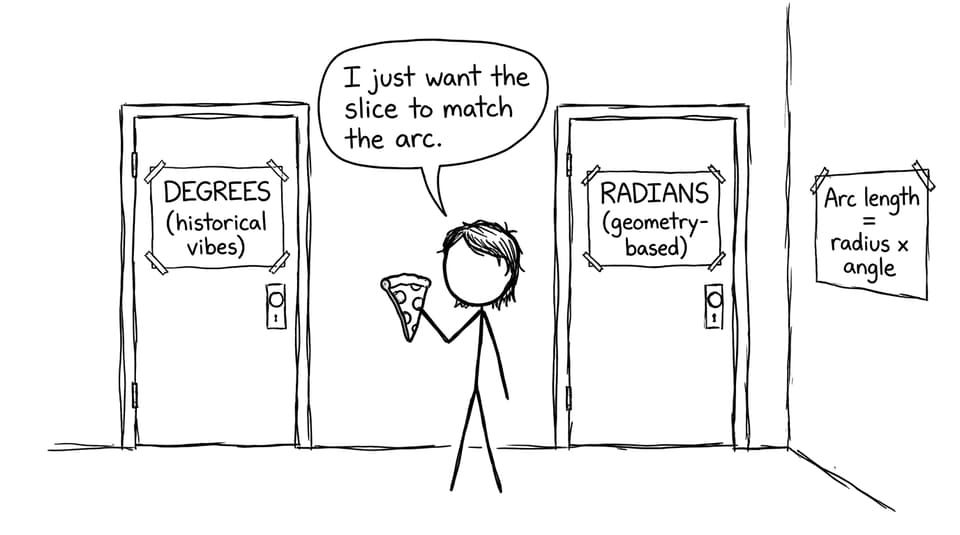
Link every angle (\theta) to arc length using (s=r\theta).
-
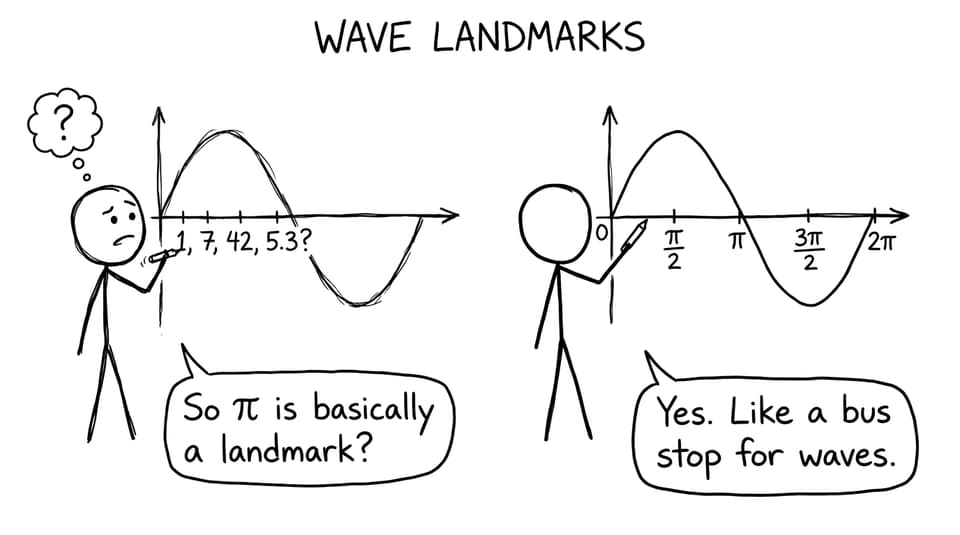
Memorise a few landmarks: (0, \pi/2, \pi, 3\pi/2, 2\pi).
-
In IB Math calculus, assume radians unless the question screams otherwise.
-
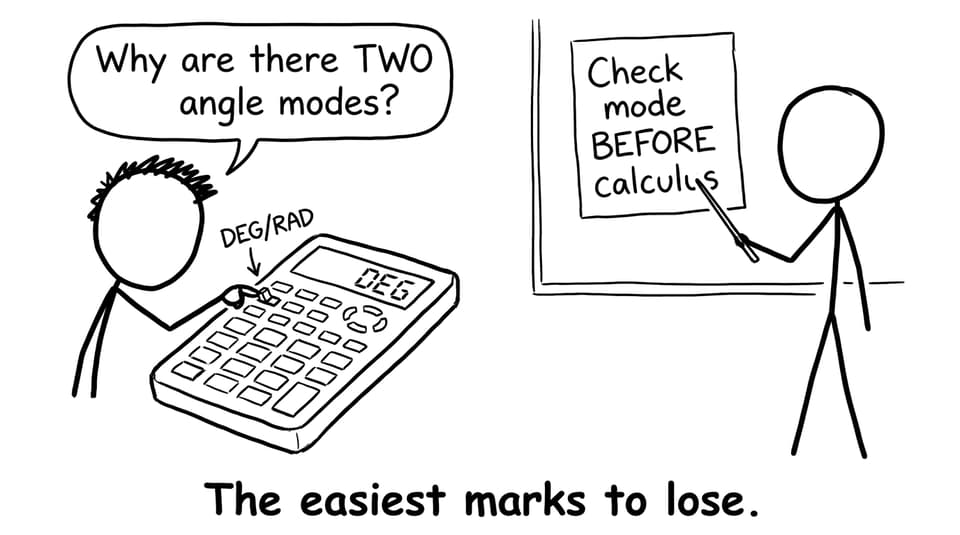
Before calculating anything trig-heavy, check calculator mode.
If you want the syllabus-aligned version of this idea, keep the notes open while you practise: Circle: radians, arcs, sectors (AA SL Notes).
What a radian is actually measuring (and why IB Math likes it)
Degrees slice a circle into 360 equal parts because humans collectively agreed it was a nice number. That’s it. Useful, familiar, historical.
A radian is different. A radian measures an angle by comparing two lengths:
Where (s) is the arc length and (r) is the radius. That’s why a radian is dimensionless. It’s a pure ratio.
This is also why radians feel unnatural at first: your intuition wants angles to be “separate” from lengths. But in IB Math, radians quietly connect them, which unlocks arc length and sector area without extra scaling. For targeted practice that looks like exam questions, use Circle: radians, arcs, sectors (AA SL Questionbank).
Why degrees become awkward the moment calculus arrives
The clean derivative facts you learn in IB Math, like
-
(\frac{d}{dx}(\sin x)=\cos x)
-
(\frac{d}{dx}(\cos x)=-\sin x)
only hold in that elegant form when (x) is measured in radians.
In degrees, the derivatives still exist, but they come with extra constants that clutter everything. Radians are the setting where trig functions match their “natural” rates of change.
This is also why small-angle approximations feel like magic: (\sin\theta\approx\theta) only works when (\theta) is in radians. If you want that intuition explained (and the common exam traps), read Why Do Small-Angle Approximations Feel Like Magic in IB Maths?.
For a structured syllabus path through trig and its rules, keep Trig Rules for IB Math HL & SL Explained nearby while you drill questions.
Why (\pi) shows up everywhere (it’s not trying to ruin your life)
(\pi) appears because it’s the circle’s constant: circumference is (2\pi r). When you define angle through arc length, a full turn naturally becomes (2\pi) radians.
So (\pi) isn’t decoration. It’s the receipt that proves radians are tied directly to circle geometry.
This is one reason many IB Math students start liking radians later: once (2\pi) feels like “one full rotation,” graphs and identities become easier to see.
Why radian graphs feel harder to read (until you adopt landmarks)
Degree graphs have friendly numbers. Radian graphs have (\pi)-fractions that look like algebra.
The trick is to treat (\pi/2) and (\pi) as landmarks, not values to compute. They’re like signposts on the unit circle and on trig graphs.
If you want to reinforce that visual link, the unit-circle approach in Unit circle + trig graphs notes (Math AI) makes the “landmark” idea stick.
The most common IB Math radian mistake: mixing modes
The saddest losses in IB Math are the avoidable ones: perfect method, wrong answer, because the calculator was in DEG.
Build a ritual:
-
Before any trig or calculus question, glance at the mode.
-
If you’re using (s=r\theta) or (A=\tfrac12 r^2\theta), you need radians.
-
If the question gives degrees explicitly, convert once and move on.
If your weakness is conversion under pressure, practise it like a skill: Converting from degrees to radians (Bootcamp).
Bringing it home: make radians “natural” the IB Math way
Radians feel unnatural when they live in your head as converted degrees. They feel natural when they become what they really are: a clean ratio that ties angles to circles, graphs, and calculus.
If you want that shift to happen quickly, build your practice around real exam-style prompts: use RevisionDojo’s Questionbank, Study Notes, and Flashcards to lock in landmarks; test yourself with Mock Exams and Predicted Papers; and use AI Chat plus the Grading tools to catch unit mistakes before they become habits. That’s how IB Math stops being a series of conversions and starts becoming a set of connected ideas.