

Why Does Modelling Salary Changes Feel So Inconsistent in IB Math?
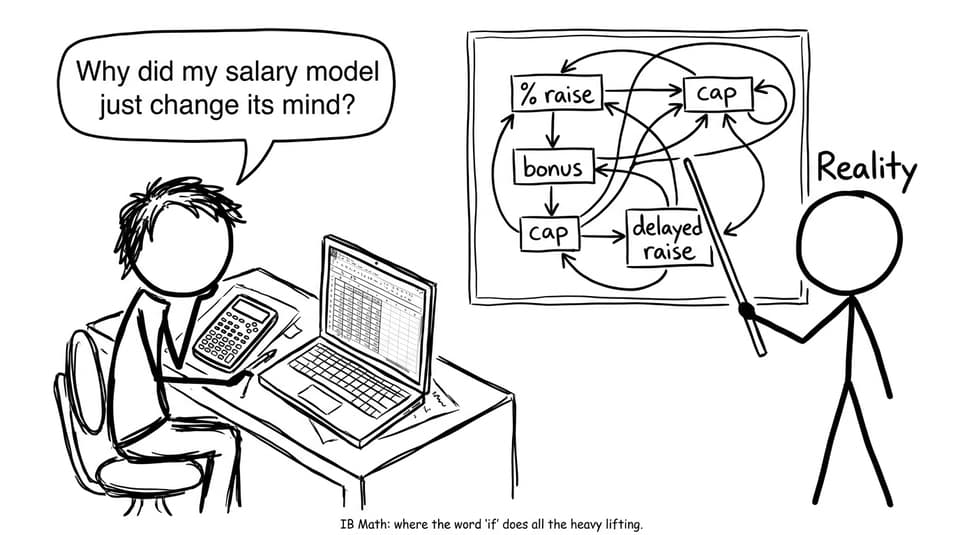
You open a salary question in IB Math and expect the usual comfort: a neat formula, a tidy sequence, a predictable pattern. Then the question adds one sentence: “A bonus is paid in year 3,” or “the raise is capped,” or “the increase begins after a probation period.” Suddenly your model feels like it’s slipping through your fingers.
That frustration is not a sign you’re bad at IB Math. It’s a sign you’re meeting the real point of the topic. Salary modelling is designed to test judgment: can you translate messy rules into a clear mathematical structure, and then explain what that structure means?
Quick checklist for salary modelling in IB Math
Before you calculate anything, run this short checklist (it saves marks):
-
Define the salary variable clearly (e.g., (S_n) is salary in year (n))
-
Underline the rule words: percentage, fixed, after, until, maximum, bonus
-
Decide if the model is linear, exponential, or piecewise (often piecewise)
-
Write the update rule year-to-year before finding values
-
State assumptions explicitly (timing, rounding, whether bonus affects future raises)
If you want a structured place to practise these habits, start from the IB Math course hub: IB Mathematics Applications & Interpretation Resources.
Why salary growth is rarely one clean pattern in IB Math
A lot of IB Math topics train you to spot a single “family” quickly: arithmetic sequences (constant differences) or geometric sequences (constant ratios). Salary contexts look similar on the surface, so it’s natural to reach for one formula.
But salaries behave more like rules than like sequences. A single scenario might include a percentage raise (multiplicative), a one-time bonus (additive), and a cap (a conditional stop). That combination forces a piecewise model: different rules in different years.
This is also why salary modelling fits the Applications & Interpretation mindset. The course isn’t only asking “can you compute?” It’s asking “can you model responsibly?” For a broader strategy on exam-style modelling, see How to Approach Math AI SL Modeling Questions.

Why percentage raises feel familiar but behave differently
A percentage raise resembles compound interest, so many students treat it like automatic exponential growth. In IB Math, that’s only safe when the raise is:
-
applied every year,
-
applied to the current salary,
-
and not limited by extra conditions.
The moment a question says “for the first 4 years,” or “until the salary reaches 60,000,” the constant growth factor stops being constant. The raise becomes conditional. Examiners often award method marks for spotting this and switching your model when the rule switches.
If financial modelling concepts blur together, pair salary questions with inflation practice, because they often appear in the same skill set. This helps: When Should Inflation Be Included in IB Financial Modelling Questions.
Why bonuses and caps break intuition in IB Math
Bonuses and caps are the two small details that create big inconsistency.
A fixed bonus is additive: it bumps the salary once, but it doesn’t automatically “compound” unless the question states that future raises apply to the new total. A cap is a hard ceiling: it turns a growth model into a “grow, then flatten” model.
A clean way to write this in IB Math is:
-
“For years 1 to 3, (S_{n+1}=1.05S_n)”
-
“In year 4, (S_4 = S_3 + 2000) (bonus)”
-
“After that, (S_{n+1} = \min(1.03S_n, 60000))”
You don’t need fancy notation every time. You need clarity. If you want help building that clarity under time pressure, RevisionDojo’s Study Notes and Flashcards are built for exactly these rule-changes.
The real reason students lose marks: not explaining the model
The “inconsistent” feeling often comes from expecting one right answer. But IB Math modelling can allow multiple reasonable approaches, as long as you communicate assumptions.
Examiners reward:
-
a clearly defined model,
-
consistent application,
-
correct interpretation (with units),
-
and honest limitations.
That’s why RevisionDojo’s AI Chat is useful when you practise: you can paste your rule definition and ask, “What assumption did I just make without stating?” Combine that with the Grading tools so you see where explanation marks live.
For more on how interpretation is graded in this subject, read: Why Does IB Care About Interpretation More Than Precision in Maths.
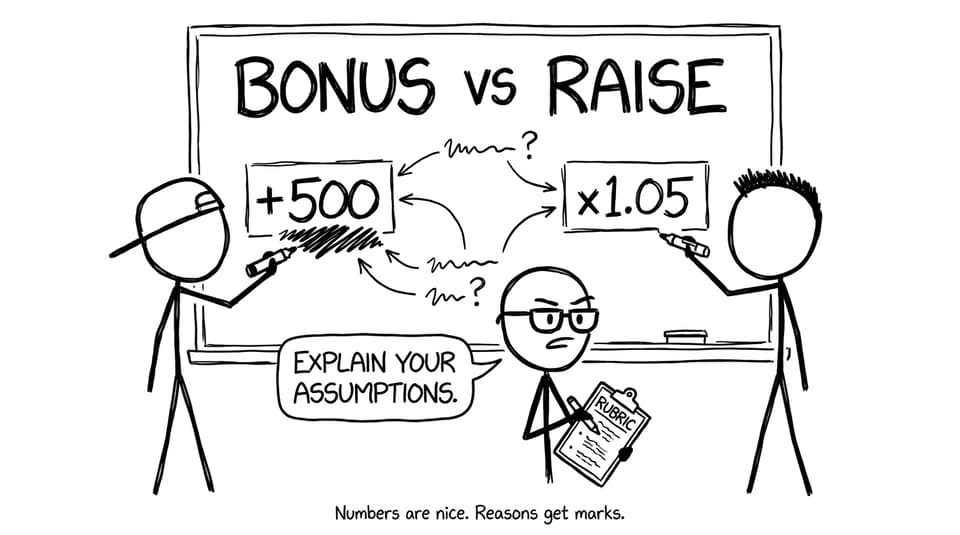
Common IB Math mistakes in salary modelling
These show up again and again:
-
Assuming constant percentage growth when the question changes the rule
-
Mixing a fixed increase and a percentage increase in the same step
-
Ignoring a cap or threshold after writing it down correctly
-
Writing numbers with no explanation of timing (start vs end of year)
-
Giving a final value with no interpretation (“what does this mean for the worker?”)
If you’re revising for Paper 2, salary modelling often appears alongside sequences and financial tech skills. This guide helps you prioritise: Ace IB Math Applications and Interpretation Paper 2.
A calmer way to practise salary modelling in IB Math
Salary modelling feels inconsistent in IB Math because real salary rules are inconsistent. The win isn’t finding one magic formula. The win is building a model you can defend.
On RevisionDojo, you can learn the concept quickly with Study Notes, drill realistic variants in the Questionbank, lock in the language with Flashcards, and test under pressure with Predicted Papers and Mock Exams. If salary questions keep surprising you, that’s a signal to practise the rule-switching skill until it stops feeling like a surprise.