

Kinematics in IB Math is the moment calculus stops being neat and starts behaving like reality. You can differentiate polynomials all day, but the second a question mentions “a particle” and “changes direction,” your confidence can wobble. Not because you suddenly forgot calculus, but because IB is testing something subtler: whether you can attach meaning to your symbols.
That’s why kinematics with calculus feels confusing in IB Math. It asks you to think in layers: what the function represents, what the derivative represents, what the integral represents, and what the sign represents. If even one layer is blurry, the whole question feels slippery.
The quick clarity checklist (use before you calculate)
Before you touch your pen, run this checklist (it saves marks in IB Math):
-
Label what’s given: s(t), v(t), or a(t) (include units if you can).
-
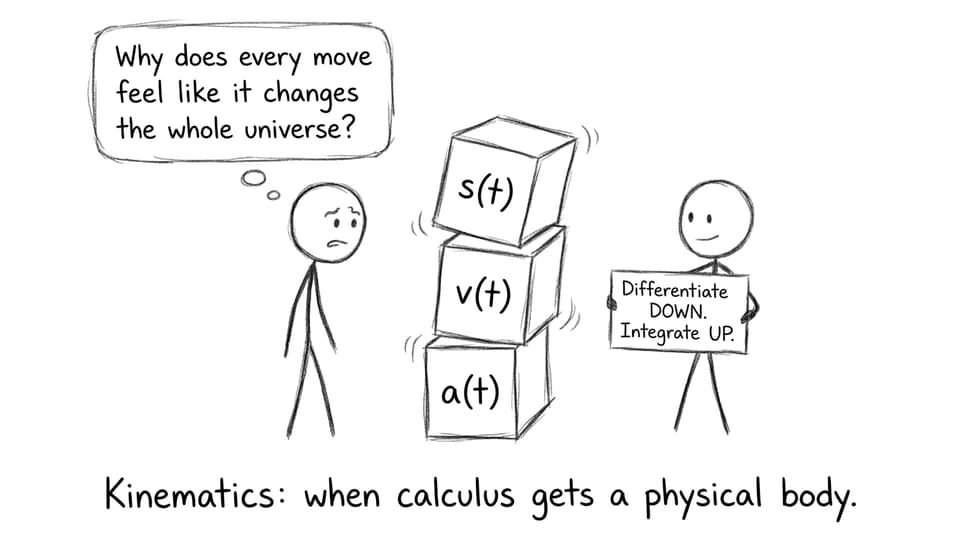
Decide your move: differentiate to go “down” (s to v to a), integrate to go “up.”
-
Mark your time interval and read “from” and “to” carefully.
-
If integrating, write + C immediately.
-
Look for initial conditions (like at t = 0 or at t = 3).
-
Ask: “Is this asking for displacement (signed) or total distance (always positive)?”
For targeted practice, the SL 5.9 Kinematics problems hub is built for exactly this kind of exam setup.
Why kinematics feels harder than “normal” calculus in IB Math
In regular calculus exercises, you’re often rewarded just for correct procedures. In IB Math kinematics, procedure is only half the job. The other half is interpretation.
You’re juggling three connected ideas:
-
Position/displacement s(t): where you are.
-
Velocity v(t): how fast position is changing.
-
Acceleration a(t): how fast velocity is changing.
The relationships are simple, but the meaning changes everything:
-
(v(t)=\frac{ds}{dt})
-
(a(t)=\frac{dv}{dt}=\frac{d^2s}{dt^2})
-
(s(t)=\int v(t),dt)
If you want a clean refresher on the calculus side, the IB Math AA Calculus topic page and its calculus notes help you rebuild the chain from first principles.
The most common mix-up: velocity vs acceleration
Many IB Math errors come from doing correct differentiation on the wrong quantity.
Velocity and acceleration can both be positive, negative, increasing, or decreasing. The “feel” of motion is not the same as the sign of a function unless you interpret it carefully:
-
Negative velocity means moving in the negative direction (not “slowing down”).
-
Negative acceleration means velocity is decreasing (which could mean slowing down or speeding up, depending on the direction).
A quick habit: write a one-line translation next to your working:
-
“v(t) < 0, so the particle is moving left.”
-
“a(t) > 0, so velocity is increasing.”
That one sentence often earns interpretation marks.
Why integration feels worse: the constant is not optional
Differentiation in IB Math feels deterministic. Integration feels like a guess, because it introduces a family of functions.
That “mystery” is the point: (+C) represents your starting situation.
When the question says something like “At (t=0), the particle is at the origin,” it’s giving you the information to pin down (C). If you skip that step, your algebra might be perfect and your model will still be wrong.
RevisionDojo’s notes on indefinite integration and substitution are a strong place to drill the “integrate then apply condition” routine until it’s automatic.

Displacement vs distance: the sign trap that IB Math loves
Displacement is net change in position. Distance is total travel.
In IB Math, the calculus difference is a big deal:
-
Displacement over ([t_1,t_2]): (\int_{t_1}^{t_2} v(t),dt)
-
Total distance: (\int_{t_1}^{t_2} |v(t)|,dt)
So if velocity goes below the axis, your integral for displacement can shrink or even cancel. That’s not a mistake. It’s motion changing direction.
If you want exam-style examples of this exact situation, RevisionDojo’s SL 5.9 Kinematics notes and questionbank practice make the sign logic unavoidable in a good way.

How IB Math tends to assess kinematics (so you can prepare)
Kinematics questions in IB Math commonly ask you to:
-
Differentiate (s(t)) to find (v(t)) or (a(t))
-
Integrate (a(t)) or (v(t)) and use initial conditions
-
Interpret turning points (where (v(t)=0))
-
Explain what a negative value means in context
-
Switch between algebra and graphs
If you learn best by watching someone narrate the “meaning” while solving, try the SL 5.9 videos alongside your practice.
Bring it all together (and make it feel simpler)
Kinematics with calculus feels confusing in IB Math when the symbols stop being “just functions” and start being a story about motion. The fix isn’t more memorisation. It’s clearer labeling, cleaner choices between differentiate vs integrate, and a habit of translating every answer back into meaning.
If you want that loop to become automatic, RevisionDojo is built for it: use the Study Notes to learn the relationships, drill the Questionbank for exam-style setups, lock in key distinctions with Flashcards, and sanity-check your interpretation with AI Chat and Grading tools. When you’re ready to simulate pressure, Mock Exams and Predicted Papers help you practice the exact pacing IB Math demands. And if you want a human to spot your blind spots quickly, RevisionDojo Tutors can fix weeks of confusion in a single session.