


In IB Math, a lot of students meet integration with a quiet confidence. You have rules for differentiation. You can do product rule in your sleep. So when someone says integration is “the reverse,” your brain expects a rewind button.
Then you try your first mixed set of integrals and it feels like reversing a movie… by manually reassembling every frame.
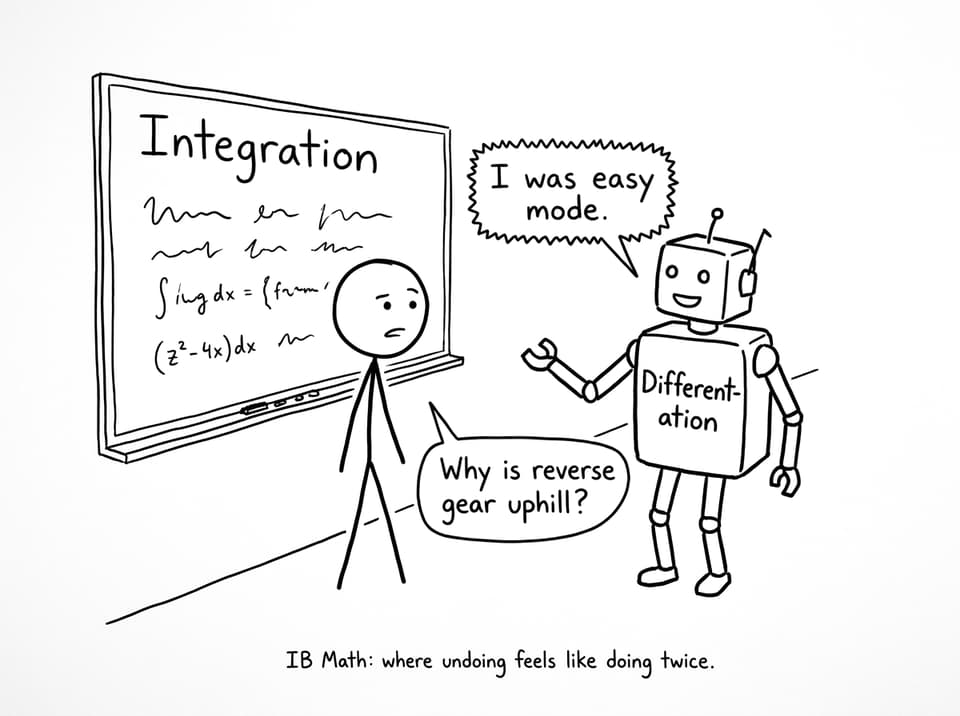
Integration in IB Math is harder not because it’s cruel, but because it asks a different question. Differentiation often asks, “What is the rule?” Integration asks, “What is the story?” That shift is why it feels like the reverse of differentiation but harder.
A quick checklist: why integration feels harder in IB Math
-
Differentiation is procedural; integration is often a decision.
-
Integrals measure accumulation, not just “undoing.”
-
Antiderivatives aren’t unique (hello, + C).
-
Definite integrals demand interpretation (area, signed area, totals).
-
IB Math exam questions reward explanations, not only answers.
If you want a clean topic map to revise from, the IB Math AA Calculus hub is a good place to anchor your practice.
Integration is “reverse,” but the reverse of what?
In IB Math, differentiation is like taking a complex motion and asking for its speed at one instant. It’s local. It’s sharp. The rules are designed to make that local step fast.
Integration is about adding up tiny pieces of change until you get a total. That’s why it connects to area under a curve, distance from velocity, or total change from a rate. It’s global, not local.
When you treat integration as only “anti-differentiation,” you’ll still be fine on straightforward antiderivatives. But you’ll lose marks on the questions IB actually likes: ones that ask what the integral means. If you’re revising that interpretation side, use How to Interpret Integration as Area and Accumulation.
Why differentiation feels more systematic than integration
Differentiation in IB Math is built on a small set of reliable moves: power rule, chain rule, product rule, quotient rule. Even tricky problems usually reduce to applying those moves in sequence.
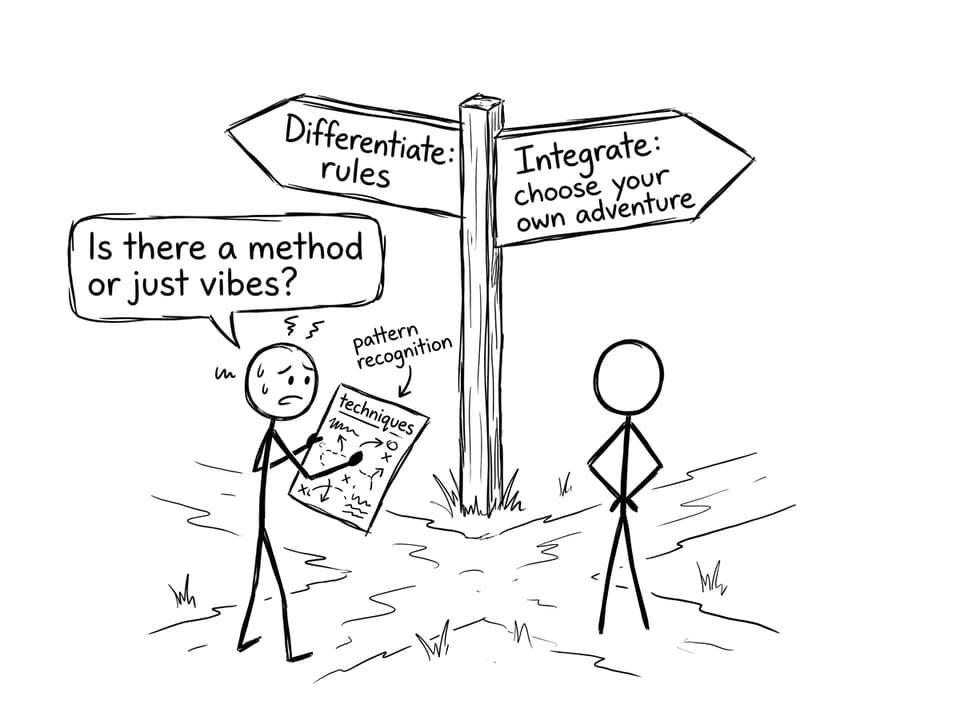
Integration is less rigid. You have options: reverse chain rule, substitution, parts, partial fractions, trig identities, or sometimes a clever rearrangement. Two students can integrate the same function with different methods and both be correct.
That freedom is exactly what makes it feel harder. Your brain wants a single door labeled “correct method,” but integration often gives you a hallway.
For method selection practice, RevisionDojo’s targeted resources help:
The constant of integration (+ C) is a concept, not a decoration
In IB Math, “forgetting + C” is rarely treated as a small slip. It signals that you might be thinking of antiderivatives as single answers, rather than families of answers.
If (F'(x)=f(x)), then (F(x)+C) also differentiates to (f(x)). That means indefinite integrals produce a whole family of functions. The constant isn’t there to annoy you; it’s there because mathematics is being honest.
When questions give you an initial condition (for example, a point on the curve), you’re being asked to pin down that family to one specific function. That’s where students who “mechanically integrate” often stumble.

Definite integrals feel different because they are different
A definite integral in IB Math produces a number: a total, a net change, or a signed area. There’s no + C because you’re not describing a family anymore; you’re calculating a specific accumulated quantity between two bounds.
This is also where interpretation marks appear.
A student can do the substitution perfectly and still lose marks if they don’t state what the value represents (net area vs total area, distance vs displacement, etc.). If you struggle with multi-step problems like that, use How to Review Complex Calculus Problems Systematically.
How IB Math tends to assess integration
You’ll usually see integration assessed through:
-
Indefinite integrals with clear algebraic techniques
-
Definite integrals tied to area, graphs, or modelling
-
Links between differentiation and integration (often via interpretation)
-
Applied contexts like motion
If motion is your weak spot, Why Kinematics with Calculus Feels Confusing is a strong bridge between “rules” and “meaning.”
How to make integration feel less unpredictable in IB Math
A helpful mindset shift in IB Math is this: treat integration like choosing a tool, not recalling a spell.
Try this routine:
-
Decide first: definite or indefinite?
-
Ask: what does the integral represent (area, total change, accumulation)?
-
Scan for structure (composition suggests substitution; products suggest parts; rational forms suggest decomposition).
-
After you get an antiderivative, quickly differentiate to check.
On RevisionDojo, you can turn that routine into a loop:
-
Learn with Study Notes and Video Lessons
-
Drill with the Questionbank and Flashcards
-
Use AI Chat when you’re stuck on method choice
-
Check method marks with Grading tools
-
Build exam readiness with Mock Exams and Predicted Papers
-
If you need personal guidance, tap the Tutors and the Coursework Library for clearer writing and structure
Bringing it home: make IB Math integration feel learnable
Integration feels like the reverse of differentiation but harder because it is less about reversing rules and more about understanding accumulation, choosing methods, and explaining meaning. That’s exactly why it shows up so often in IB Math exams.
If you want integration to feel predictable, build the habit of practicing technique and interpretation together. RevisionDojo makes that easier with its Questionbank, Study Notes, Flashcards, AI Chat, and examiner-style Grading tools, plus timed Mock Exams and Predicted Papers for real exam conditions. When you’re ready, start with the SL 5.5 integration introduction resources and keep your IB Math practice consistent.