



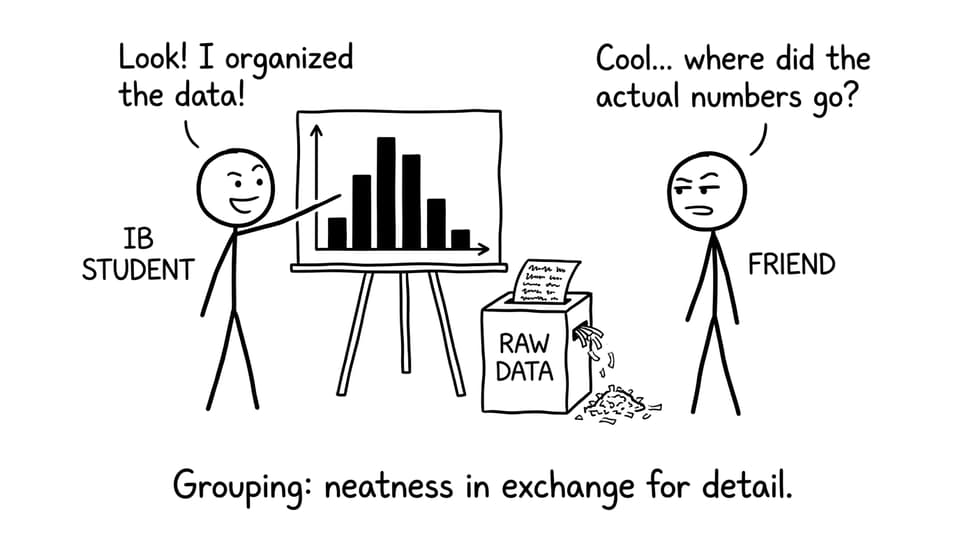
Grouped data feels like tidying your room. You stack everything into neat boxes, step back, and suddenly the mess looks manageable. But when you actually need your favourite pen, you realise something uncomfortable: the boxes don’t tell you where anything is.
That’s the quiet trick behind grouped data in IB Math statistics. It makes large datasets readable in histograms and frequency tables, but it also erases details that examiners expect you to acknowledge. The students who lose marks aren’t usually the ones who can’t calculate. They’re the ones who describe an estimate like it’s a fact.
Quick checklist: what to say the moment you see grouped data
When a question uses grouped classes (like 10-20, 20-30, etc.), train yourself to write or think:
-
The raw values are not known, only intervals and frequencies.
-
Any mean/standard deviation from grouped data is an estimate.
-
The estimate depends on an assumption (usually class midpoints).
-
Shape features (outliers, clusters, gaps) can be hidden by grouping.
-
Conclusions should focus on trends, not exact values.
If you want extra practice for these exact question styles, the Statistics and Probability Questionbank is built to mirror what IB Math examiners actually reward.
What grouped data really does in IB Math
In ungrouped data, you know each observation: every score, height, time, or measurement.
In grouped data, IB Math replaces those exact observations with:
-
a class interval (the “box”), and
-
a frequency (how many values fell into that box).
That swap is the entire point. A histogram becomes readable. A table becomes shorter. Patterns become visible.
But you also lose the ability to answer a simple question: “Where inside the interval were the values?”
For the core graphs and tables, it helps to revise the foundations in SL 4.2 Histograms, CF graphs, box plots notes and then test yourself with exam-style prompts in the matching Histograms and cumulative frequency bootcamp.
Why grouped data loses information (and why examiners care)
The information loss isn’t abstract. It changes what you can know.
You lose exact values, so central tendency becomes an estimate
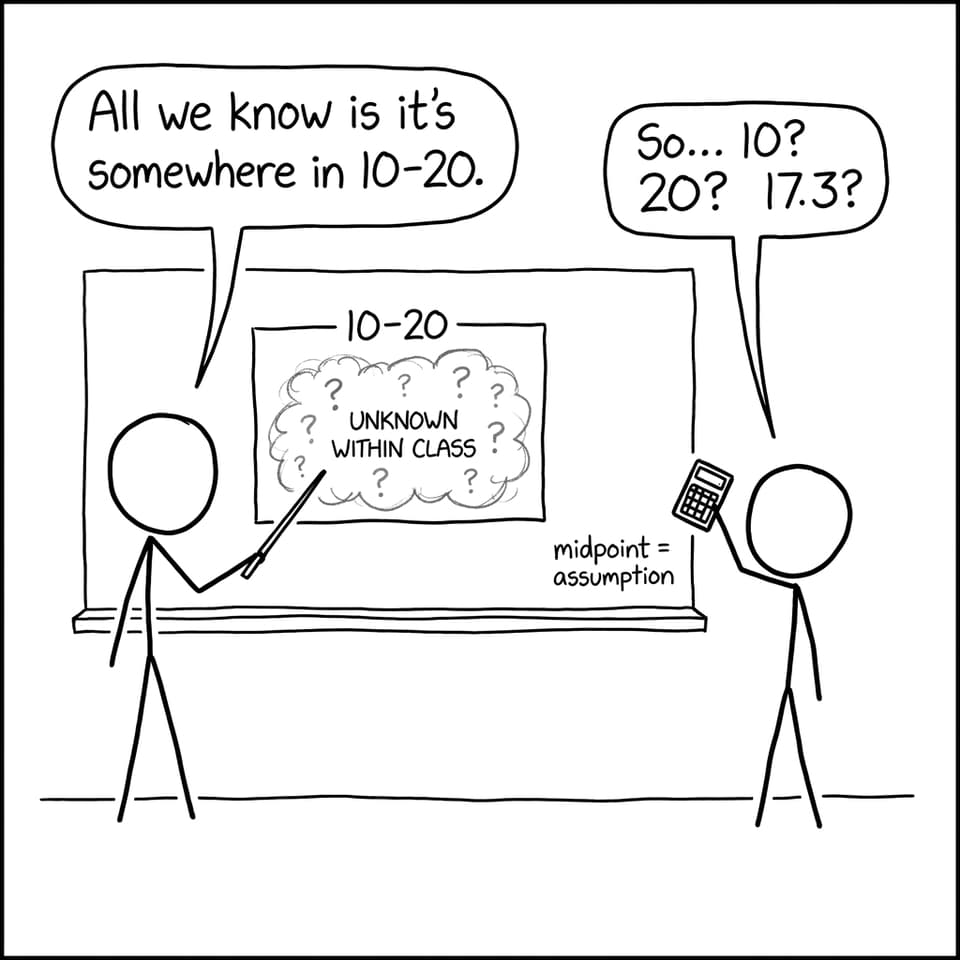
To find the mean of grouped data in IB Math, you typically use class midpoints. That forces an assumption: every value in the interval behaves like the midpoint.
Sometimes that’s reasonable. Sometimes it’s wildly wrong, especially if values cluster near one end of a class. The key is not to panic, but to communicate.
If you need a quick refresher on how central tendency is defined and discussed, use Mean, median, mode notes.
You lose precision on spread, so standard deviation is also approximate
Standard deviation from grouped data inherits the same midpoint assumption. You’re measuring variability of the midpoints, not the original values.
That’s why grouped-data standard deviation is best described as an estimate, and why interpretation must be cautious. If spread and interpretation often feel harder than calculation, Why standard deviation feels harder to interpret than the mean is a useful reset.
You can lose outliers, clusters, and gaps
When classes are wide, extreme values can disappear into the top or bottom interval. Small clusters can melt into a larger bar. A bimodal distribution can look unimodal.
This is also why IB Math questions sometimes hint at class width issues. Seeing that trade-off is part of the assessment, and it connects closely to Why choosing the wrong class width distorts histograms in IB maths.
The most common way students lose marks
It’s not the arithmetic. It’s the language.
Students often write:
- “The mean is 17.4, so the typical value is 17.4.”
when examiners wanted:
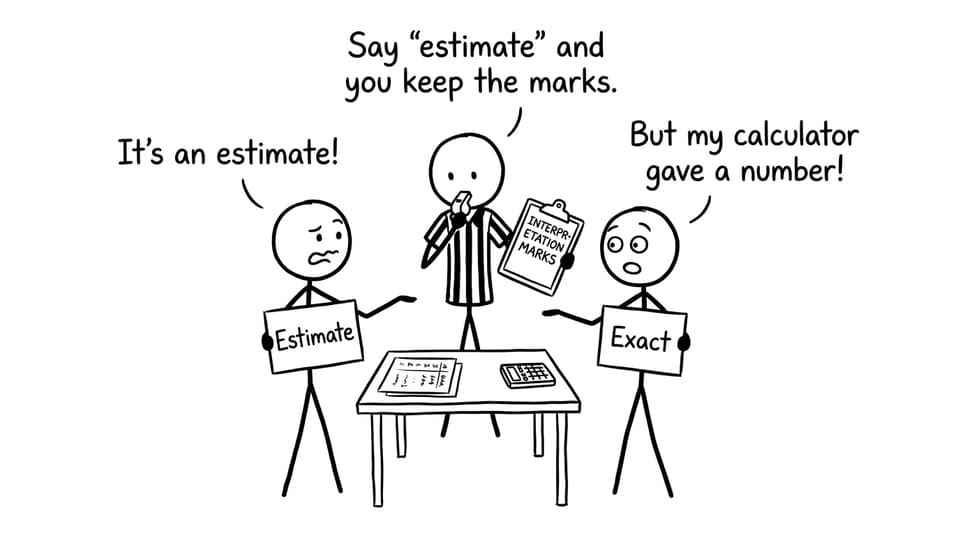
- “The mean is estimated as 17.4 due to grouping, so the typical value is approximately 17.4.”
That single word, estimated, can be the difference between full interpretation marks and a frustrating annotation.
To build that exam-safe habit, it helps to practise with feedback. RevisionDojo’s AI Chat can challenge your wording, and the Grading tools can help you see whether your interpretation sounds precise without pretending grouped data is exact.
How IB Math expects you to write about grouped data
Here’s a reliable sentence template you can adapt in almost any IB Math statistics question:
“Because the data are grouped, the calculated mean/standard deviation is an estimate based on class midpoints, so conclusions should be interpreted approximately.”
Then, focus your interpretation on:
-
comparison (which group is higher/lower),
-
trend (increasing/decreasing), and
-
overall shape (roughly skewed/symmetric),
instead of claims about specific raw values.
If you’re unsure how to approach the wording of a statistics prompt, How to approach statistics questions confidently is a strong guide for turning calculations into marks.
Conclusion: treat grouping as a trade-off, not a shortcut
In IB Math, grouped data is a deal you make with the examiner: you get a cleaner picture of a messy dataset, and in return you admit what the picture cannot show. Once you see that trade-off, statistics questions become calmer. You stop over-claiming. You start writing like a statistician.
If you want to make that habit automatic, RevisionDojo is built for it: practise grouped-data questions in the Questionbank, learn the wording with Study Notes and Flashcards, refine explanations with AI Chat, and pressure-test your skills with Predicted Papers and Mock Exams. Grouping may lose information, but your marks don’t have to.