



Exponential decay in money problems has a special talent: it makes sensible mathematics feel like a prank. You type a perfectly reasonable percentage into your calculator, press enter, and the value falls faster than your confidence.
In IB Math, that uncomfortable moment is not a sign you are bad at modelling. It is evidence that your brain is wired for straight lines, while money problems often follow curves. Depreciation, inflation-adjusted value, and “value after repeated losses” are built to punish linear intuition.
A quick IB Math checklist for spotting exponential decay
Before you calculate anything in IB Math, run this short checklist:
-
Are you told a percentage change per time period (like 12% per year)?
-
Does the quantity change relative to its current value (not the original)?
-
Is the change repeated over equal intervals (years, months, quarters)?
-
Would a straight-line model eventually go negative or feel unrealistic?
If yes, you are almost certainly in exponential decay.
What exponential decay really means (and why it feels unfair)
Exponential decay means “multiply by the same factor each time.” In finance language, it is a constant percentage decrease.
If an asset depreciates by 10% per year, the decay factor is 0.9, so after (t) years the value is:
The counterintuitive part is subtle: you do not lose 10% of the original value each year. You lose 10% of what is left. That makes the early drops feel dramatic, and later drops feel strangely slow.
If you want a clean refresher of the function structure behind this, pair this article with Exponential and logarithmic functions notes (AA SL 2.9).
Why your brain expects linear loss instead
Most students walk into IB Math with a “same amount per year” default.
It is not laziness. It is training. School often starts with arithmetic sequences: add 5 each time, subtract 3 each time, keep it tidy.
Money problems are rarely tidy.
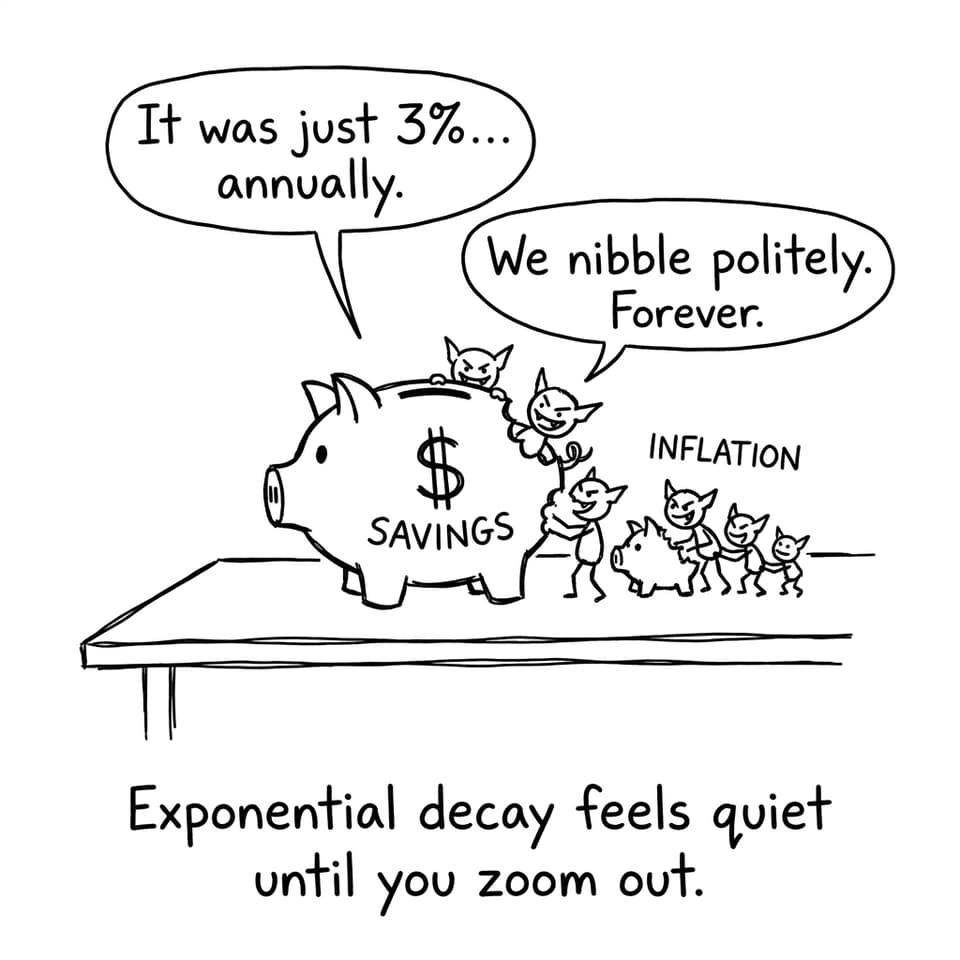
A laptop does not lose $200 every year forever. A currency does not lose exactly 3 units of purchasing power every year. The loss scales with the current value, so the model has to scale too. That is why IB Math leans on exponential models in realistic contexts, especially in Applications and Interpretation.
For modelling practice that looks like exam questions, Modelling functions notes (AI SL 2.5) is a solid next step.
Why decay results feel “too extreme” in IB Math finance questions
Exponential decay often feels extreme because compounding hides in plain sight.
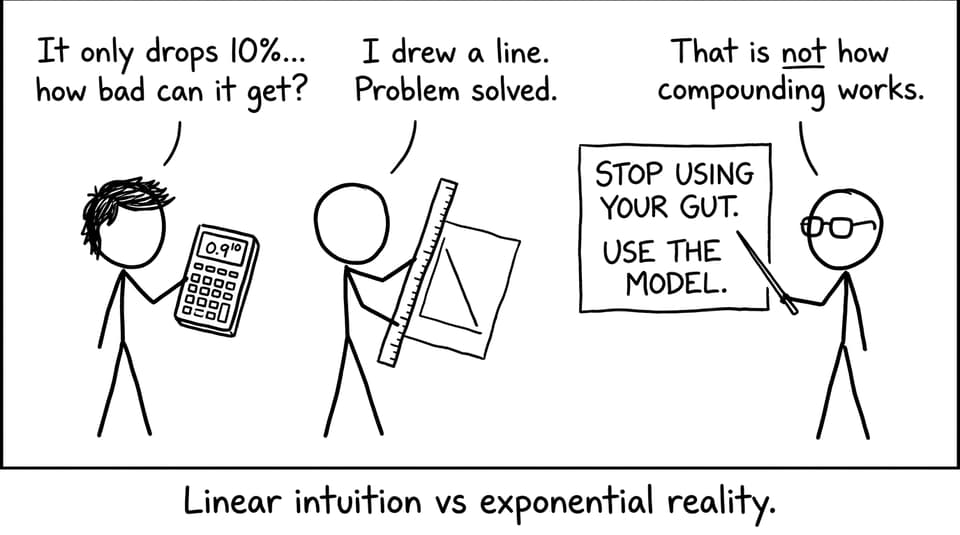
A 10% drop repeated 10 times is not “about 100%,” and it is not “about 0%.” It is (0.9^{10}\approx 0.349). That means roughly 35% remains.
The emotional mistake is treating repeated percentage change like repeated subtraction.
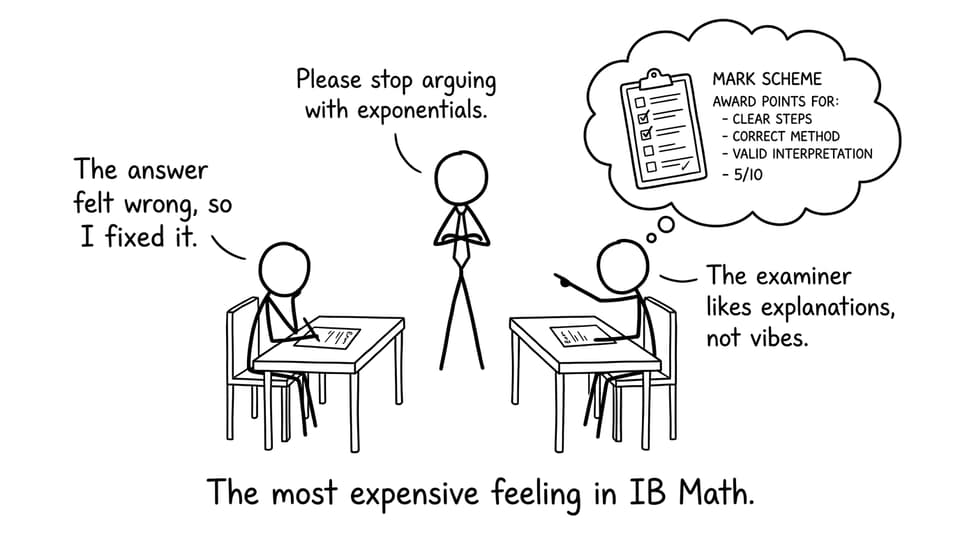
In IB Math, examiners want you to notice the difference and justify your model choice. If your final number seems shockingly small, the correct response is not to “fix” it. The correct response is to explain why exponential decay shrinks fast at first and then levels off.
To see how RevisionDojo phrases that kind of interpretation, read Why exponential growth and decay is easy to misinterpret in IB Maths.
Common IB Math mistakes with exponential decay (money edition)
These come up repeatedly in exam-style marking:
-
Using a linear model (subtracting a fixed amount) instead of a decay factor
-
Writing (1-10= -9) instead of (1-0.10=0.90)
-
Mixing time units (monthly rate with yearly exponent)
-
Applying the percentage change to the wrong base value
-
Rejecting the correct answer because “it feels wrong”
If you want targeted practice, try the Functions questionbank for Math AI or the AA financial applications questionbank (SL 1.4).
How to earn marks: set up, compute, interpret
A reliable IB Math approach looks like this:
-
Define variables (what is (V_0)? what is (t)? units?)
-
Write the factor explicitly (for 12% decay, use (0.88))
-
Match the exponent to time (years, months, etc.)
-
Interpret: say what the number means in context, and whether it is reasonable
If you are unsure what “interpret” should sound like, How to interpret mathematical models in the IB Math IA gives a practical template you can borrow for exam answers too.
Bringing it home with RevisionDojo
Exponential decay feels counterintuitive because it is quiet at first, then relentless, then strangely calm again. That emotional pattern is exactly why it shows up so often in IB Math exams: it reveals whether you can model beyond instinct.
If you want that skill to feel automatic, RevisionDojo is built for it. Use the Study Notes to lock in the model, the Flashcards to remember factors and forms, the Questionbank and Mock Exams to practise under pressure, and AI Chat to debug your setup when a question “looks wrong.” When you are ready to push your timing and accuracy, the Predicted Papers and Grading tools help you train for how marks are actually awarded, and the Tutors can quickly fix recurring misconceptions.
The next time decay feels unfair, treat that feeling as a cue: this is a modelling question, not a vibes question. And in IB Math, that shift is worth marks.