In IB Math, it’s easy to treat domain like a small line you tack on at the end. But in real-world function questions, domain isn’t decoration; it’s the part that proves you understood the story.
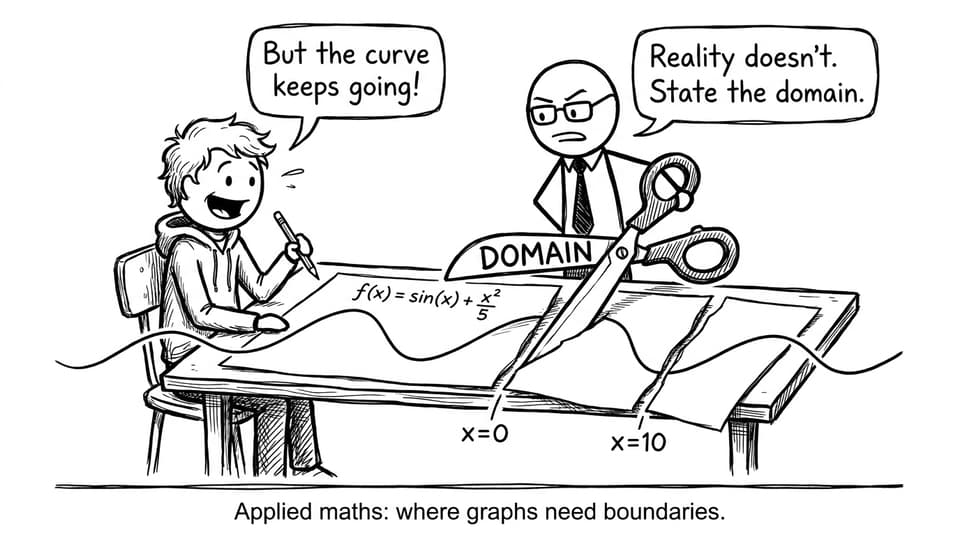
A model can be algebraically perfect and still be wrong in context. That’s the quiet trap in IB Math: the function may work forever, but the situation never does. Time starts somewhere. Populations can’t go negative. Capacity is finite. Domain is how your maths admits that reality has edges.
Domain in IB Math is the “permission slip” for inputs
In IB Math, the domain is the set of input values that are allowed. In pure questions, that often means “where the function is defined” (no division by zero, no negative inside a square root, logs stay positive). But in modelling, domain also means “what values make sense.”
Think of domain as a permission slip. Without it, your model gives answers to questions nobody asked.
If you need a quick refresher on the formal side of domain and range, the notes here are a solid anchor: Functions, domains, range, graphs (AI SL 2.2). AA students can also cross-check the definition and restrictions here: Functions, notation, domain, range (AA SL 2.2).
Quick checklist: how to set a domain in real-world functions
Use this every time you see a context in IB Math:
-
Name the variable (What does (x) represent? Time? Age? Distance?)
-
Write the natural lower bound (Often (x \ge 0) for time, length, mass, money)
-
Write the context upper bound (End of experiment, capacity, valid range of data)
-
Match units (days vs years mistakes can create a fake domain)
-
State it explicitly using inequalities (ex: (0 \le t \le 10))
This is also exactly the mindset expected in modelling topics like Modelling skills (AI SL 2.6) and broader modelling practice.
Why domain matters more in real-world IB Math than “nice” algebra
A function doesn’t know what it’s describing. It will happily output nonsense if you feed it nonsense.
In IB Math modelling, marks often sit in the interpretation layer: defining variables, setting constraints, and explaining what the answer means. Domain is where those marks live because it shows you’re not doing “equations in a vacuum.”
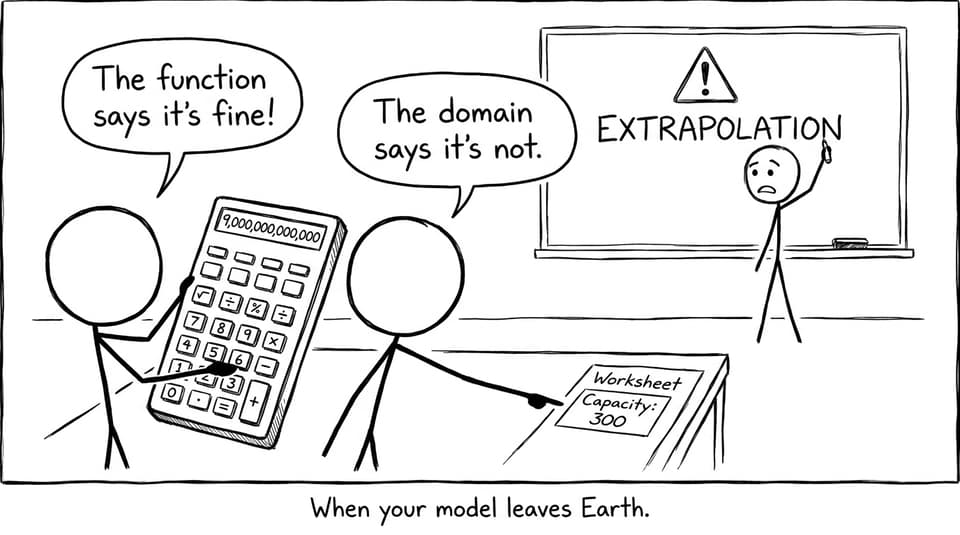
Here’s the key idea: a model is only valid inside the domain that matches the scenario. Any prediction outside that is not “bold” or “extended”; it’s simply invalid.
If you want to see how RevisionDojo frames this examiner logic in a step-by-step process, read How to Approach Math AI SL Modeling Questions.
The most common domain mistakes IB examiners punish
These show up constantly in IB Math, especially in Applications & Interpretation:
Assuming the domain is all real numbers
It’s the default in your head because many classroom functions are built that way. Real scenarios rarely are.
Letting the calculator choose the story
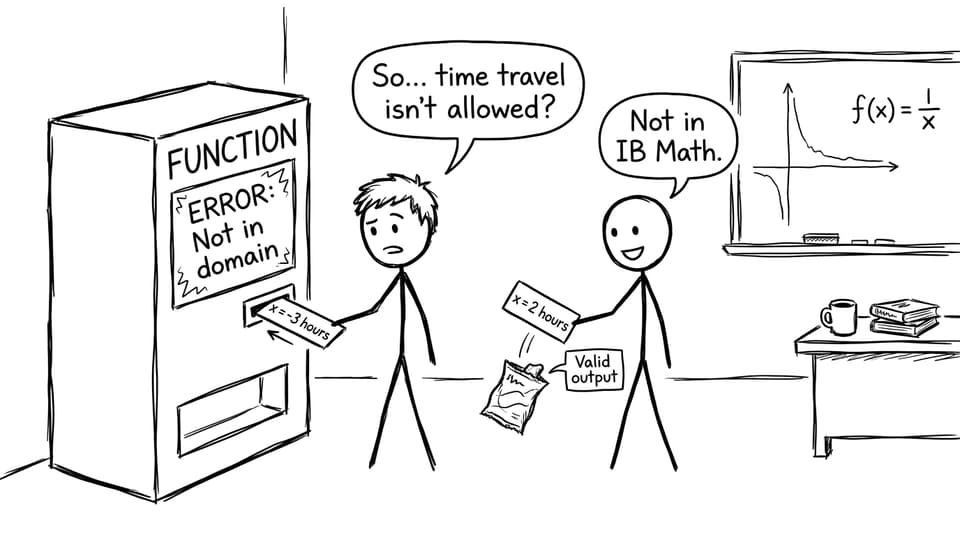
Your GDC will happily evaluate (f(-5)). That doesn’t mean (-5) minutes exists in the problem.
Interpreting outside the domain (the silent mark-loser)
Even if you stated the domain earlier, you can still lose marks if your conclusion uses an input value outside it.
This pattern is closely linked to wider constraint mistakes discussed here: Why Do Students Ignore Constraints in IB Function Models?.
How domain protects your modelling marks in IB Math AI
In IB Math AI, the course leans toward decision-making: choose a model, justify it, interpret it, and admit limitations. Domain is one of the cleanest ways to show limitation without writing a paragraph.
Two students can have the same equation. The one who states and respects domain looks like an analyst. The other looks like someone who memorised regression.
To practise this properly, use RevisionDojo’s SL 2.2 Questionbank: Functions, domains, range, graphs, where you can drill domain decisions under exam-style prompts and get feedback.
A final exam habit: write domain like you write units
The simplest way to stop losing marks in IB Math is to treat domain as part of the answer, not an optional side note. State it. Justify it with one sentence if needed. And never interpret beyond it.
If you want this to become automatic, RevisionDojo is built for exactly that kind of repetition: drill domain and modelling questions in the Questionbank, lock definitions with Flashcards, clarify confusing prompts with AI Chat, and pressure-test your habits in Mock Exams and Predicted Papers. Domain is where real-world marks hide; go collect them.

