

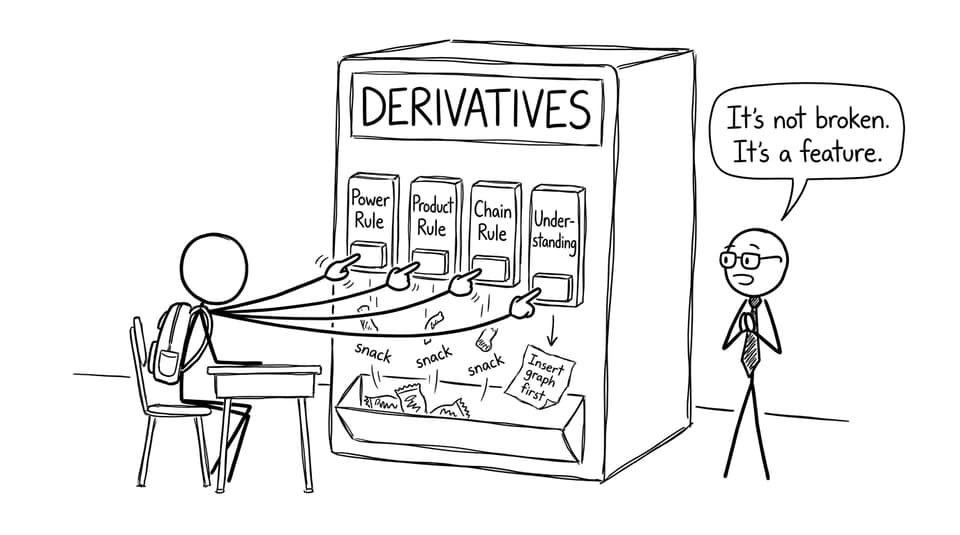
Differentiation often feels like the moment IB Math stops being “math” and becomes “rules.” You sit down with the best intentions, meet the power rule, product rule, and chain rule in quick succession, and suddenly your success seems to depend on whether your memory behaves under pressure.
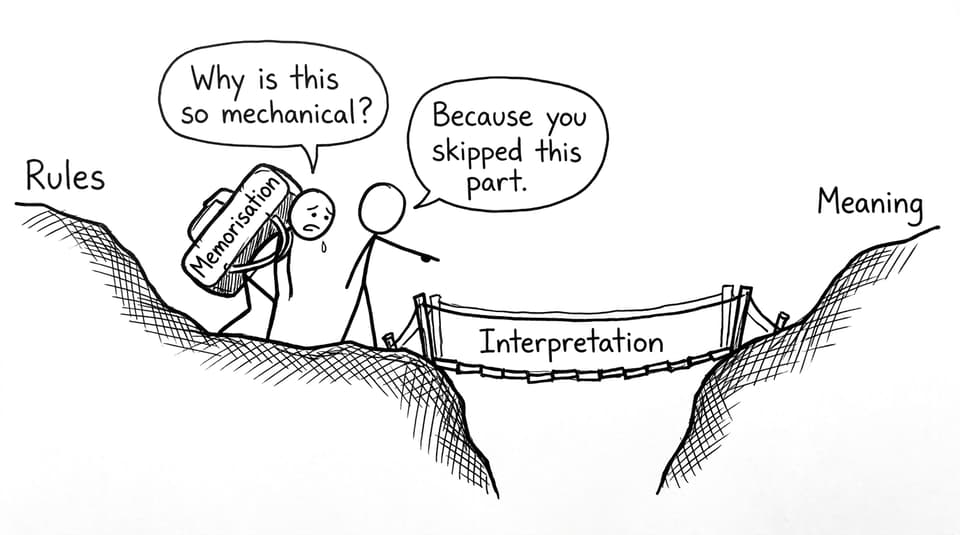
That mechanical feeling is real. But it’s also temporary. And in IB Math, it usually comes from one simple mismatch: you’re taught the shortcuts before you’re allowed to feel why they work.
A quick checklist to stop IB Math differentiation feeling robotic
Use this as a reset before you do your next set of IB Math calculus questions:
-
Name the variables: “What changes?” and “with respect to what?”
-
Identify structure first: sum, product, quotient, composite.
-
Write one interpretation sentence (even if the question doesn’t ask).
-
Sketch a quick curve-and-tangent doodle to anchor meaning.
-
Practice in exam style, not just textbook style.
If you want a clean topic map for where differentiation sits in the course, start with IB Mathematics Analysis and Approaches Resources.
What differentiation is really doing in IB Math
In IB Math, a derivative is not “the answer after applying rules.” It’s a description of change.
A derivative measures how fast one quantity changes compared to another. Graphically, it’s the gradient of the tangent to a curve. In context, it’s a rate like “meters per second” or “cost per item.”
That’s why the earliest calculus lessons matter more than they look. When you revisit the definition and tangent idea, the rules stop feeling like random spells and start feeling like compressed logic. If you need that foundation again, RevisionDojo’s note on SL 5.1--Introduction of differential calculus is a strong refresher.
Why IB Math teaches rules before meaning (and why that backfires)
IB Math has a practical constraint: the syllabus is broad, and students need to differentiate lots of functions quickly. So the course introduces efficient rules early.
The side effect is psychological. When you learn a tool before you understand the problem it solves, the tool feels like the subject.
But differentiation rules are really just shortcuts for one idea: “What happens to the output when the input changes a tiny bit?” The moment you start looking for that idea in each question, the rules become less like instructions and more like labels.
To tighten the “rules” part without losing the “meaning” part, practice alongside clear summaries like SL 5.6--Chain, product and quotient rules Notes.
Why the chain rule feels extra mechanical in IB Math
The chain rule feels robotic because it’s the first time IB Math punishes “surface reading.” A function like (\sin(3x^2+1)) looks like one expression, but it’s actually layers.
The chain rule is IB’s way of testing whether you can see structure: outside function, inside function, and how a change in (x) moves through both.
A useful mental translation is:
-
Outside changes because inside changes.
-
Inside changes because (x) changes.
-
Multiply those changes.
If you’re doing AA HL, implicit differentiation adds another layer of structure-reading. RevisionDojo’s Implicit Differentiation Notes & Questions (HL) is a good place to practice that skill with IB-style prompts.
The real reason you lose marks: interpretation, not differentiation
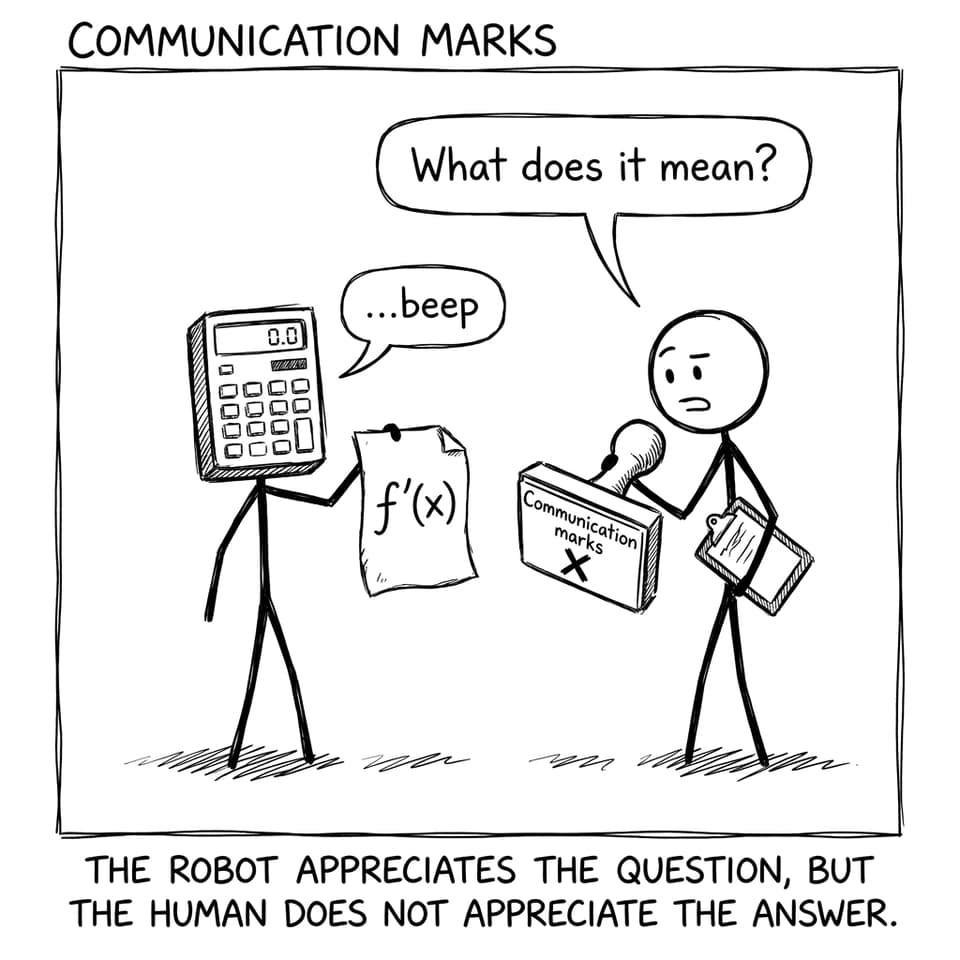
Many IB Math students can compute (f'(x)) correctly and still drop marks because the question wasn’t only asking for a derivative. It was asking what the derivative means.
Examiners reward communication: stating what increases, what decreases, what a positive derivative implies, and what a stationary point represents in context. Vague lines like “the derivative is increasing” often don’t meet the wording standard because they don’t connect math to meaning.
That’s where targeted exam practice helps. Instead of doing 30 random derivative drills, do 10 questions where you must write an interpretation sentence every time. RevisionDojo’s Calculus - IB Questionbank is built for that kind of repetition with feedback.
How IB Math exam questions quietly raise the difficulty
In IB Math, differentiation rarely appears alone. It’s often hidden inside tasks like:
-
linking a derivative to a graph’s behaviour
-
showing where a function increases/decreases
-
justifying max/min points
-
setting up optimisation models
That’s why it can feel “easy in drills, hard in exams.” The differentiation step is only one piece.
If optimisation is where things start to feel overwhelming, pair your derivative practice with How to Use Derivatives for Optimization Problems and the deeper explanation in Why Is Optimisation One of the Hardest Topics in IB Maths?.
Bringing it together (and using RevisionDojo to make it stick)
Differentiation feels mechanical in IB Math because you’re handed the machinery before you’re shown the landscape it’s meant to measure. The fix isn’t “memorise harder.” It’s to attach every rule to structure, every derivative to an interpretation sentence, and every calculation to a graph-level story about change.
RevisionDojo helps you build that loop deliberately: Study Notes to rebuild meaning, Flashcards to make rules effortless, AI Chat to ask “what does this represent?” without embarrassment, and Grading tools to sharpen communication. Then you consolidate with the Questionbank, timed Mock Exams, and Predicted Papers-style practice, and even support from Tutors when a topic won’t click. If differentiation still feels mechanical, you don’t need more tricks--you need a better feedback cycle, and RevisionDojo is built for exactly that.