



The moment IB Math stops feeling like “math you can finish”
There’s a specific kind of panic that only shows up in IB Math when infinite series arrive. You see a tidy expression like (1 + \tfrac12 + \tfrac14 + \tfrac18 + \cdots) and your brain tries to do what it always does: finish the job. Add it up. Get the answer. Move on.
But infinity refuses to be “finished.” And that’s why convergence feels so unintuitive: it asks you to accept a result without ever completing the process.
In IB Math, this topic isn’t really testing whether you can plug into a formula. It’s testing whether you can switch mental gears from counting to limits.
Quick checklist: what to confirm before you trust any answer
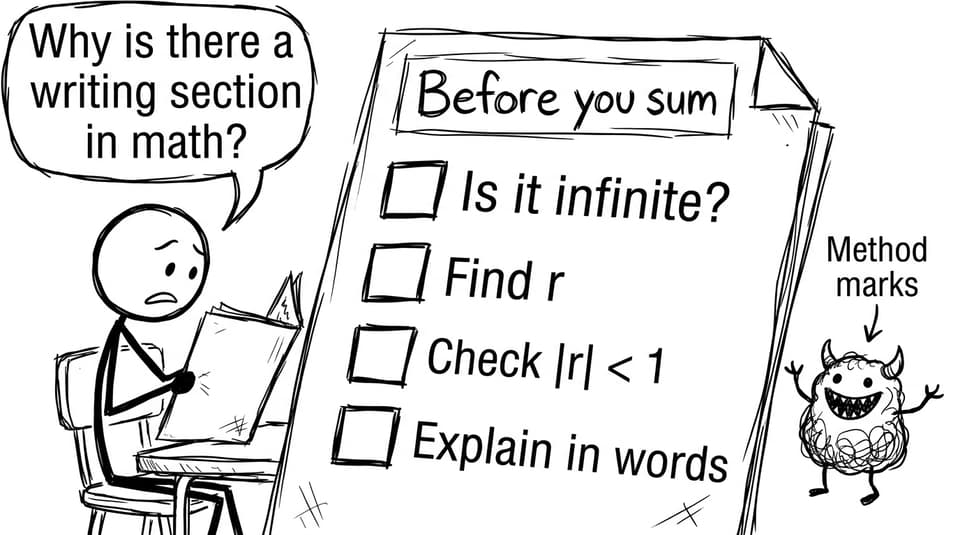
Use this quick reset whenever an IB Math series question starts to feel slippery:
-
Is it a sequence (terms) or a series (sum)?
-
Is the sum finite or to infinity?
-
Can you identify (a) (first term) and (r) (common ratio)?
-
Have you checked the condition (|r| < 1) before summing to infinity?
-
Can you explain convergence in one sentence (not just compute it)?
If you want a clean “home base” for this skill, keep Geometric Series Explained for IB Maths (AA SL & HL) open while you practice.
What convergence actually means (and why wording matters in IB Math)
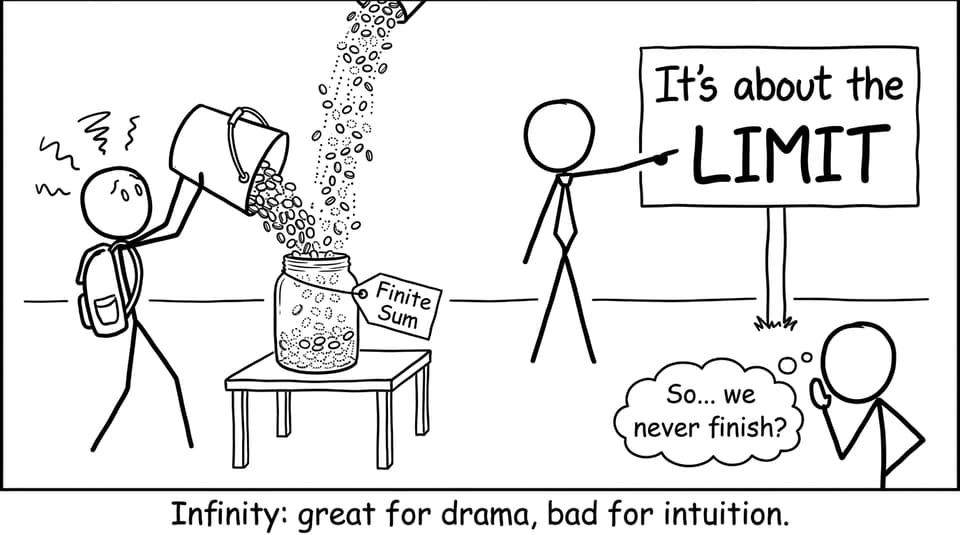
A series converges when its partial sums approach a fixed finite value as you add more terms. That sentence is doing heavy lifting.
Notice what it doesn’t say: it doesn’t say you ever reach the value by completing the sum. In IB Math, convergence is a statement about limiting behaviour. You’re not finishing an infinite calculation; you’re observing what the totals are heading toward.
This is why exam questions often include explanation marks. The examiner wants to see that you understand the story: partial sums, trend, limit.
For a syllabus-aligned explanation and practice, use the AA notes on Sum of infinite geometric sequence (SL 1.8).
Why “adding forever” feels impossible to your intuition
Everyday arithmetic trains a simple rule: add positive numbers and the total grows. So when IB Math asks you to believe that infinitely many positive terms can still land on a finite answer, it feels like a magic trick.
But it’s not magic. It’s a trade.
You’re trading quantity of terms for size of terms. If the terms shrink fast enough, the extra contribution becomes negligible. The sum keeps increasing, but by smaller and smaller amounts, until the increase is practically invisible.
That’s also why the IB loves geometric examples: they make “shrinking fast enough” easy to see.
Why the (|r| < 1) condition is the whole point
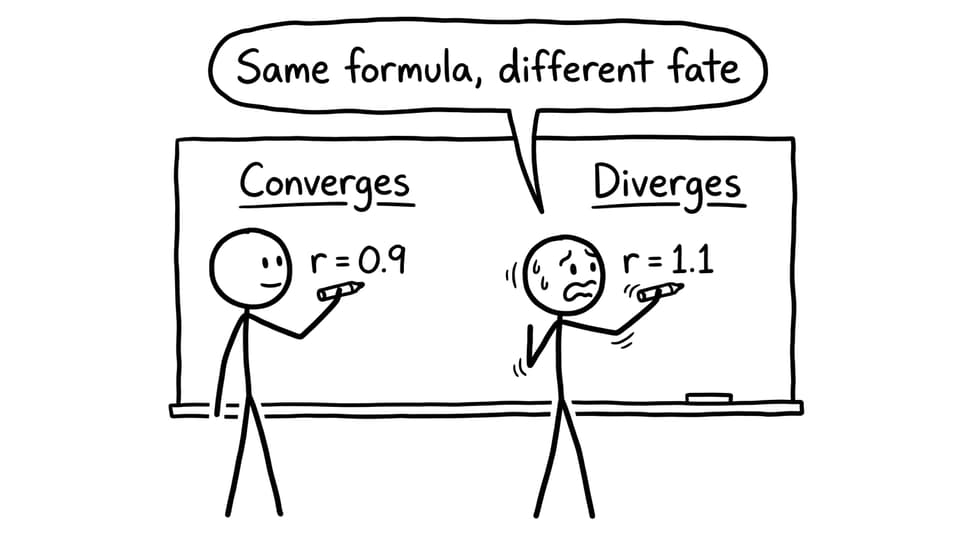
In IB Math, infinite geometric series work because each term is multiplied by the same ratio (r). If (|r| < 1), the terms decay toward zero quickly. If (|r| \ge 1), they don’t decay, and the sum can’t settle.
That condition isn’t a side note. It’s the logic.
-
(r = 0.9): still shrinking, so the total can stabilize.
-
(r = 1): terms don’t shrink, so the sum grows forever.
-
(r = -0.9): terms shrink but alternate, so the sum can still converge.
-
(r = 1.1): terms grow, so divergence is inevitable.
To strengthen this part fast, practice the topic directly in SL 1.3 Geometric sequences and series and then switch to repetition with the SL 1.3 Questionbank.
How IB Math usually tests convergence (and where marks disappear)
Most IB Math questions on convergence don’t fail students on algebra. They fail students on habits. Common tasks include:
-
Deciding whether a series converges (often before calculating anything)
-
Using geometric sum-to-infinity ideas correctly
-
Explaining why a series converges or diverges
-
Interpreting the result in a context (especially modelling)
A useful companion read is How to Approach Sequences and Series Effectively (Flashcards), because it focuses on recognition and method, not memorising.
The classic mistakes
-
Using the sum-to-infinity formula without checking (|r| < 1)
-
Treating a finite sum like an infinite sum (or the reverse)
-
Confusing sequence vs series language
-
Writing only a final answer and losing method/explanation marks
When you’re revising, combine RevisionDojo Study Notes for clarity with the Questionbank for volume, then use AI Chat when a step “almost” makes sense but not quite.
A calmer way to build intuition (and marks) with RevisionDojo
Convergence feels unintuitive in IB Math because it asks you to trust a limit more than a finished calculation. The fix isn’t more memorisation; it’s more exposure to the same idea in different outfits.
Use RevisionDojo as your practice loop: start with Study Notes, drill with the Questionbank, lock in conditions using Flashcards, ask AI Chat the one question you’re embarrassed to ask in class, then pressure-test with Mock Exams and Predicted Papers. If you’re working on written reasoning, the Tutors and Coursework Library can keep your explanations sharp and exam-ready.
When infinite series finally click, they don’t feel like a paradox. They feel like a quiet skill you can rely on in IB Math, especially when everyone else is still arguing with infinity.