

Continuity is one of those IB Math ideas that feels like philosophy until it steals marks.
You can be excellent at substitution, confident with algebra, and still lose points because your solution assumes a function behaves nicely at a boundary. In IB Math, continuity matters because it’s the bridge between what a formula says, what a graph shows, and what a limit promises. When that bridge has a crack, everything built on top of it (especially calculus) becomes shaky.
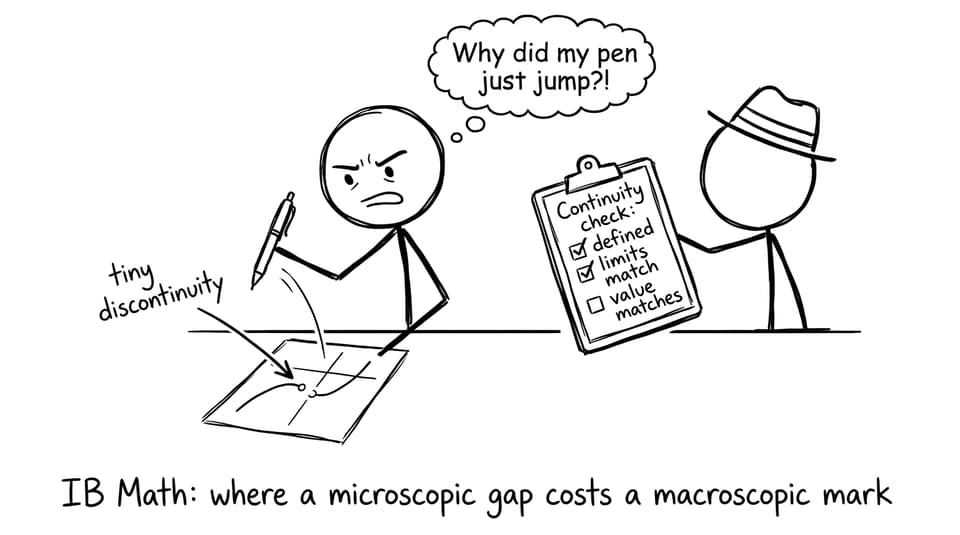
The IB Math definition that keeps showing up
In IB Math, a function is continuous at (x=a) when three things agree.
The continuity checklist
To show (f(x)) is continuous at (x=a):
-
Defined: (f(a)) exists.
-
Limit exists: (\lim_{x\to a} f(x)) exists (left and right match).
-
They match: (\lim_{x\to a} f(x) = f(a)).
This is why continuity questions feel different from “just calculate” questions. They’re asking you to compare behavior near a point with the actual value at the point.
If you want a clean limits refresher before continuity, start with Notes for SL 5.1--Introduction to Limits.
Why continuity matters so much in IB Math exams
Continuity is tested so often in IB Math because it reveals whether you understand functions as objects with behavior, not just expressions you plug numbers into.
Here’s what continuity unlocks:
-
Graphs and interpretation: You can justify holes, jumps, asymptotes, and removable discontinuities with proper language.
-
Piecewise function accuracy: You can handle boundary points without guessing.
-
Calculus foundations: Differentiation and many calculus arguments assume smooth, predictable behavior.
RevisionDojo’s IB Mathematics Analysis and Approaches resources organize these links between functions and calculus so you see the pattern instead of memorizing rules.
Where IB Math continuity questions usually hide
In IB Math, continuity most often appears in questions that look innocent.
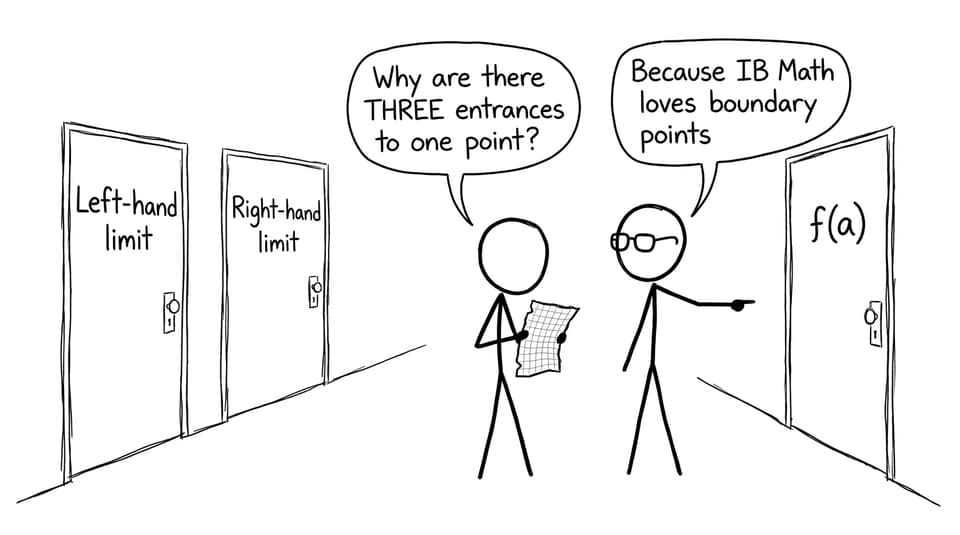
Piecewise boundaries
A classic setup: a piecewise function with a “join” at (x=a). The marks typically reward a complete argument:
-
compute left-hand limit
-
compute right-hand limit
-
compare them
-
then compare to (f(a))
The quickest way to get comfortable is doing many variations. Try the SL 2.2 Functions questionbank for boundary-style reasoning.
Limits that exist even when the function doesn’t
A function can be undefined at (x=a) but still have a limit there. That difference is a frequent IB Math trap.
If limits still feel hard to picture, read Why Are Limits So Hard to Visualise in IB Maths?.
Common continuity mistakes (and how to fix them)
Most continuity errors in IB Math come from skipping one comparison.
-
Only finding (f(a)): That’s just the “defined” condition.
-
Only finding a limit: You still must connect it to (f(a)).
-
Forgetting one-sided limits: Especially at boundaries.
-
Mixing up continuity and differentiability: They’re related, but not identical.
A practical fix is to force yourself into a sentence template: “(f(a)) is __. The left-hand limit is __, the right-hand limit is __, so the limit is __. Since __, the function is (not) continuous.”
For heavy calculus practice where continuity and limits keep resurfacing, use the Calculus topic hub and then drill with the Calculus questionbank.
A quick exam routine for IB Math continuity
Use this short loop when revising IB Math continuity:
-
Read one explanation in RevisionDojo Study Notes (aim for clarity, not speed).
-
Do 5 targeted questions in the Questionbank.
-
Use AI Chat to ask “Which condition failed and how do I state it?”
-
Convert recurring errors into Flashcards (especially the sentence templates).
If you’re building a broader plan around this, The Ultimate IB Math Study Routine for Busy Students pairs well with continuity practice.
Continuity is small, but it moves everything
In IB Math, continuity is the quiet rule that decides whether your algebra connects to the real behavior of a function. Once you treat it as a habit (defined, limit, match), it stops being abstract and starts becoming a reliable way to earn marks.
To make continuity feel automatic, use RevisionDojo as your loop: learn with Study Notes, drill with the Questionbank, lock in language with Flashcards, and clean up explanations with AI Chat. Add Mock Exams, Predicted Papers, and Tutors when you want full exam pressure with real feedback. That’s how continuity stops being a chapter and becomes part of how you think in IB Math.