


Why does this feel like a new topic when it isn’t?
You learn exponential growth early in IB Math. It’s tidy. A curve rises, you write a formula, you move on.
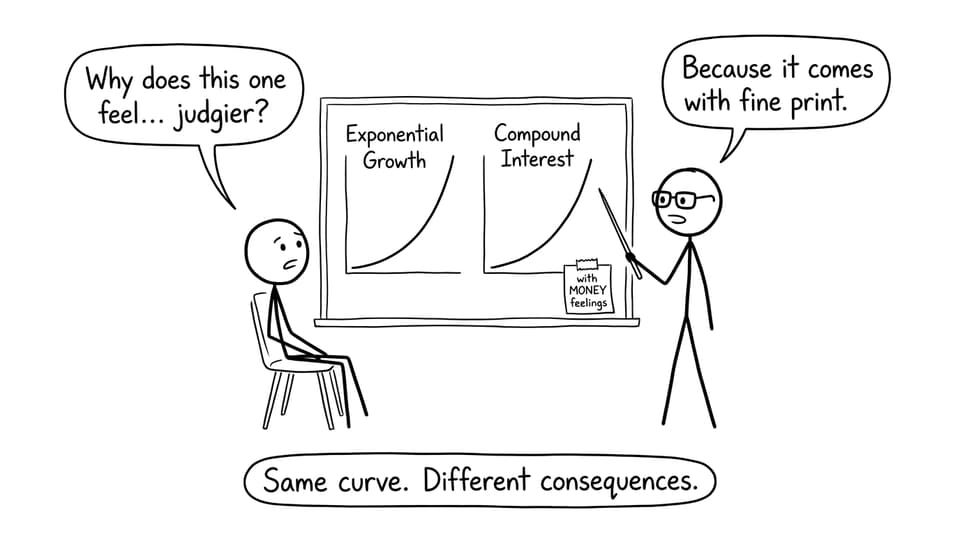
Then compound interest shows up. Same curve, same structure, yet it somehow feels stricter, wordier, and more dangerous. Like the question is quietly waiting for you to misread one phrase and lose marks.
That reaction is normal. In IB Math, compound interest is exponential growth wearing real-world clothing. And the outfit comes with pockets full of conditions.
Quick checklist: what to identify before you calculate
Before you touch a calculator, train yourself to scan for five things (this alone can rescue a lot of IB Math marks):
-
Principal: what is the starting amount?
-
Rate: nominal or effective?
-
Compounding: yearly, monthly, quarterly?
-
Time unit: years, months, quarters?
-
Interpretation: do they want a number, a comparison, or a comment?
If you want targeted practice, the AI finance topic hub is built around these exact decision points.
Exponential growth is clean; compound interest is messy on purpose
Pure exponential growth problems in IB Math often look like this: “A population grows by 4% per year.” There’s nothing to debate. Your model is the whole story.
Compound interest adds a second layer: meaning. The model still looks exponential, but you are now modelling a contract. Contracts hide assumptions.
That is why compound interest feels different from exponential growth in IB Math. Not because the algebra changed, but because the reading did.
If exponential models still feel slippery, revisit a simple walkthrough like Example of exponential growth (explained simply), then come back to finance with that clarity.
The compounding period is the trap most students don’t see
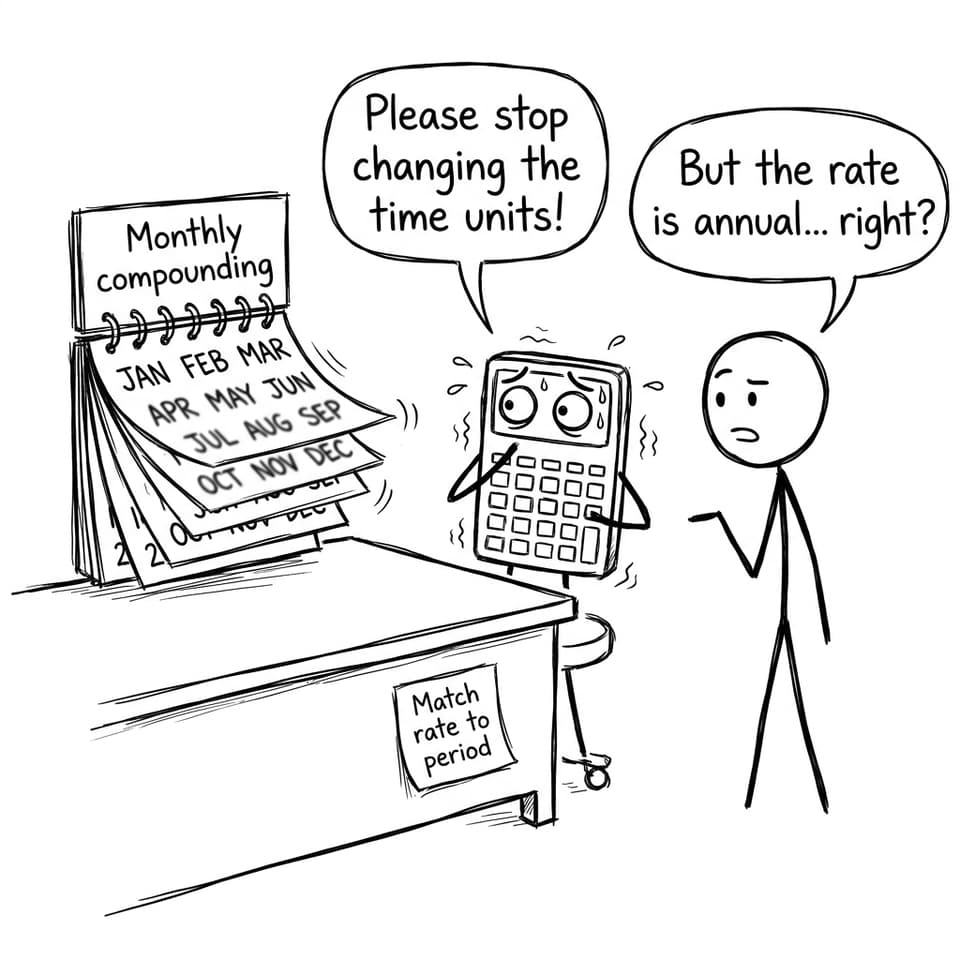
The most common “I knew the method” mistake in IB Math finance questions is a mismatch between the rate and the time unit.
An annual interest rate compounded monthly means:
-
the growth factor per month is (1+\frac{r}{12})
-
the number of periods is (12t) if (t) is in years
Students often keep (r) annual but treat (t) as months (or the reverse). The calculation can look sophisticated and still be wrong.
RevisionDojo has lots of exam-style practice where this is the entire point of the question, especially in Loan repayments and amortization questionbank.
Why memorising the formula doesn’t protect you in IB Math
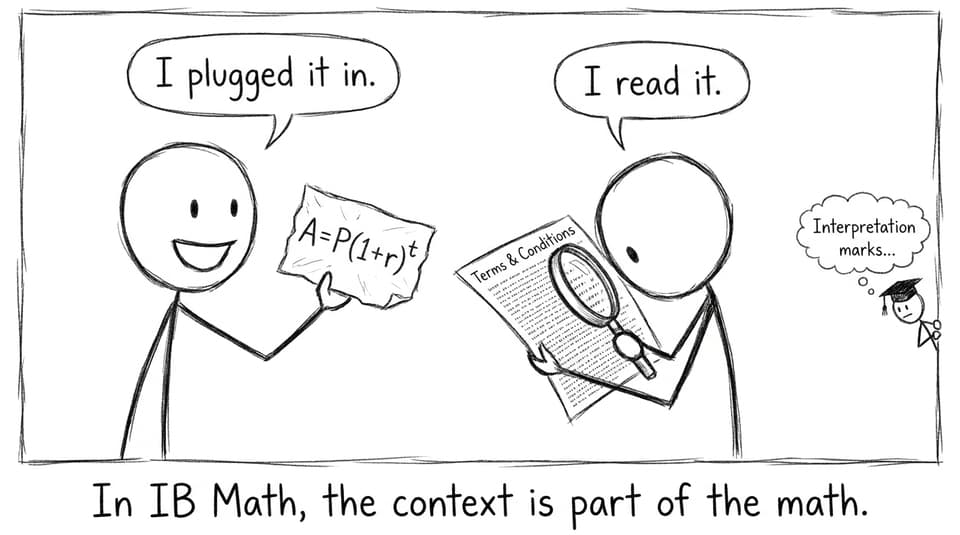
Many students carry a compound interest formula like a lucky charm. But in IB Math, the marks often sit in the decisions around the formula:
-
Is the rate nominal or effective?
-
Is compounding discrete or continuous?
-
Are deposits made at the start or end of each period?
-
Does rounding change the final comparison?
This is exactly why the IB tends to place compound interest more comfortably inside modelling-heavy contexts (especially in AI). You are being assessed on judgement, not just substitution.
A good support is the IB Math AI data booklet for the standard forms, but pair it with interpretation practice from Modelling functions notes.
Small changes feel dramatic because exponential growth is sensitive
Compound interest also feels emotionally different because tiny tweaks in rate or time create visibly different outcomes.
A 0.5% rate change barely registers in a linear model. In an exponential model, that “barely” repeats again and again. After enough periods, it stops being barely.
In IB Math, examiners like this sensitivity because it invites commentary: Which plan is better long-term? Is the final value reasonable? What happens if inflation changes? That’s why practice sets in the Math AI course page tend to ask for conclusions, not just numbers.
Exam tips: how to make compound interest feel like “just exponentials” again
To make compound interest feel less like a different universe in IB Math, use a repeatable routine:
-
Rewrite the rate per period before you write the model.
-
Rewrite time in number of periods (months, quarters, years).
-
Delay rounding until the final line.
-
Sanity-check: does the amount grow or shrink, and does that match the context?
-
If asked to “comment,” write one sentence about trend and one about limitations.
For definition-level accuracy (rate vs factor, nominal vs effective), How to use flashcards to learn IB Math definitions is a surprisingly high-impact habit.
Bringing it home: make IB Math finance feel predictable
Compound interest feels different from exponential growth in IB Math because it adds human constraints: time units, compounding rules, and interpretation marks. Once you treat the wording as part of the model, it becomes predictable again.
If you want that predictability under exam conditions, RevisionDojo is built for it: practice with the Questionbank, lock in concepts with Study Notes and Flashcards, stress-test your understanding with Mock Exams and Predicted Papers, and use AI Chat plus Grading tools to fix mistakes quickly. Compound interest is still exponential growth. With the right practice, it can feel that way again in IB Math.