


Why do vector equations of lines cause so many errors in IB Math?
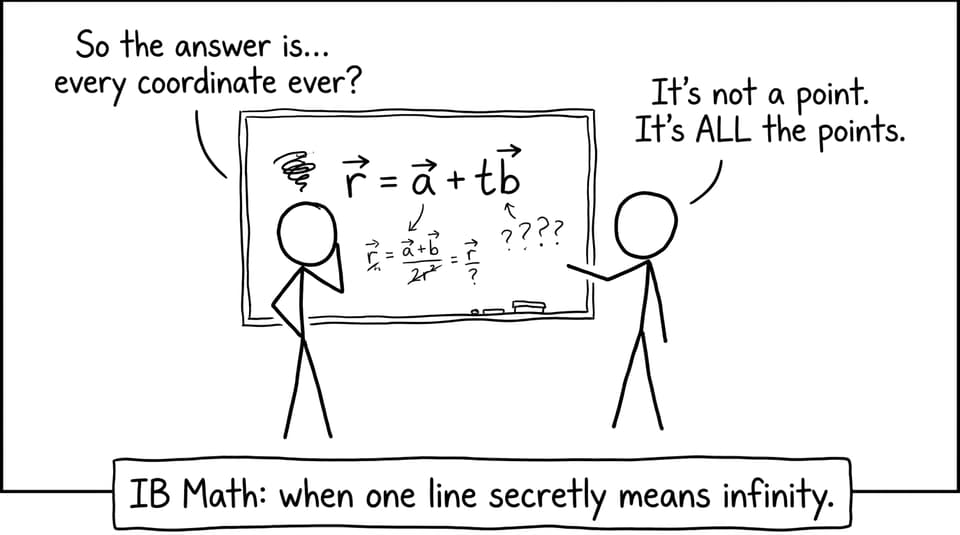
The first time many students meet a vector equation of a line in IB Math, it feels almost too neat:
One short line of symbols… and somehow it represents an entire geometric object in 3D space. That’s the trap. In exam conditions, your brain wants one equation == one point == one answer. But vector form is not a single answer. It’s a machine that generates infinitely many points.
That mismatch between what you think the equation is saying and what it actually says is where most marks disappear.
Quick checklist before you touch the algebra (IB Math)
Keep this micro-checklist in your head whenever a vector line question shows up in IB Math:
-
Identify a point on the line (position vector (\mathbf{a}))
-
Identify the direction (direction vector (\mathbf{b}))
-
Name the parameter clearly (usually (\lambda), but sometimes (t))
-
If there are two lines, use two parameters ((\lambda) and (\mu))
-
Convert forms only after you know what information must stay the same
If you want a clean refresher on how the geometry connects to the symbols, use How to Connect Vectors and Geometry in IB Math AA.
The equation is a “point generator,” not a point
In IB Math, (\mathbf{r}) is a position vector for a general point on the line. That means (\mathbf{r}) changes as (\lambda) changes. Students lose marks when they treat (\mathbf{r}) like a fixed coordinate.
A good mental model: (\mathbf{a}) is where you start, (\mathbf{b}) is the direction you walk, and (\lambda) is how many “steps” you take (including backwards when (\lambda<0)).
If you need structured practice in this exact style, go straight to AHL 3.14 Vector equation of line Questionbank or the parallel AI topic AHL 3.11 Vector equation of a line in 2D and 3D Questionbank.
The most common mix-up: position vector vs direction vector
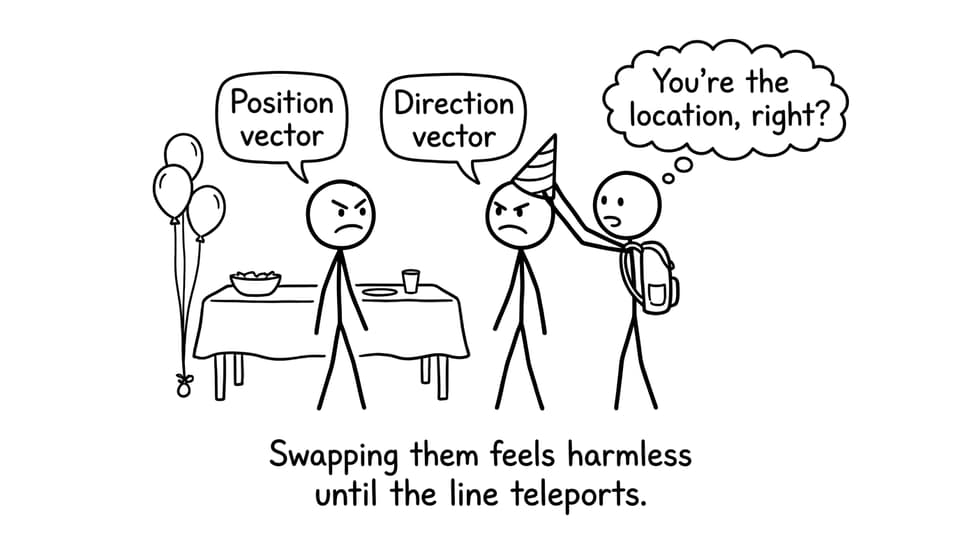
This is the classic IB Math slip: swapping (\mathbf{a}) and (\mathbf{b}).
-
(\mathbf{a}) anchors the line to a location (a specific point)
-
(\mathbf{b}) tilts the line (a direction)
They are not interchangeable. A wrong swap can still look “reasonable” algebraically while describing a completely different line.
To build intuition, it helps to revisit the fundamentals: AHL 3.12 Vector definitions Notes.
Parameters feel abstract because students try to eliminate them too early
A parameter is not an enemy. In IB Math, (\lambda) is often the meaning.
Where students stumble:
-
They try to eliminate (\lambda) immediately (without knowing why)
-
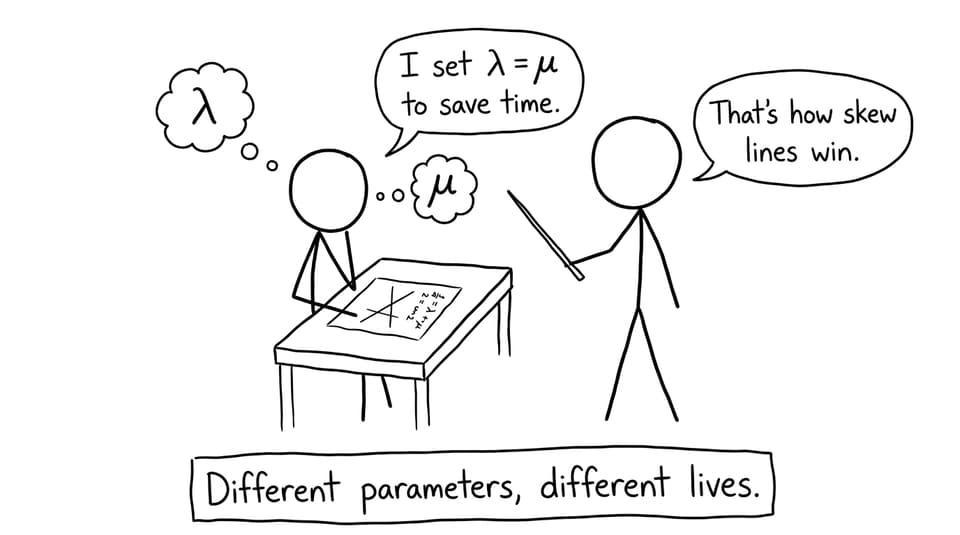
They forget that each line gets its own parameter in intersection questions
-
They solve for (\lambda) but never interpret what it means (like whether a point really lies on the line)
A practical habit: plug in (\lambda=0) and (\lambda=1) quickly to generate two points. Even a rough sketch based on those two points can prevent a whole chain of errors.
Converting between vector, parametric, and Cartesian forms is a “translation” task
IB Math questions love conversions because they test flexibility, not memorisation.
-
Vector form shows structure: start point + direction
-
Parametric form makes components explicit
-
Cartesian (symmetric) form highlights ratios and can simplify some geometric reasoning
Mistakes happen when conversions are done mechanically. One sign error in a component becomes a different line. One forgotten restriction (like a zero component in the direction vector) can make your Cartesian form invalid.
For aligned explanations and examples, use AHL 3.14 Vector equation of line Notes and Videos for AHL 3.14 Vector equation of line.
Intersections are error-prone because they require two separate stories
To find an intersection, you are telling two line stories at once:
Then you equate components and solve for (\lambda) and (\mu). The biggest exam error in IB Math: assuming (\lambda=\mu) or forgetting to introduce (\mu) at all.
If you want extension context (because intersection questions often sit next to line relationships), AHL 3.15 Classification of lines Notes is a helpful companion.
How RevisionDojo helps you stop losing “silly” vector marks
Vector line questions reward calm structure. RevisionDojo is built for that rhythm: learn, practise, check, repeat.
-
Use the Study Notes and Videos to rebuild meaning, not just steps.
-
Drill with the Questionbank until the setup becomes automatic.
-
Use Flashcards for quick recall of forms and interpretations.
-
Ask AI Chat to diagnose where your setup went wrong (especially with parameters).
-
Use Grading tools to see how method marks are actually awarded.
-
If you’re pushing for top grades, add Mock Exams and Predicted Papers (for exam-style pacing without panic).
-
If you’re stuck in a loop, the Tutors feature can reset your approach fast.
For broader vector confidence in IB Math, read Understanding Vectors in IB Math HL: A Complete Guide for Success and the mindset piece Why Does Vector Geometry Feel So Different from Algebra in IB Maths.
Closing: the real reason this topic hurts (and how to flip it)
Vector equations of lines cause errors in IB Math because they look like algebra but behave like geometry. When you treat (\mathbf{r}=\mathbf{a}+\lambda\mathbf{b}) as a story about movement (start here, go this way, slide by (\lambda)), the confusion fades quickly.
If you want that understanding to hold under exam pressure, build a simple loop on RevisionDojo: review the AHL 3.14 notes, practise in the Questionbank, and use AI Chat plus Grading tools to diagnose mistakes before they become habits. That’s how IB Math vector questions stop being a mark trap and start becoming predictable.