


Trigonometric identities don’t usually feel hard while you’re calmly revising. They feel hard at the exact moment you need them most: when the clock is loud, your algebra is messy, and every identity looks like it’s wearing the same disguise.
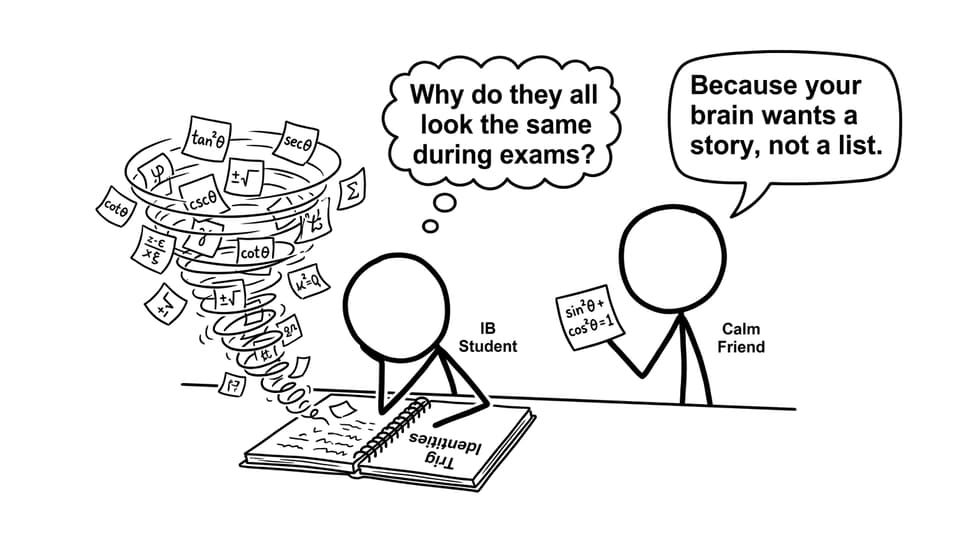
That’s the hidden frustration of IB Math. It’s not that the identities are impossible. It’s that the exam asks you to recognise relationships under pressure, not recall a list like a song lyric. And when you’ve learned trig identities as “rules to remember,” your brain has nothing sturdy to grab.
What a trigonometric identity is really doing in IB Math
A trigonometric identity is an equation that is true for all values (where both sides are defined). In IB Math, identities are basically a translation tool: they let you rewrite an expression into a form that’s easier to simplify, prove, solve, differentiate, or integrate.
So the real skill isn’t “knowing many identities.” It’s knowing why a few core ones are powerful, and how to spot when an expression is asking for them.
If you’re building the conceptual base, start with the unit-circle side of trig in RevisionDojo’s topic pages, especially SL 3.5: Unit circle definitions of sin, cos, tan and the broader Geometry and Trigonometry hub.
Quick checklist: how to make trig identities stick
Use this short checklist before your next IB Math session on identities:
-
Anchor everything to sin²θ + cos²θ = 1
-
Convert “fancy trig” back to sin and cos when stuck
-
Practice recognition: same identity, different clothing
-
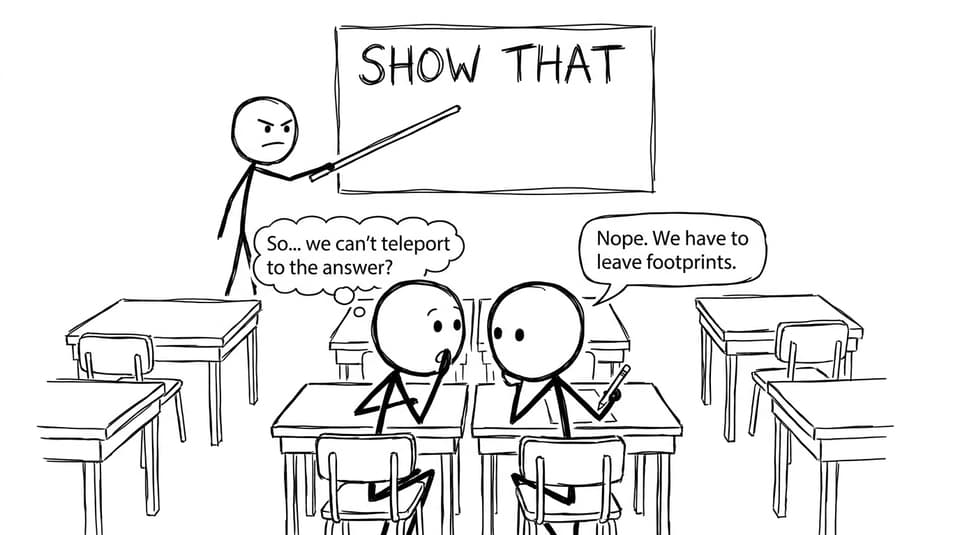
For “show that” questions, simplify one side at a time
-
Turn your mistakes into spaced repetition using RevisionDojo Flashcards
Why memorising identities collapses under exam pressure
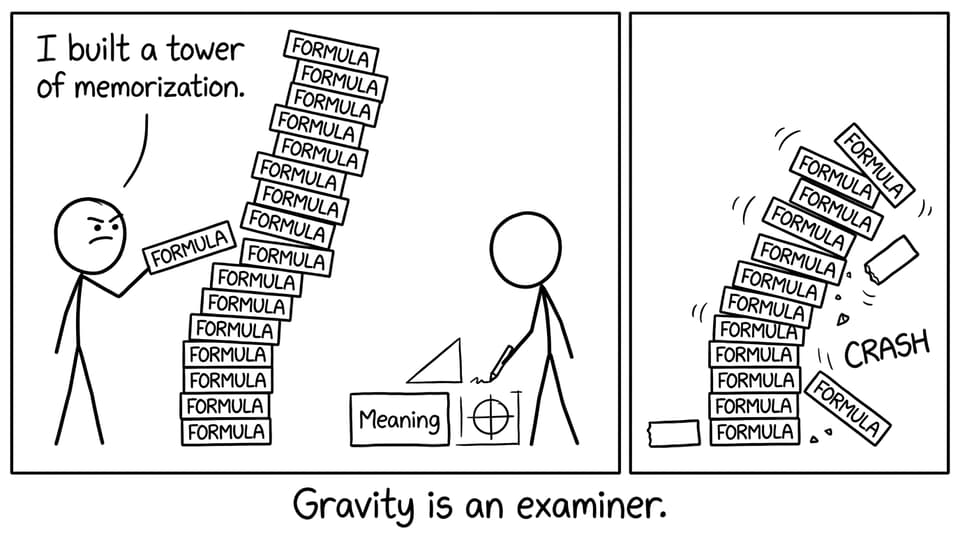
Rote memorisation creates a fragile kind of knowledge: you can repeat it, but you can’t navigate with it. Under pressure, the mind does pattern-matching. If you’ve only stored identities as isolated lines, you’ll confuse similar structures:
-
tan vs cot
-
1 + tan²θ vs 1 - sin²θ
-
cos(2θ) in its multiple equivalent forms
The exam exploits this. Not in a cruel way, but in a very IB way: it rewards students who understand structure.
A practical way to train this is targeted repetition. RevisionDojo’s Geometry & Trigonometry Questionbank gives you exam-style identity questions where the real challenge is choosing the right rewrite, not doing ten lines of arithmetic.
Why some identities show up constantly in IB Math
Students often spend time memorising identities they rarely use, then blank on the ones that drive most questions.
High-frequency identities in IB Math tend to be the ones that:
-
simplify mixed trig expressions,
-
convert everything into sin/cos for algebra,
-
unlock trig equations and calculus steps.
That’s why topics like SL 3.6: Pythagorean identity and double angles matter so much. And if you’re HL, compound angles become a repeat visitor: see AHL 3.10: Compound angle identities (Notes).
For a wider map of what matters across the course, keep the IB Math AA hub open while you revise.
Why rearranged identities feel like a different language
IB rarely presents identities in the “textbook” layout. Instead, it hides them inside algebra.
Example of the skill (not the exact question): you might see a problem where rewriting (\sin x\cos x) is the turning point, or where you need to spot that (1-\sin^2 x) is quietly (\cos^2 x).
This is where method-based practice beats rereading notes. RevisionDojo breaks identity work into recognisable patterns, like Question Type 3: Using identities to solve difficult trigonometric equations and targeted drills such as Question Type 2 exercises: rewriting trig expressions.
How IB Math tests trig identities (and how to respond)
Most identity marks come from a few familiar formats:
-
simplifying expressions (often to a requested form)
-
proving “show that” statements
-
solving trig equations with domain restrictions
-
using identities inside calculus steps
So the strategy is also familiar: start from the more complicated side, make one intentional substitution at a time, and keep algebra clean.
If trig equations are the place you lose marks, pair identity work with this concept: periodicity. The explanation here helps: Why do trigonometric equations have so many solutions in IB Maths?.
Conclusion: turn identities into a small, reliable toolkit
Trigonometric identities feel hard to remember in IB Math when they live in your head as disconnected lines. They start to feel simple when they become a toolkit: a few anchors, a few transformations, and lots of recognition practice.
If you want a clean system, build a loop with RevisionDojo: learn quickly with Study Notes, drill using the Questionbank, lock recall with Flashcards, ask AI Chat when a step doesn’t make sense, then test yourself with Mock Exams and Predicted Papers. When your working earns marks consistently, the identities stop feeling like things to “remember” and start feeling like things you can use.