


The moment trig starts “multiplying” your answers
You solve a trigonometric equation, your calculator gives a clean angle, and for a brief second the world feels orderly.
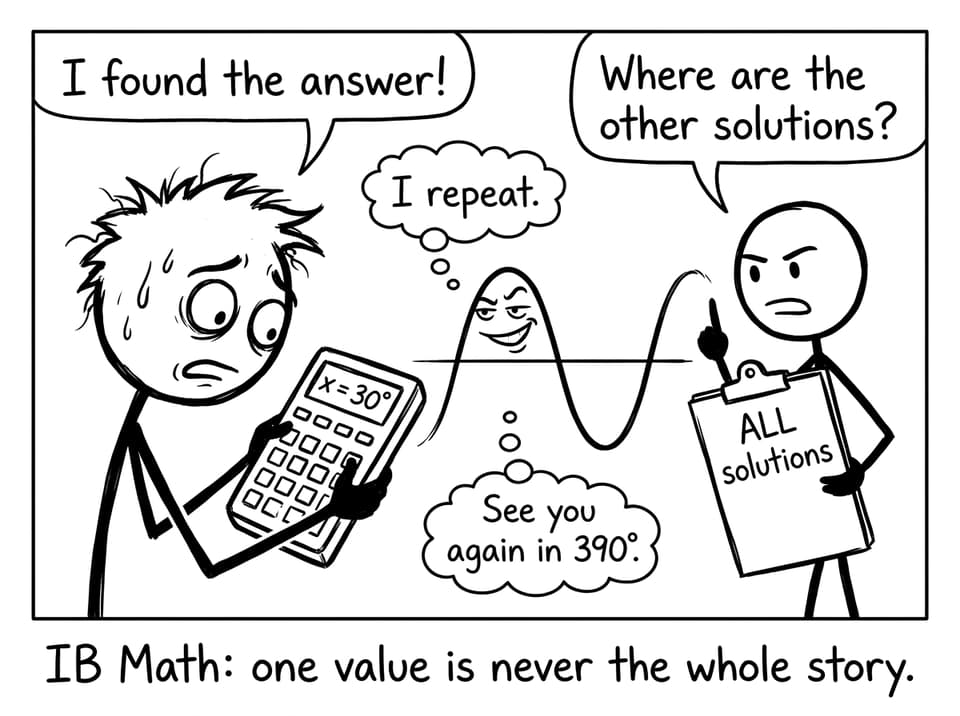
Then you read the markscheme comment that hurts most in IB Math: “Incomplete solution set.”
Trigonometric equations feel unfair at first because they don’t behave like most algebraic equations. In algebra, one correct value often ends the story. In trigonometry, one correct value is usually just the first page. The point of these questions in IB Math isn’t only to test solving skills. It’s to test whether you understand the hidden nature of trig functions: they repeat, they mirror, and they sometimes disappear.
IB Math quick checklist: how to not miss solutions
Use this mini-routine every time you see a trig equation:
-
Identify the period (sin/cos: (2\pi); tan: (\pi))
-
Find principal/reference solutions (from unit circle or inverse trig)
-
Use symmetry (quadrant logic) to generate paired angles
-
Write the general solution (add (2\pi k) or (\pi k))
-
Apply the domain restriction last (filter to the interval)
-
Check angle units (radians vs degrees)
If you want targeted drills for this exact skill, the SL 3.8 Solving Trig Equations page is built for repeated practice in IB Math.
Periodicity: the real reason solutions keep coming back
The most important idea is periodicity: trig functions return to the same output after a fixed interval.
-
(\sin x) and (\cos x) repeat every (2\pi)
-
(\tan x) repeats every (\pi)
So if (x = a) is a solution to (\sin x = \tfrac12), then every (x = a + 2\pi k) is also a solution, for integer (k). In IB Math, this is why examiners expect you to either (1) give a general solution or (2) list all solutions within a specified interval.
To build fluency, it helps to pair equation-solving with graph intuition. RevisionDojo’s Geometry & Trigonometry hub for IB Math AA keeps the unit-circle logic, graphs, identities, and equation methods in one place.
Symmetry: why one answer often has a “partner”
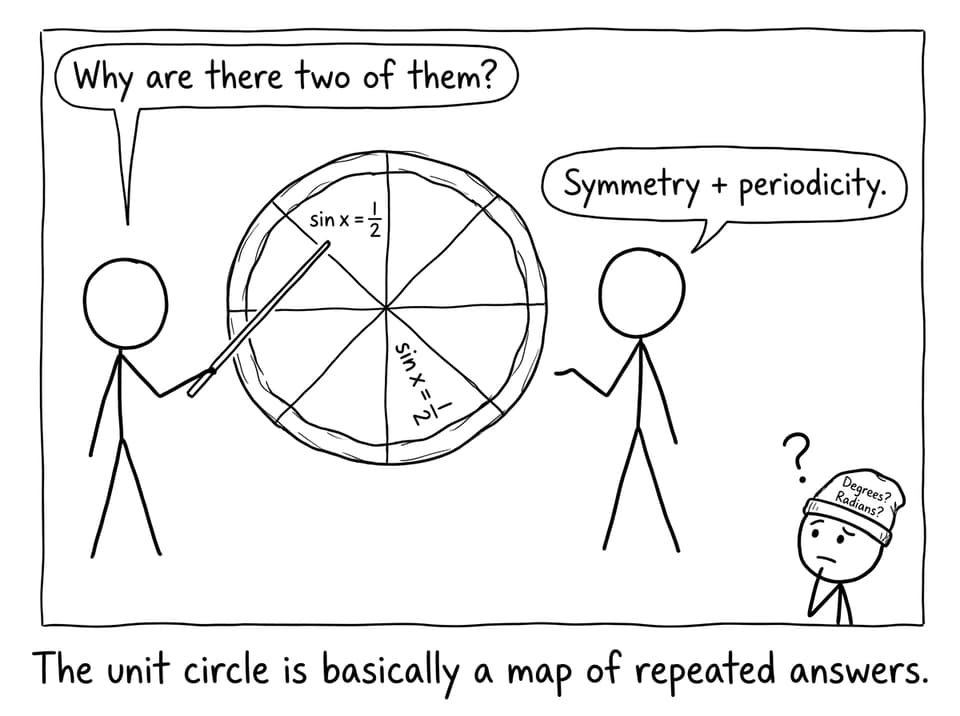
Even inside one period, trig values usually occur more than once.
Example idea (no heavy computation needed): (\sin x) is the (y)-coordinate on the unit circle. A horizontal line like (y = \tfrac12) typically hits the circle in two places, giving two angles in ([0, 2\pi)). That “two intersections” picture is symmetry made visible.
This is also why students who rely only on (\arcsin) or (\arccos) often lose marks in IB Math: inverse trig typically returns just a principal value, not the full symmetric set.
For a quick refresher of key identities and how they connect, see How to Master Trigonometric Identities for the IB and the companion guide, IB Math Trig Formulas: Essential Guide for HL and SL.
Domain restrictions: the quiet instruction that decides your final mark
Most IB Math trig equations only become “finite” because the question puts a fence around them:
-
(0 \le x \le 2\pi)
-
(-\pi \le x \le \pi)
-
(0^\circ \le x \le 180^\circ)
A clean method is:
-
Solve in the base interval (often ([0, 2\pi)) for sin/cos)
-
Expand to the general solution using periodicity
-
Filter to the required domain
If you flip steps 2 and 3, you still can succeed, but it’s easier to miss edge cases. RevisionDojo’s SL 3.8 notes on solving trig equations are especially good at showing the “general then restrict” rhythm.
Why tangent feels like it’s playing a different game
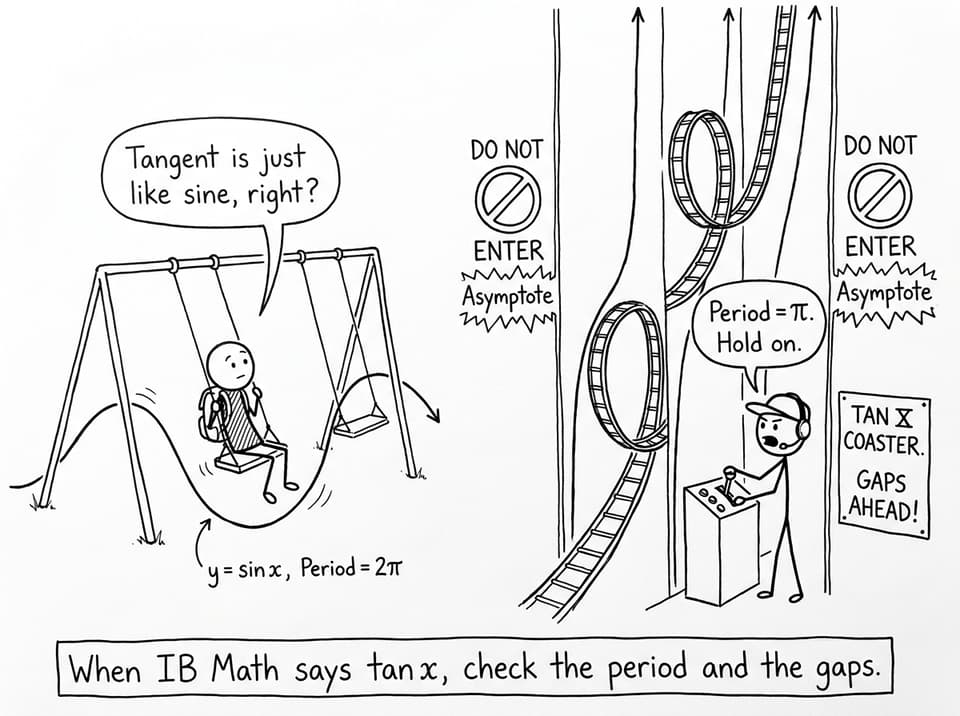
(\tan x) is the function that teaches humility.
It repeats every (\pi), not (2\pi), and it has vertical asymptotes where (\cos x = 0). That means there are values of (x) where (\tan x) isn’t defined, and that affects equations and solution sets.
In IB Math, tangent questions often test whether you remember two habits:
-
Use (\pi k) for the general solution, not (2\pi k)
-
Watch for restrictions coming from denominators after rearranging
How RevisionDojo helps you turn “many solutions” into a routine
The fastest way to get comfortable is repetition with feedback.
On RevisionDojo, you can loop the exact exam skill:
-
Use the Questionbank from SL 3.8 solving trig equations to drill equation types.
-
Consolidate with Study Notes and Flashcards (especially periods, symmetry angles, and identities).
-
Ask AI Chat to check if your solution set is complete and whether your domain filtering is correct.
-
Use Grading tools to spot the recurring reason marks are lost.
-
When you want realism, build timed sets with Mock Exams and topic practice from Geometry & Trigonometry Questionbank.
Closing thought: IB Math rewards completeness, not speed
Trigonometric equations don’t have “too many solutions.” They have the number of solutions that periodicity and symmetry demand.
Once you start seeing trig as a repeating story with reflections, IB Math questions become calmer: solve once, mirror it, shift it, then restrict it. If you want a structured way to practice that loop with feedback, RevisionDojo’s Questionbank, Study Notes, Flashcards, AI Chat, Grading tools, Predicted Papers, Mock Exams, Coursework Library, and Tutors turn the messy feeling of “endless answers” into a routine you can trust in the exam.


