


Transformations are the moment many IB students realise that IB Math is not only about getting the right answer. It is about reading an equation like a set of stage directions.
You can memorise every rule in the textbook and still freeze in an exam when you see something like (y=2f(x-3)+1). Suddenly, the graph in your head stops behaving. Left becomes right. Stretch becomes shift. And your confidence drains fast.
That confusion is normal. Transformations of functions are one of the first topics where IB Math demands visual thinking, not just algebra.
A quick IB Math checklist for transformations
Use this quick checklist before you touch your pen:
-
Identify the parent function (the “base graph”).
-
Separate what happens outside (f(\cdot)) from what happens inside.
-
Apply one transformation at a time.
-
Decide whether each step changes outputs (y) or inputs (x).
-
If there are multiple steps, write the order you will apply them.
If you want exam-style practice aligned to the syllabus, start with SL 2.11 Transformation of functions and then move into the Questionbank for SL 2.11.
What transformations are really testing in IB Math
In IB Math, transformations are not “graph tricks.” They are a test of whether you understand that functions are machines: input goes in, output comes out.
-
Changes like (f(x)+k) adjust the output after the machine has done its job.
-
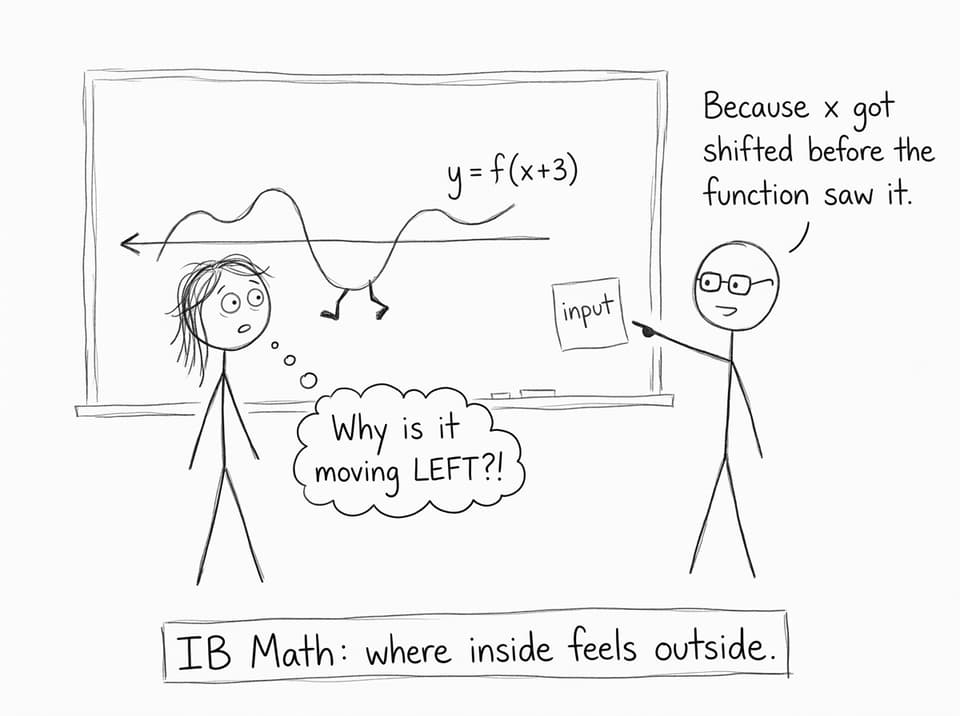
Changes like (f(x+k)) adjust the input before the machine even starts.
This is why transformation questions often feel like they are written to catch you out: they are designed to test structure and interpretation. RevisionDojo explains this cleanly in its topic notes, especially in SL 2.11 notes on transformation of functions.
Why horizontal transformations feel “backwards” in IB Math
The biggest mental trap in IB Math transformations is the inside of the function.
If you see (y=f(x-3)), many students think “minus 3 means left.” But (x-3) means the function receives an input that is 3 smaller than x. To get the same output as before, you must move right.
A useful sentence to repeat in your head:
Inside changes are about where an output happens, not the size of the output.
To make this stick, practise with multiple representations: equation, graph, and words. The Functions Questionbank is ideal because it forces you to switch between forms under time pressure.
Why order matters more than you expect
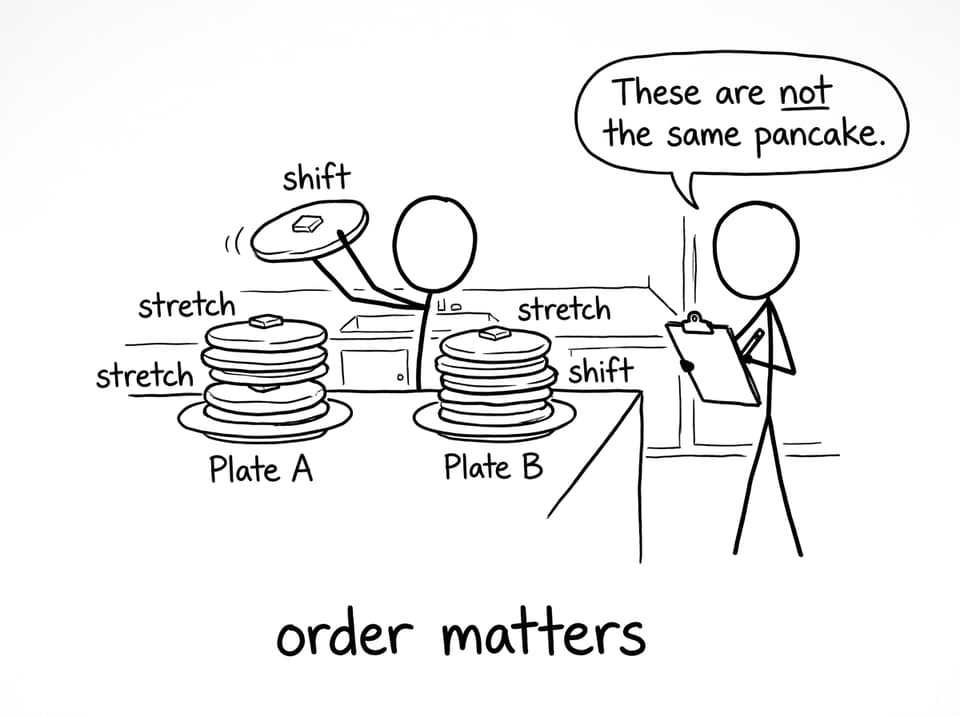
Composite transformations are where IB Math starts feeling less like arithmetic and more like choreography.
(y=2f(x)+6) is not the same as (y=2(f(x)+6)). The first doubles the output, then shifts up. The second shifts up, then doubles the entire result.
That is exactly what IB examiners like to test: do you see the structure, or are you applying rules mechanically?
A strong way to train this is to do short, mixed drills using RevisionDojo’s Flashcards and then confirm with Questionbank solutions. Pair it with the broader functions foundation in Understanding Functions in IB Math AA.
Why equations, graphs, and words get tangled
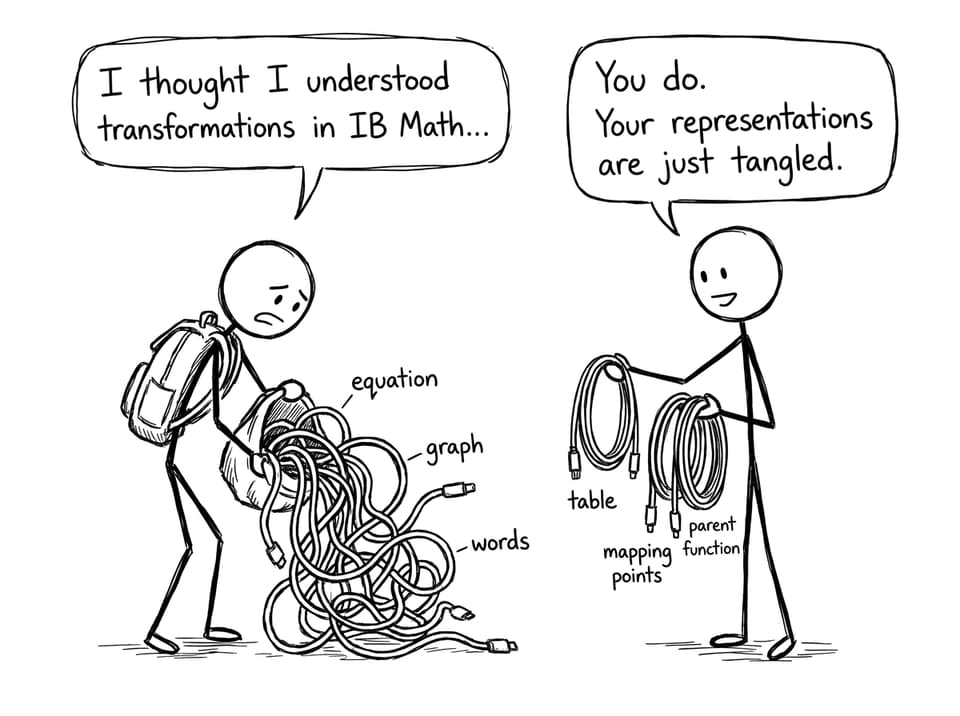
Transformations demand translation:
-
Graph to equation: “What change created this shift/stretch?”
-
Equation to graph: “What motion does this notation describe?”
-
Words to both: “Describe the transformation clearly and precisely.”
Many students can do one direction, but not the reverse. Under exam pressure, that feels like “I knew this yesterday.” In reality, your brain just stored the idea in one format.
RevisionDojo helps here because you can combine Study Notes, AI Chat, and Grading tools to practise explaining transformations in full sentences, then check whether your wording would earn method marks.
Exam-focused habits that make transformations easier
-
Always sketch the parent graph lightly first.
-
Transform key points (intercepts, vertex, asymptotes) before drawing the full curve.
-
Write mini-mappings like ((x,y)\to(x+3,y)) when appropriate.
-
Use tech wisely: confirm with a graphing tool, but do not outsource your thinking.
For a wider strategy, read How to master functions and transformations (Graphing Toolkit) and then practise modelling-style transformations in trig contexts like SL 3.7 Circular functions: graphs, composites, transformations Questionbank.
A calmer way to get good at IB Math transformations
Transformations confuse students because they sit at the border between algebra and imagination. That is also why they are so valuable: once you can see how equations move graphs, a lot of IB Math starts to feel more connected.
If you want this topic to stop being a “guess-and-check” moment, use RevisionDojo as your practice home base: Study Notes for clarity, Flashcards for recall, Questionbank for exam-style repetition, AI Chat for explanations, plus Mock Exams and Predicted Papers to make it stick under pressure. When transformations finally click, they do not just help with one unit, they change how you read every function you meet in IB Math.