Tangents and normals can feel like the moment IB Math stops talking to reality.
You might be fine differentiating a function in isolation, then suddenly the question asks for “the equation of the tangent at x = a” and everything goes foggy. Not because you forgot the calculus, but because the task quietly shifts from algebra to geometry. And in IB Math, that shift is where marks are won or lost.
In other words: tangents and normals feel abstract when the derivative feels like a symbol instead of a direction.
The quick IB Math checklist (use this every time)
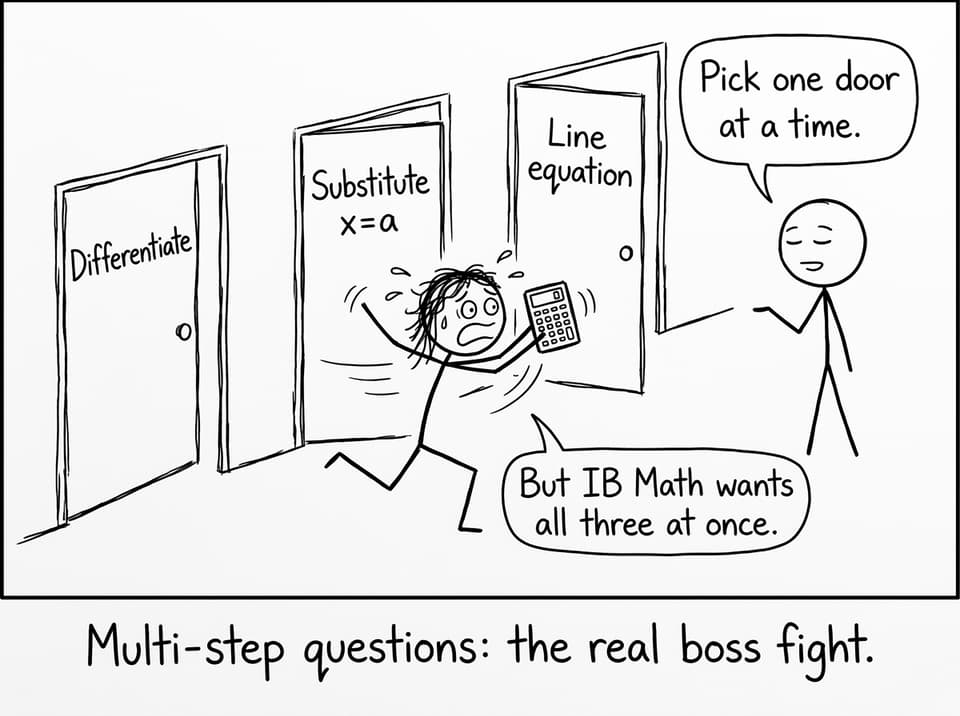
When a tangent/normal question appears in IB Math, run this checklist:
-
Identify the point: either given as ((a, f(a))) or you must find it.
-
Differentiate to get (f'(x)).
-
Evaluate the gradient at the point: (m_{\text{tan}} = f'(a)).
-
Choose the line:
-
Tangent: use (m_{\text{tan}})
-
Normal: (m_{\text{norm}} = -\frac{1}{m_{\text{tan}}}) (if the tangent gradient isn’t zero)
-
-
Write the equation using point-slope form: (y - y_1 = m(x - x_1)).
-
Sanity check with a tiny sketch or your GDC.
If you want targeted practice, the SL 5.4 Tangents and normal Questionbank (Math AA) is built exactly around this flow.
What a tangent actually means in IB Math
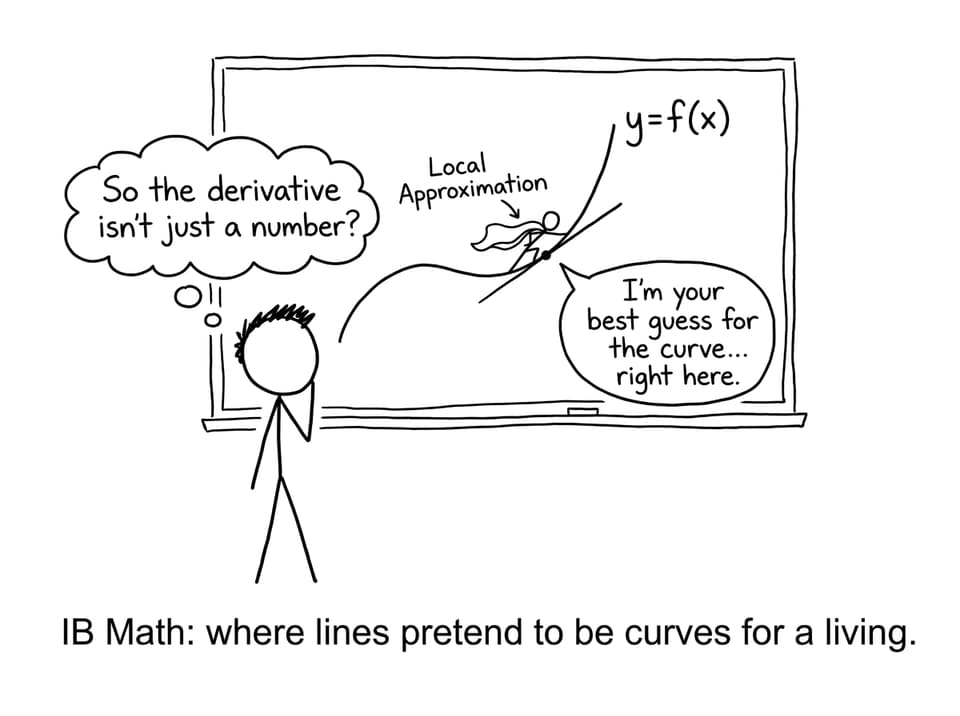
A tangent line is the curve’s “best straight-line impression” at one point.
That phrase matters because it connects everything IB Math expects you to connect: the derivative, the graph, and local behaviour. The tangent isn’t just a line that touches a curve; it’s the line that shares the same instantaneous slope.
So when you compute (f'(a)), you are not harvesting a random number. You are capturing a direction, the direction the curve is heading right there.
To lock this in conceptually, review the calculus hub and then drill:
That trio is the fastest way to make IB Math tangents feel less like ritual and more like meaning.
Why normals feel even more abstract
Normals feel harder because they require a second translation: “perpendicular” becomes “negative reciprocal.”
Many students memorize (m_1 m_2 = -1) and still lose marks because the geometry never becomes real. A normal is the direction pointing straight out from the curve at that point. In IB Math, the normal is often used to test whether you can move between:
-
a visual right angle,
-
a gradient relationship,
-
and a line equation under pressure.
If you’re studying Math AI, this topic page is a clean way to see the same idea through a different lens: SL 5.4 Tangents and normals (Math AI), plus the matching Math AI SL 5.4 Notes.
Where IB Math students actually lose marks
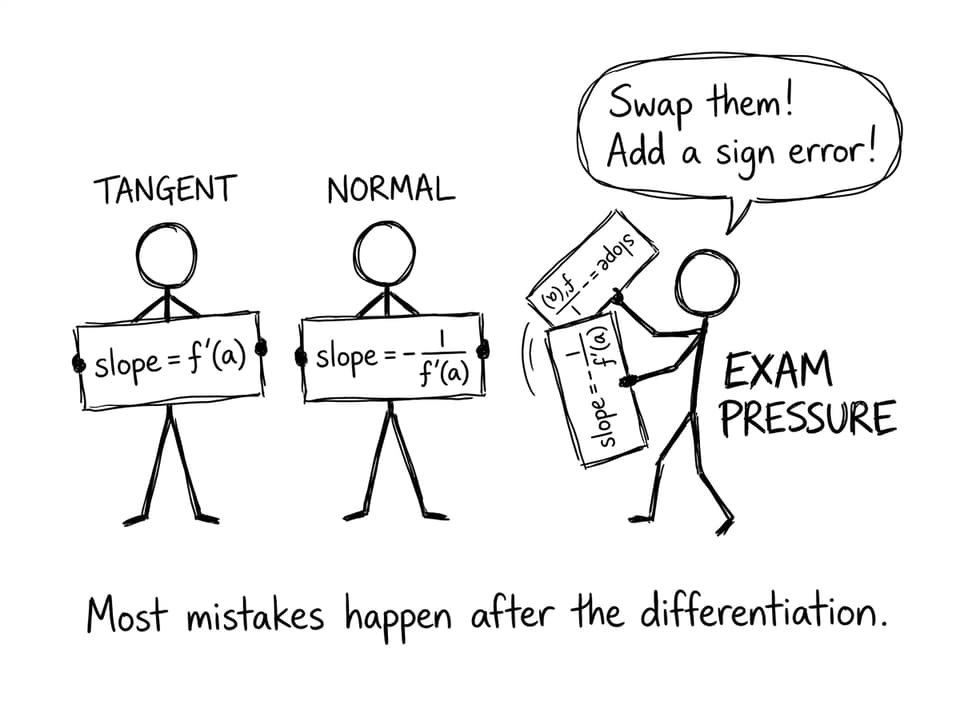
The most common pattern is frustrating: differentiation is correct, then the final line is wrong.
In IB Math, tangent/normal questions are often multi-step, which means your working has to be structured even when the function is ugly. Typical slip-ups include:
-
using (f'(x)) but forgetting to evaluate at (x=a)
-
using the tangent slope for the normal (or vice versa)
-
sign errors when taking the negative reciprocal
-
writing the line in the wrong form or substituting the wrong point
If your fundamentals feel shaky, start earlier in the chain at SL 5.1 Introduction of differential calculus before returning to tangents and normals.
Exam tips that make tangents and normals feel concrete
In IB Math, clarity is a strategy.
-
Write (m_{\text{tan}} = f'(a)) explicitly before you do anything else.
-
Then write (m_{\text{norm}} = -1/m_{\text{tan}}) only if the question asks for the normal.
-
Use point-slope form first, then rearrange if needed.
-
Do a 3-second sketch: is the tangent meant to slope up or down? Does the normal look perpendicular?
For extra reinforcement, RevisionDojo’s SL 5.4 Tangents and normal Videos (Math AA) help you “hear” the reasoning steps, which is often what turns procedure into understanding.
Bring it back to RevisionDojo
Tangents and normals stop feeling abstract when you treat them as meaning first, algebra second. That’s the heart of IB Math: translating between a graph’s story and a line’s equation.
If you want this to become automatic, RevisionDojo is built for it. Use the Study Notes to re-ground the geometry, the Flashcards to keep key relationships sharp, and the Questionbank to practice exam-style steps with feedback. Then stress-test yourself with Mock Exams, Predicted Papers, and Grading tools that force clean working under time pressure. When you get stuck, AI Chat, the Coursework Library, and Tutors help you fix the exact misunderstanding instead of doing another random set.
Make tangents and normals a comfort topic, and let RevisionDojo turn that clarity into marks.


