



If you’ve ever walked out of an IB Math exam thinking, “But I used the calculator exactly like they told us to,” you’re not alone.
The strange part is that technology is allowed (and sometimes expected) in IB Mathematics courses, especially when you’re working with graphs, models, and messy arithmetic. Yet students still lose marks in algebra questions after using a graphing calculator.
It isn’t because IB hates technology. It’s because algebra questions are built like small stories: the examiner wants to see relationships, structure, and meaning. When technology replaces that story with a single number, marks quietly disappear.
A quick checklist to avoid tech mistakes in IB Math algebra
Before you touch your calculator, run this fast check:
-
What is the question actually asking (solve? prove? interpret?)
-
What method marks are available besides the final answer?
-
If you use a graph or solver, what will you write to justify the result?
-
Can you state what the solution means (units, context, restrictions)?
-
Can you sanity-check the answer without the calculator?
If you want practice that forces this habit, use targeted algebra sets in RevisionDojo’s Number and Algebra Questionbank and compare your working to the markscheme logic.
What IB expects technology to do (and not do)
In IB Math, technology is a support tool: it helps you compute, explore, and confirm. But it’s not supposed to replace reasoning.
IB expects you to use technology to:
-
Explore how changing parameters changes a function
-
Check algebraic manipulation you’ve already set up
-
Produce accurate numerical approximations when exact values are unrealistic
-
Support interpretation with graphs, tables, or regression output
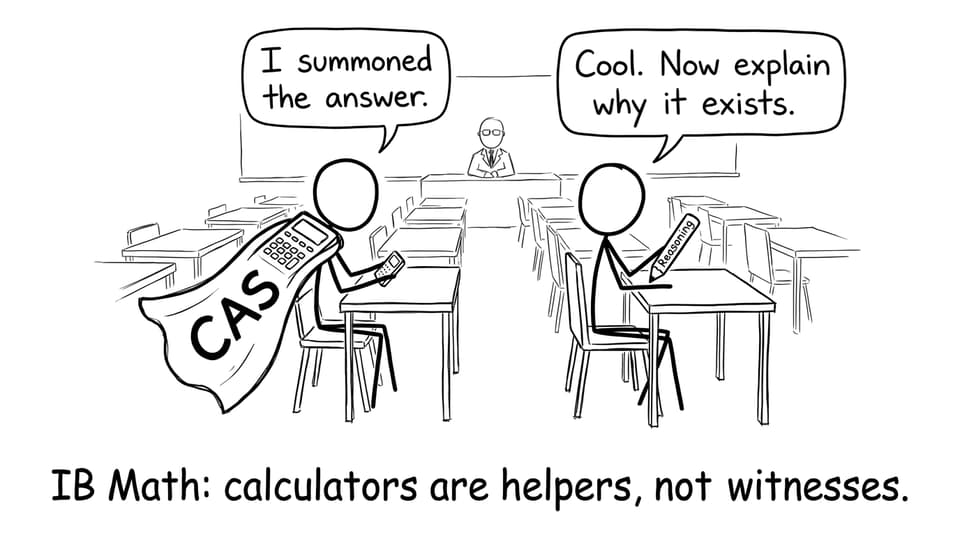
The issue is communication. Examiners can’t award “method” or “reasoning” marks for button presses they never see. This becomes even more important on calculator papers, where many students can obtain the same number, but only some can explain why it’s the right number.
For paper-specific strategy, see How to Prepare for IB Math Paper 2 (Calculator Allowed).
Why algebra is where technology gets misused most
Algebra is the part of IB Math that asks you to respect structure.
When IB gives you an equation, it’s rarely only asking “what’s x?” It’s also asking whether you understand what the equation represents, how variables relate, and whether your final solution makes sense.
Technology can short-circuit that process.
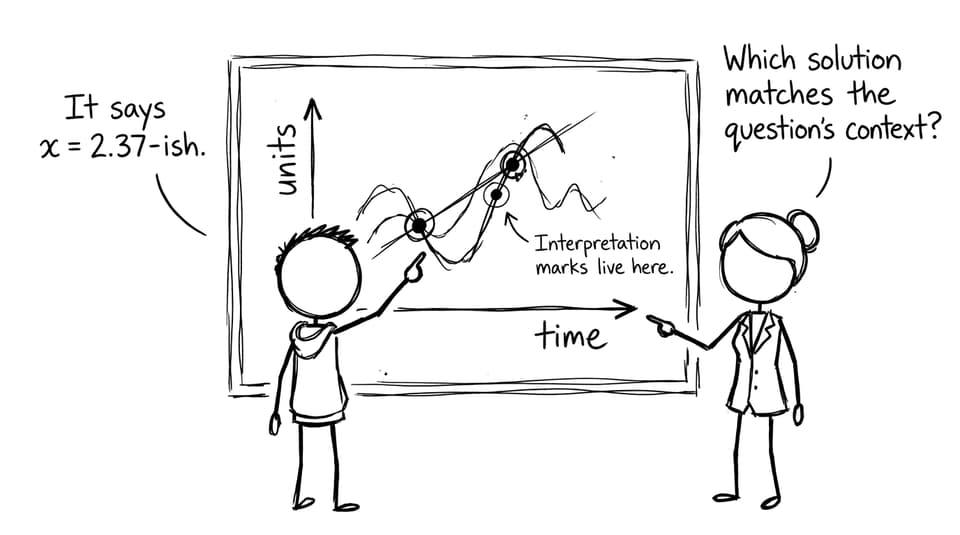
A numerical solver gives you x ≈ 2.37. But did you check whether x must be an integer? Or positive? Or within a real-world domain like time between 0 and 24 hours? Algebra questions often hide these constraints in wording, and technology won’t protect you from ignoring them.
The most common ways students misuse technology in IB Math
These patterns show up again and again in algebra-heavy questions:
Getting a correct answer with no justification
You use “solve” and write the solution. But you don’t show how the equation came from the prompt, what the solution represents, or why it’s valid.
Using a graph, then forgetting the sentence that earns marks
Graph intersections are powerful, but IB still expects you to interpret them: “The intersection represents when the two models are equal, so the time is…” One line can separate full marks from partial.
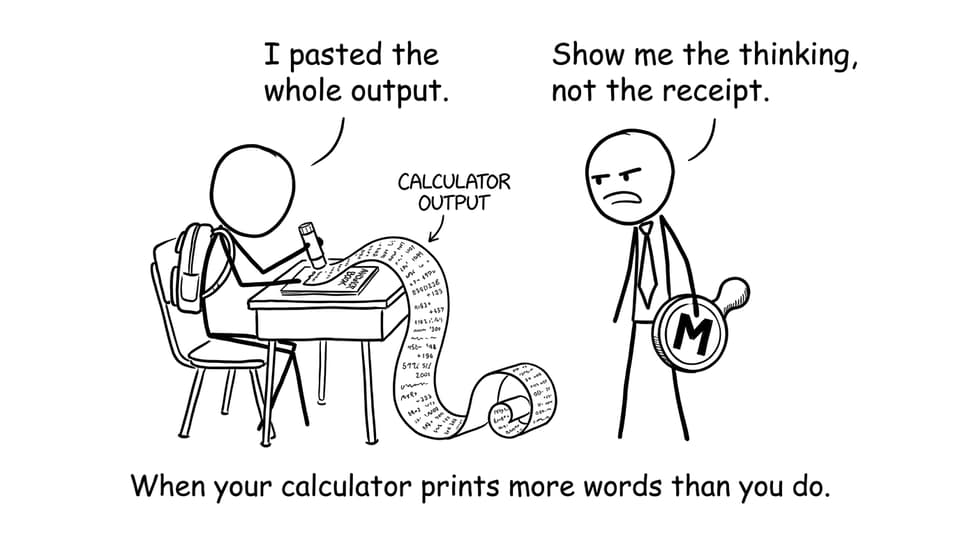
Copying calculator output like it’s evidence
Long outputs feel official. But IB marking is about mathematical communication, not receipts.
Ignoring algebraic structure entirely
Sometimes the point is to factor, rearrange, or spot a pattern. If you jump straight to a solver, you might miss the method marks designed for structure.
To build better habits, practice explaining your steps with RevisionDojo’s How to Use the Questionbank for Targeted Math Revision, then use AI Chat to rewrite your explanation more “examiner-friendly.”
When technology is used well in IB Math algebra
Smart technology use looks like this:
-
Set up algebra first, then use the calculator to compute the final numeric value
-
Use graphing to confirm solutions, then state what the graph shows and why it matters
-
Check solutions by substitution or by comparing against context constraints
-
Round appropriately and label clearly (units, domain, meaning)
If you’re unsure what your calculator is allowed to do in exams, RevisionDojo’s guides help you avoid risky setup mistakes: How to Use Graphing Calculators During IB Math Exams and Forbidden calculators in IB exam.
A closing thought (and what to do next)
Misusing technology in IB Math algebra usually isn’t laziness. It’s a mismatch: students use a powerful tool to do a task the examiner didn’t ask for.
So aim for a simple rule: let technology do computation, and let you do meaning.
If you want a system that makes that automatic, build a loop with RevisionDojo: revise the concept in Study Notes, drill it in the Questionbank, ask AI Chat to critique your explanation, then test yourself with Predicted Papers and Mock Exams using the built-in Grading tools. When your working starts to read like an examiner’s markscheme, technology stops being a risk and becomes a quiet advantage in IB Math.