



Growth factors are the kind of IB Math idea that feels harmless right up until you lose a clean method mark.
You read “increases by 5% per year.” Your hand moves on autopilot. You type something into your calculator. The number that comes out looks plausible. And then the markscheme quietly disagrees.
In IB finance questions, the hard part is rarely the arithmetic. It’s interpretation: understanding what the percentage change is doing over time, what it multiplies, and what time unit it belongs to. That’s why growth factors keep getting misread in IB Math.

Quick checklist: growth factor sanity checks in IB Math
Before you calculate anything, run this quick IB Math checklist:
-
Convert the percent to a multiplier: increase -> 1 + r, decrease -> 1 - r
-
Decide the time step: yearly, monthly, quarterly
-
Match the exponent to the number of time steps
-
Ask: should the quantity be bigger or smaller?
-
Ask: is the result financially reasonable?
If you want targeted practice on these exact question styles, the IB Mathematics Applications & Interpretation hub is built around them.
What a growth factor actually means (and why IB Math cares)
A growth factor is not “the percentage written as a decimal.” It’s the multiplier applied to the whole amount.
That sounds obvious, but it’s where many IB Math errors begin. Students see 5% and think “0.05.” But 0.05 is only the change, not the new amount after the change.
-
5% increase -> multiply by 1.05
-
5% decrease -> multiply by 0.95
IB finance problems reward students who treat this as modelling, not conversion. If you want a clean refresher that connects the idea to exponential models, review Example of Exponential Growth: Explained Simply.
Why decreases break people’s brains in IB Math finance
Decreases feel like they should be “negative.” But growth factors for decay are usually still positive numbers, just less than 1.
A classic IB Math mistake is writing a 10% decrease as -0.10, then trying to “compound” it. In finance contexts (depreciation, inflation-adjusted value, shrinking balances), the model is multiplicative, not additive.
- 10% decrease each year -> multiply by 0.90 each year
The deeper issue: students treat “decrease” as a sign change, when it’s actually a scaling change. RevisionDojo drills this distinction with exam-style items in the SL 1.4 Financial apps practice topic plus quick recall in the matching SL 1.4 flashcards.
Rate vs factor: the quiet confusion that costs marks
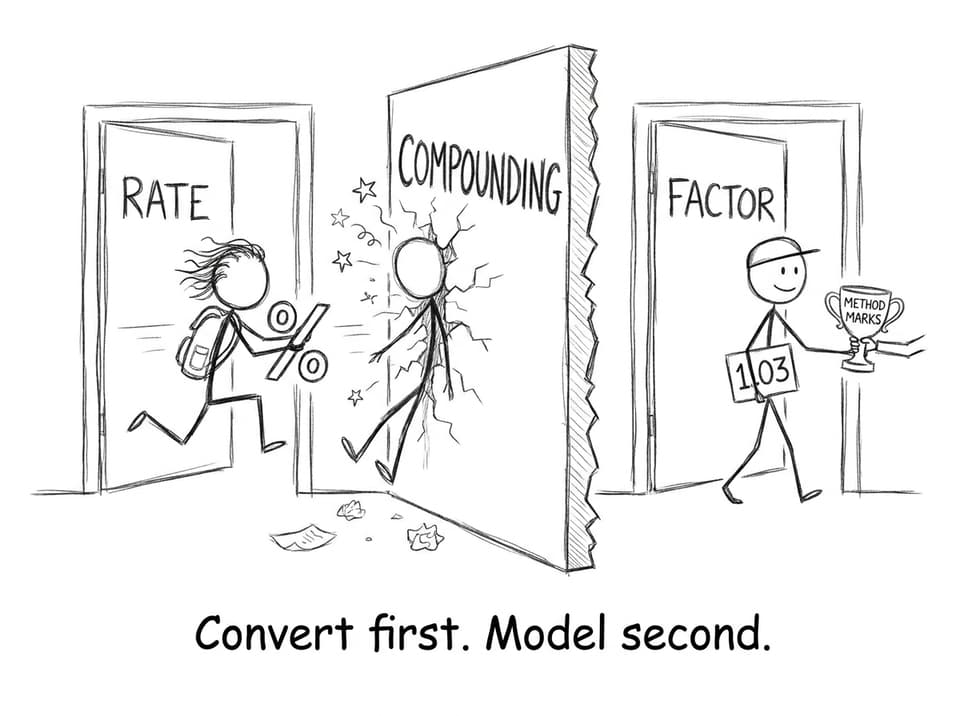
In IB Math, a rate tells you the percentage change per time step. A factor tells you the multiplier per time step. The exam expects you to move from rate -> factor before you build the model.
This is why students sometimes “apply the rate repeatedly” instead of compounding the factor. Over one year, both might look similar. Over five years, the gap becomes obvious.
If you keep feeling like finance questions are withholding the formula you want, that’s not an accident. See Why Do IB Maths Questions Avoid Giving Financial Formulas Directly.
The time-unit trap: “per year” does not mean “raise to whatever”
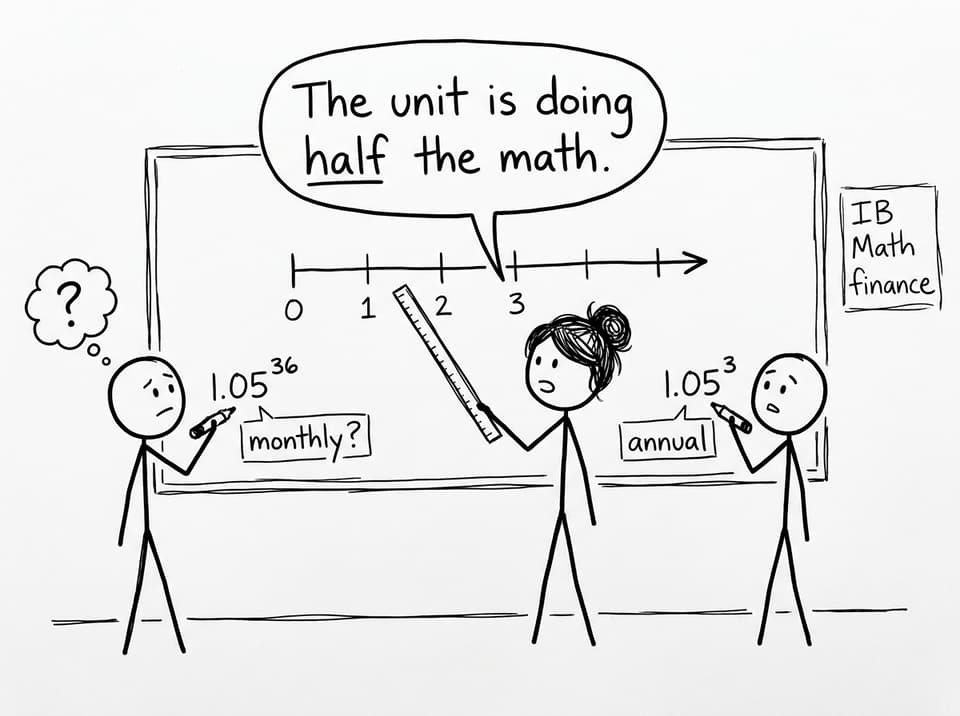
A growth factor is married to its time unit.
A huge chunk of IB Math finance errors come from using the correct factor with the wrong exponent:
-
“5% per year, compounded monthly” is not 1.05^12 unless the question explicitly defines that structure
-
Monthly compounding usually requires converting the annual rate into a monthly rate (depending on the model given)
This is also why some answers look “too big to be true.” The model isn’t wrong because the calculator failed. It’s wrong because the time step got swapped.
For more context on why finance feels different from clean exponential exercises, read Why Does Compound Interest Feel Different from Exponential Growth in IB Maths.
How to train the correct instinct (the RevisionDojo loop)
In IB Math, the best fix is repetition with feedback, not more memorisation.
A simple loop:
-
Learn the model quickly with Study Notes
-
Drill variations in the Questionbank (so wording changes stop scaring you)
-
Use AI Chat when you can’t see why your setup is wrong
-
Check your work with Grading tools to protect method marks
-
Then simulate pressure using Mock Exams and Math AI Predicted Papers
You can also build full-paper stamina using the Math AI Papers page and strategy-plan with Ace IB Math Applications and Interpretation Paper 2.
Closing: make growth factors boring (and you’ll score)
The goal in IB Math isn’t to become faster at typing numbers. It’s to make growth factors so conceptually boring that your setup is always correct.
When you practise with RevisionDojo’s Study Notes, Flashcards, Questionbank, AI Chat, Grading tools, Predicted Papers, and Mock Exams, you stop guessing what the question “probably means.” You start modelling what it actually says. And that’s where the easy marks live, especially in IB Math finance problems.