


Small-angle approximations in IB Math can feel like the moment you discover a secret corridor in a building you thought you knew. One minute, sine and tangent are these elegant curves that demand calculator respect. The next, your teacher calmly replaces them with a straight line and tells you to move on.
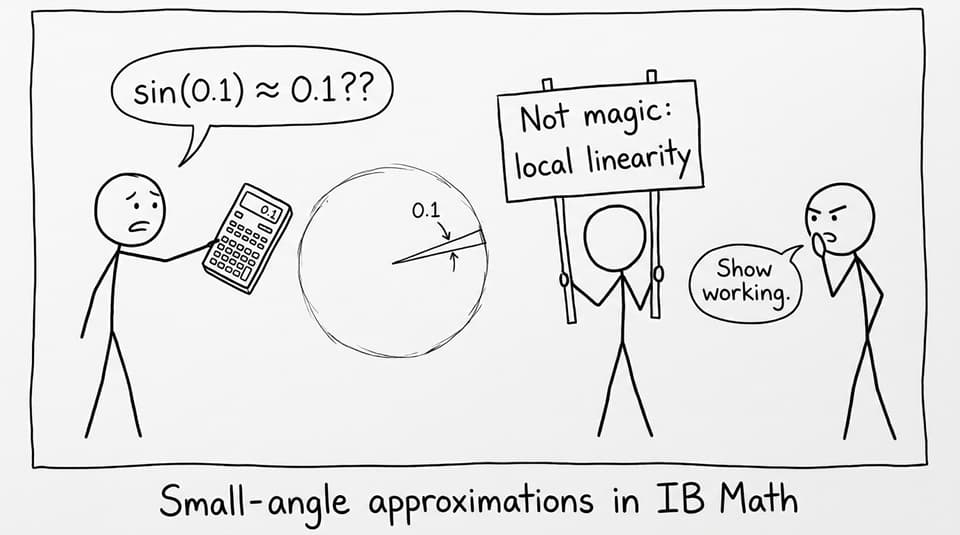
That emotional whiplash is real. But the “magic” in IB Math small-angle approximations isn’t a trick. It’s a disciplined idea hiding in plain sight: when you zoom in close enough, even complicated functions start behaving simply.
The small-angle approximation checklist (what examiners want)
Before you use any small-angle approximation in IB Math, run this quick checklist:
-
The angle is small (think: close to 0).
-
The angle is in radians.
-
You use the correct form:
-
(\sin\theta \approx \theta)
-
(\tan\theta \approx \theta)
-
(\cos\theta \approx 1 - \tfrac{\theta^2}{2})
-
-
You write (\approx), not (=).
-
If asked, you justify it using “near 0” or “local behaviour.”
For targeted practice, the Geometry & Trigonometry Questionbank is built for exactly this kind of micro-skill in IB Math.
Why small-angle approximations work in IB Math (the real reason)
Imagine looking at a mountain range from an airplane. It’s dramatic. Now imagine standing on one small patch of hillside. Suddenly it feels almost flat.
That’s the core idea: near (\theta = 0), the trig graphs become so “locally straight” that a line (or a simple curve) matches them extremely well.
In IB Math, this is really about local behaviour of functions. You’re being tested on whether you understand that “zooming in” changes what matters. The approximation isn’t replacing the function forever. It’s replacing it briefly, in a neighbourhood where the error is tiny.
If you want the syllabus-aligned big picture, start at Mathematics Analysis and Approaches (AA) Resources.
Why radians are non-negotiable in IB Math
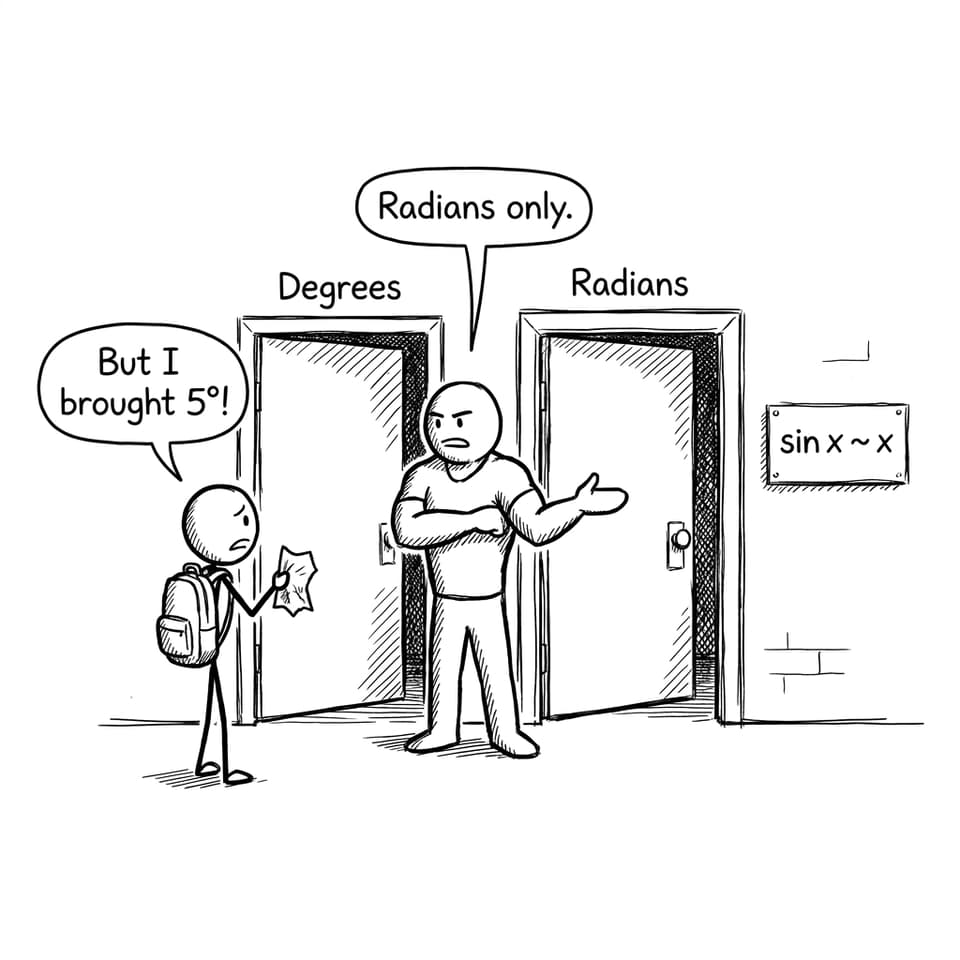
Radians are the admission ticket. Degrees are the fake ID.
The reason is subtle but important: radians tie angle size directly to arc length, which makes limits and derivatives behave cleanly. That “clean behaviour” is exactly what small-angle approximations depend on.
If you use degrees, the scaling is off, and your “nice” approximation quietly becomes wrong.
RevisionDojo breaks this down clearly in Why Does Radian Measure Feel So Unnatural in IB Maths? and reinforces it in Notes for AHL 3.7, Radians.
Why (\sin\theta) and (\tan\theta) “match” near zero
In IB Math, students often ask why both (\sin\theta) and (\tan\theta) become (\theta).
Graphically, both pass through the origin. More importantly, they initially rise at the same rate. So, when you zoom in close to 0, both curves sit almost on top of the line (y=x). That’s why the approximation feels strangely powerful: you’re swapping a curvy object for its “first impression.”
To drill this skill with exam-style feedback loops, use the Videos for Geometry & Trigonometry alongside timed sets in the Questionbank.
Why cosine gets a different approximation in IB Math
Cosine is the friend who refuses to start at zero.
At (\theta = 0), (\cos\theta = 1). So a straight-line approximation like (\cos\theta \approx \theta) would be instantly wrong. Instead, cosine begins at 1 and curves downward slowly. That’s why IB Math uses:
Notice what’s happening: the first “change” from 1 is quadratic, not linear. That difference is exactly the conceptual point exam questions love.
For quick recall under pressure, pair practice with Flashcards for Calculus (yes, even trig approximations benefit from spaced repetition because the structure is calculus-adjacent).
Common small-angle mistakes (and how to avoid them)
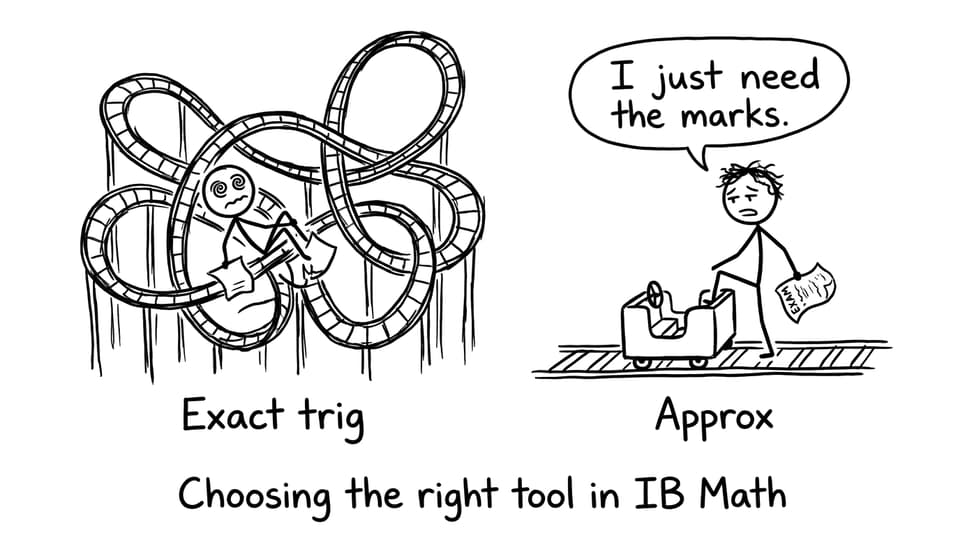
Most IB Math errors here aren’t “hard math.” They’re decision errors:
-
Using degrees because the question “looks small anyway.”
-
Applying approximations when the angle is not close to 0.
-
Writing (=) instead of (\approx), which changes the meaning.
-
Treating cosine like sine (forgetting it starts at 1).
A good fix is a short loop: do 10 targeted questions, log the exact mistake pattern, then ask AI Chat to generate a similar variant and re-test. That’s how IB Math confidence gets built: not by rereading, but by repeating the decision.
Closing: turn the “magic” into a repeatable method
Small-angle approximations feel like magic in IB Math because they compress a complicated curve into something you can hold in your head. But once you see the real mechanism: local behaviour near 0, in radians, the magic becomes method.
If you want that method to stick, build a tight routine on RevisionDojo: learn it once in Study Notes, drill it in the Questionbank, lock it in with Flashcards, sanity-check it with AI Chat, then pressure-test it using Predicted Papers and Mock Exams. That’s how you walk into the exam with fewer tricks and more certainty.