

Why sequences and series feel abstract in IB Math
You can be perfectly comfortable solving for (x) in an equation, and then suddenly sequences show up and it feels like the floor tilts.
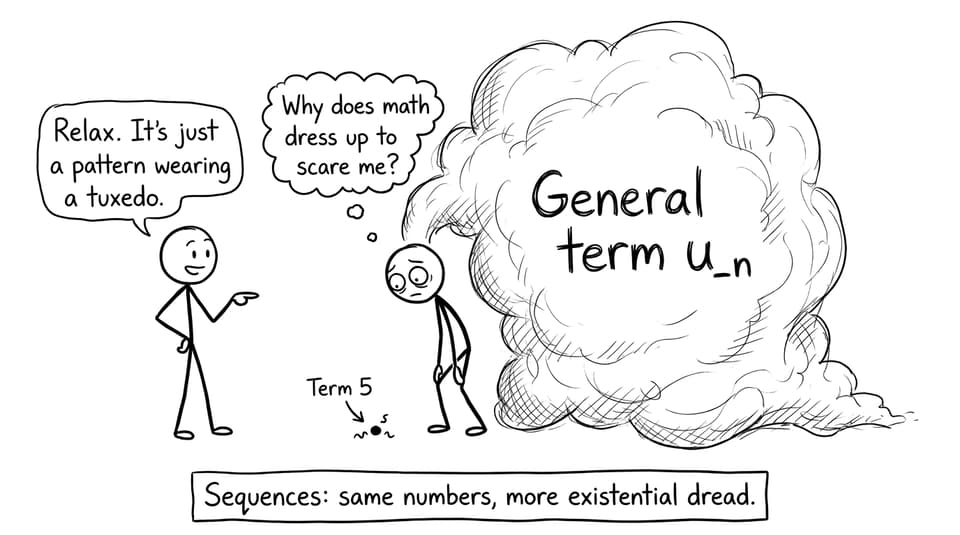
One moment you’re working with a single number you can point at. The next, IB Math asks you to think about a whole machine that produces numbers, one after another, based on position. It’s less “compute this” and more “describe how this universe behaves.” That’s why sequences and series feel abstract: they move you from arithmetic to structure.
And the exam doesn’t just reward getting the final value. In IB Math, sequences and series are a proxy for something bigger: whether you can spot patterns, generalise them, and explain your reasoning under time pressure.
A quick checklist to make IB Math sequences feel concrete
When a question starts to feel “floaty,” run this reset:
-
Are you dealing with a sequence (a list of terms) or a series (a sum of terms)?
-
Is the change additive (constant difference) or multiplicative (constant ratio)?
-
What do you know: (u_1), (u_n), (d), (r), (n), (S_n)?
-
Can you write one sentence that describes the pattern in plain English?
-
Only then: choose the formula and substitute.
If you want a syllabus-aligned home base while you practise, keep IB Mathematics Analysis and Approaches Resources open as your map.
What a sequence is really “about” in IB Math
A sequence is an ordered list where the position matters. That sounds obvious, but it’s the first source of abstraction: the starring character is not a number, it’s the index (n).
In IB Math, the skill is translating between three views of the same thing:
-
Terms: (u_1, u_2, u_3, \dots)
-
Rule: “add 5 each time” or “multiply by 0.8 each time”
-
General term: a formula like (u_n) that captures the rule
Students often jump straight to memorising (u_n) formulas. But the exam questions usually give method marks for pattern recognition first. That’s also why RevisionDojo practice works well here: the SL 1.2 Arithmetic sequences and series and SL 1.3 Geometric sequences and series pages keep the pattern front and center, not buried behind algebra.
Why arithmetic vs geometric confusion happens
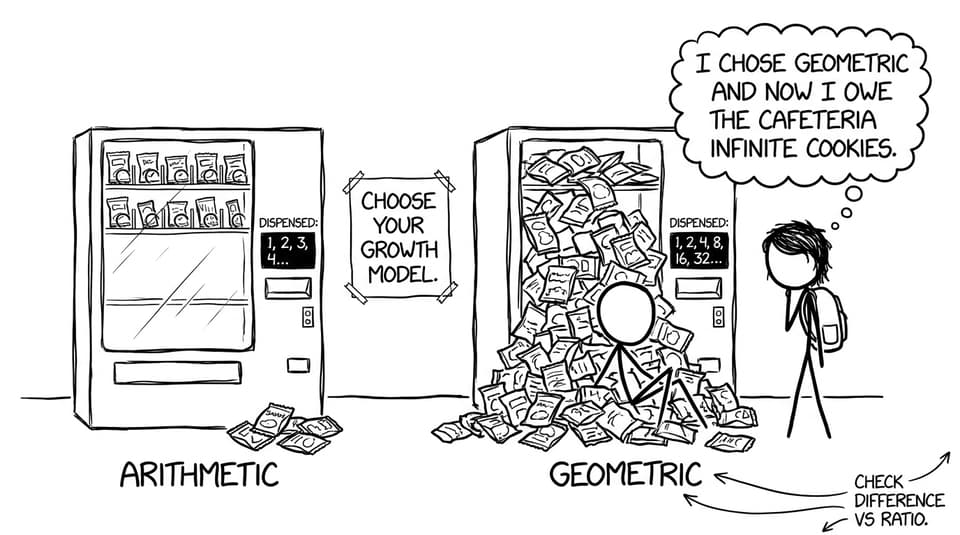
Arithmetic and geometric sequences can look similar in the first three terms, especially if the numbers are “nice.” But they grow differently:
-
Arithmetic: you add/subtract a constant difference (d)
-
Geometric: you multiply/divide by a constant ratio (r)
The mistake pattern in IB Math is predictable: students see “sequence” and reach for a familiar formula before checking whether the pattern is additive or multiplicative.
A practical habit: always compute two quick tests.
-
Difference test: (u_2-u_1), (u_3-u_2)
-
Ratio test: (u_2/u_1), (u_3/u_2)
Then commit.
For targeted drills, use the SL 1.2 Questionbank and SL 1.3 Questionbank. The fast feedback loop matters more than reading another explanation.
Why writing a general term feels like guessing
It feels like guessing because you’re trying to compress a pattern into a single sentence of algebra.
In IB Math, a reliable approach is to build the structure before the polish:
-
For arithmetic, start from (u_n = u_1 + (n-1)d)
-
For geometric, start from (u_n = u_1,r^{n-1})
But the deeper point is this: (n) is not decoration. It’s the “time step.” If you keep asking “what happens when (n) increases by 1?” the general term becomes less mysterious.
If you ever blank on formulas in an exam, the IB Mathematics Analysis and Approaches Data Booklet is a calm place to rebuild confidence during revision.
Why series and sigma notation add mental load
A series is a sequence with a running total. That tiny shift changes the question from “what is term (n)?” to “what is the cumulative effect up to (n)?”
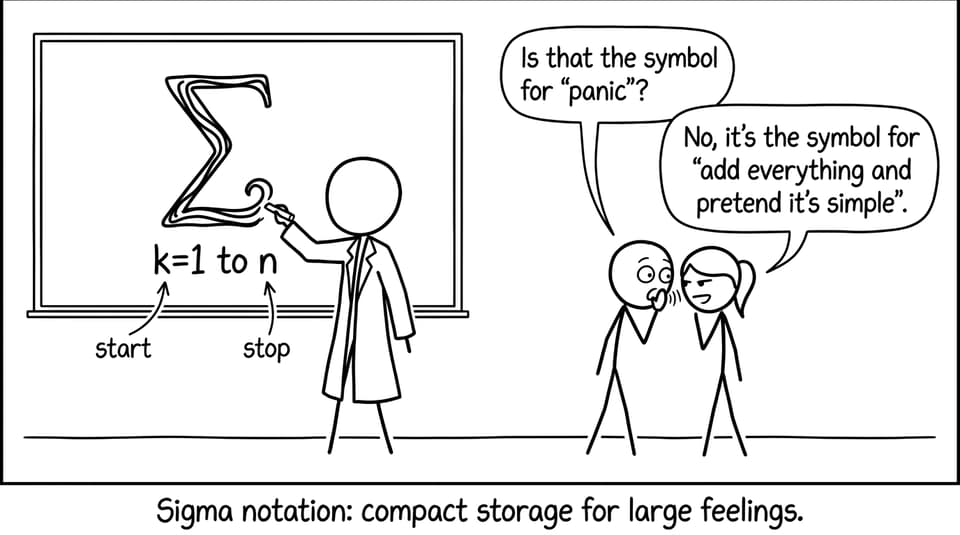
Sigma notation then hides repeated addition behind compact symbols. It’s efficient, but emotionally it feels like someone shrunk the working and dared you to expand it correctly.
Treat sigma as a sentence:
-
the bottom tells you where you start
-
the top tells you where you stop
-
the expression tells you what you add each time
When you practise, don’t just evaluate. Rewrite the first three terms explicitly. That single habit prevents most sigma errors in IB Math.
For a more guided skill build, pair this with How to Approach Sequences and Series Effectively (Flashcards) and then reinforce with SL 1.2 Flashcards.
How IB Math actually tests sequences and series
Across papers, the topic tends to show up as:
-
Identify the type (arithmetic vs geometric)
-
Find (d) or (r) from information
-
Write (u_n) cleanly
-
Switch correctly between sequence and series language
-
Interpret sigma notation without panic
This is where RevisionDojo becomes more than content. The Questionbank gives you volume, the Study Notes give you structure, and AI Chat helps you debug the exact step where your pattern-recognition broke. Add Flashcards for formulas, and you get a full loop.
If you’re close to exams, use IB Predicted Papers by IB Examiners (Free) to practise sequences and series in full-paper context, then review with Grading tools to see what method marks you missed.
Bringing it back to RevisionDojo
Sequences and series stop feeling abstract when you stop treating them like magic formulas and start treating them like stories about change: add, multiply, accumulate, repeat.
If you want that story to become automatic before exam day, use RevisionDojo as your practice engine: drill the topic with the Questionbank, lock in formulas with Flashcards, clarify steps with Study Notes and AI Chat, and then pressure-test everything with Predicted Papers, Mock Exams, and Grading tools. In IB Math, confidence isn’t a mindset. It’s a pattern you’ve seen enough times that it finally feels concrete.