



Why related rates feel impossible in IB Math
You sit down feeling oddly confident. You can differentiate polynomials. Chain rule? Fine. Implicit differentiation? Annoying, but manageable.
Then an IB Math related rates question shows up and everything melts. A cone is filling. A ladder is slipping. Two variables are changing together. You know it’s “just differentiation,” yet the page suddenly feels like it’s written in a different alphabet.
The truth is quiet: related rates problems don’t mainly test calculus. They test whether you can slow down long enough to build a model.
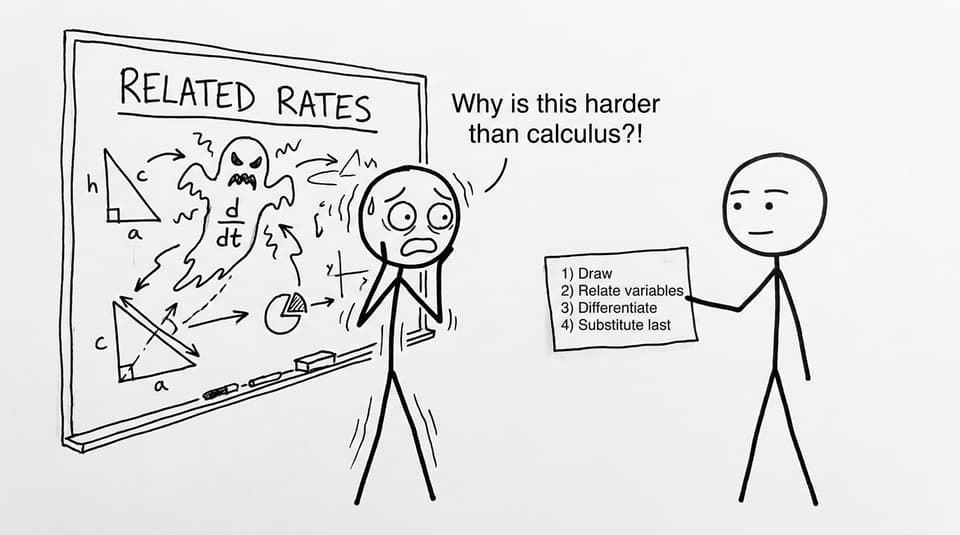
A quick related rates checklist (the part IB actually rewards)
Use this every time you do IB Math related rates:
-
Draw a simple diagram (even ugly is fine)
-
Define variables with units (what is changing? what is fixed?)
-
Write one relationship equation connecting the variables
-
Differentiate with respect to time (usually (t))
-
Substitute numbers at the end, at the stated instant
-
Sanity-check sign and units
For aligned practice on the exact syllabus area, the AHL 5.14 implicit functions, related rates, optimisation hub is the cleanest place to start.
The real reason IB Math related rates breaks your brain
Most topics in IB Math let you stay inside symbols. Related rates forces you to translate a story into math, then back into meaning.
That translation step is where students panic.
It’s also where examiners place marks.
When you write (V=\frac{1}{3}\pi r^2h), you’re not showing off a formula. You’re proving you understand the geometry. When you differentiate to get (\frac{dV}{dt}), you’re proving you understand that a derivative is a rate, not just a new expression.
If you want the theory refreshed, it helps to review the Calculus topic page for Math AA and then drill the exact style of questions in the Calculus Questionbank.
The two classic traps: “differentiate too early” and “substitute too early”
Differentiating too early
In IB Math, you only differentiate once you have a relationship that is definitely true for all times in the situation. If your relationship is wrong, your differentiation is beautifully useless.
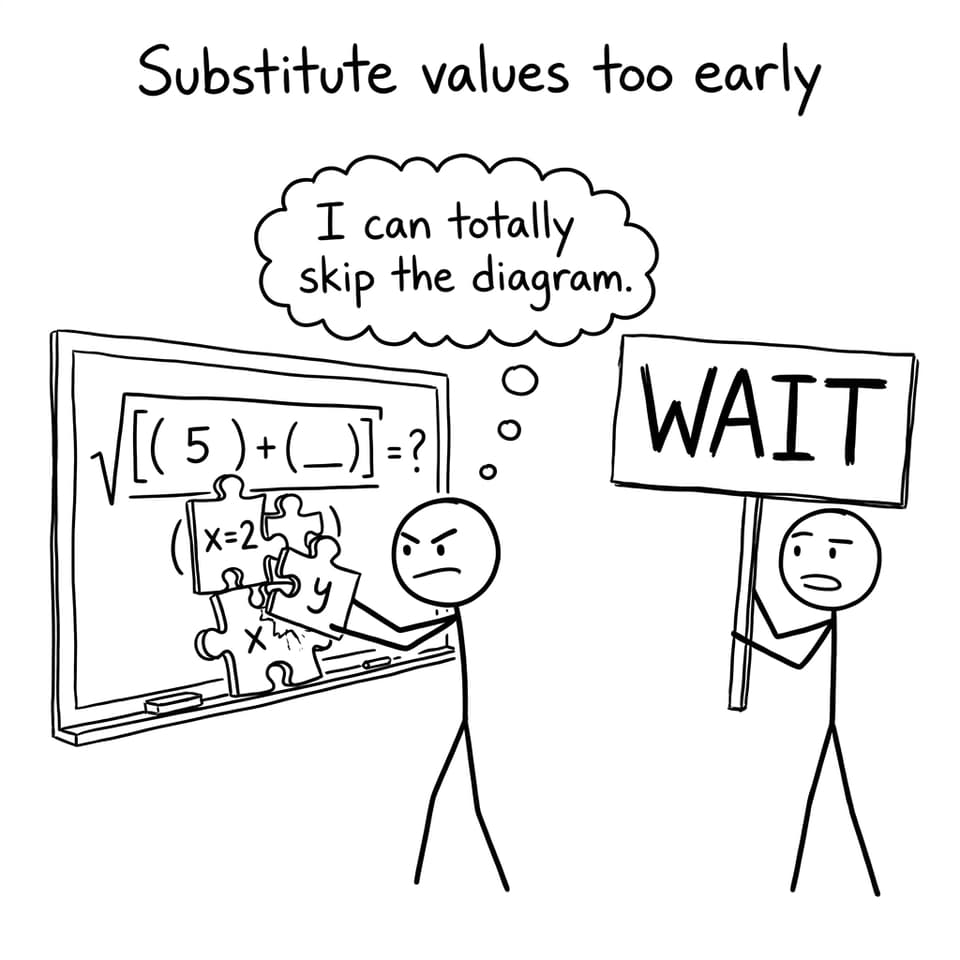
Substituting too early
Students often plug in the given numbers before differentiating. That usually freezes a variable that should still be changing, which breaks the chain rule logic.
If implicit differentiation itself feels like the stumbling block, read Why Is Implicit Differentiation So Confusing in IB Maths? and come back to related rates after.
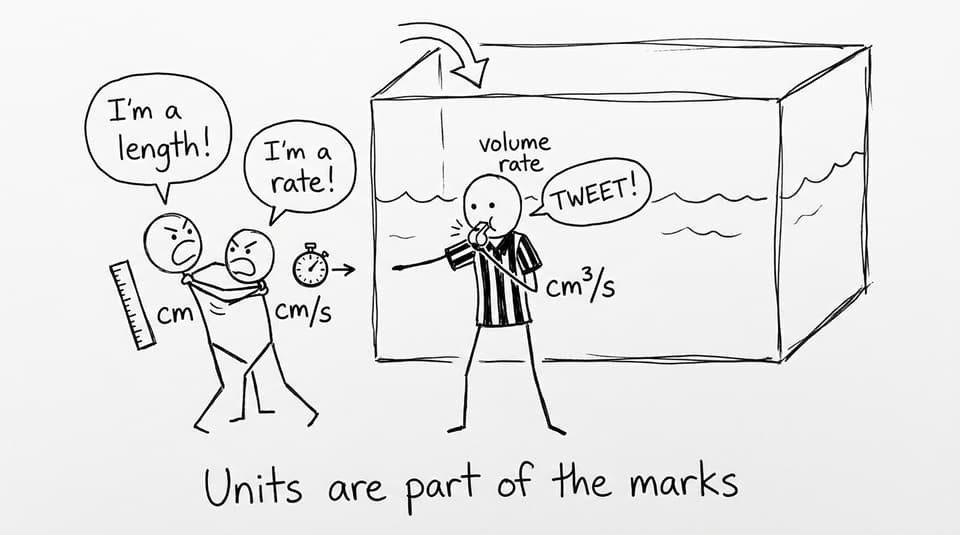
Units and signs: the “invisible marks” in IB Math
Related rates questions often hide easy marks in interpretation:
-
If a radius is shrinking, (\frac{dr}{dt}) should be negative.
-
If a volume is increasing, (\frac{dV}{dt}) should be positive.
-
Your final units must match the rate you found (length/time, area/time, volume/time).
This is why IB Math related rates can feel unfair: you can do the calculus correctly and still lose marks for physics-level common sense.
How to practise related rates without wasting hours
A smart loop for IB Math students preparing for exams:
-
Learn the pattern with the AHL 5.14 notes
-
Memorise the “moves” with the AHL 5.14 flashcards
-
Then grind exam-style setups in the AHL 5.14 Questionbank
When you want to simulate full-paper pressure (timing, stamina, decision-making), use RevisionDojo Predicted Papers and treat them like a rehearsal, then return to targeted drills.
The calm way to win at IB Math related rates
Related rates problems feel impossible when you treat them like a race. They become predictable when you treat them like a translation exercise: story to diagram, diagram to equation, equation to rates.
RevisionDojo is built for that exact shift. Use the Study Notes to see clean setups, the Flashcards to make the steps automatic, the Questionbank to practise under exam-style wording, and the AI Chat plus Grading tools to tighten your explanations. When you’re ready to test timing, add Predicted Papers and Mock Exams, and if you want guided support, the Tutors can walk you through the modelling step that most students skip.
If IB Math related rates is the topic that keeps stealing your confidence, make it the one you practise with structure. That’s usually all it was ever asking for.