


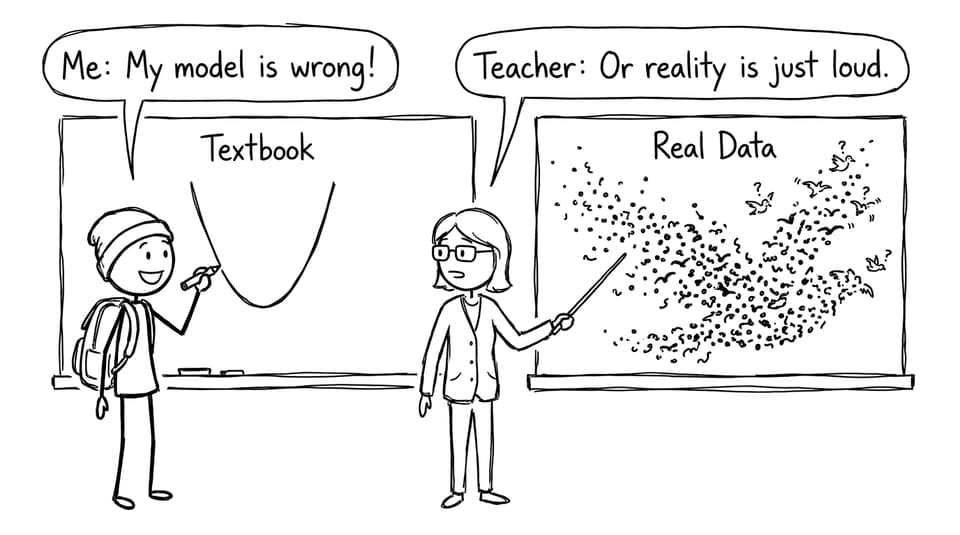
Many IB Math students have the same moment of panic: you plot real data, expecting a clean curve, and instead you get dots that look like they were sprinkled by accident. The textbook promised smooth parabolas and tidy exponentials. Reality hands you noise, gaps, and a trend that only appears if you squint.
Here’s the good news: in IB Math, that mismatch is not proof you’ve failed. It’s proof you’re doing modelling, the part of the course where you stop chasing perfection and start making judgement calls.
A quick IB Math checklist for messy graphs
Before you abandon your function, run this quick IB Math checklist:
-
Have you defined variables, units, and context clearly?
-
Is the domain realistic (time can’t be negative, populations can’t be -3)?
-
Are outliers real, or recording errors?
-
Does the model capture the overall trend (not every single point)?
-
Have you stated limitations (measurement error, missing variables, small sample size)?
If you want a structured starting point for modelling topics, open the IB Mathematics Applications & Interpretation hub and go straight to functions and modelling.
What textbook graphs are actually for (and why IB Math moves past them)
Textbook graphs are designed like training wheels. They isolate one idea at a time: “This is what exponential growth looks like.” “This is how a quadratic turns.” That’s why they assume things real life rarely gives you:
-
clean, exact measurements
-
smooth, continuous change
-
stable conditions
-
no unexpected interruptions
In IB Math, you’re eventually graded on something different: whether you can interpret a situation, choose a model, and explain what the model means. That’s why topics like SL 2.5 Modelling functions exist at all.
Why real-world functions rarely match textbook graphs
Real data is messy because reality is messy. Even when the underlying relationship is genuinely “quadratic-ish” or “exponential-ish,” your graph can look irregular for reasons that have nothing to do with your algebra.
Measurement error and rounding
Your device has limits. Timings are rounded. Sensors drift. People estimate. In IB Math, that error becomes visible as scatter.
Missing variables you didn’t measure
A textbook can control every variable. Real life can’t. Temperature, motivation, traffic, and random events all bend the pattern.
Conditions change over time
A model might fit well for a month, then break when behaviour changes. This is exactly why modelling is about “useful for now,” not “true forever.”
To practice how IB expects you to explain “useful but imperfect,” use the Functions Questionbank for Math AI and pay attention to the wording in the solutions.
The hidden reason students expect a perfect match in IB Math
Most students were trained in earlier years to treat maths like a lock-and-key problem: there’s one correct equation, and it fits exactly.
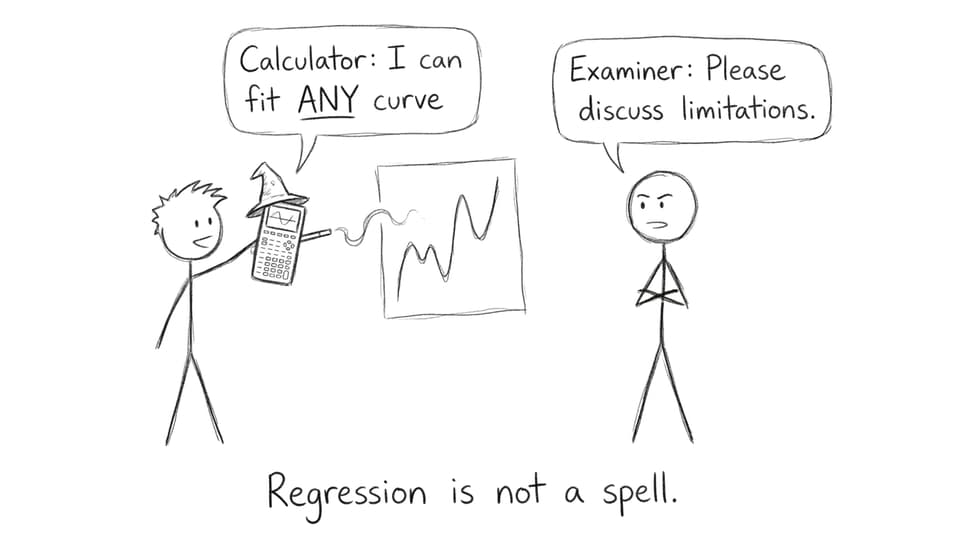
Then IB Math introduces regression, modelling, interpretation, and technology. Suddenly, you can produce an equation that looks sophisticated, but you still have to justify whether it makes sense. The discomfort isn’t because you’re “bad at functions.” It’s because the course quietly shifts you from certainty to judgement.
What IB Math examiners reward when graphs look imperfect
In modelling questions, examiners usually reward the student who communicates clearly over the student who forces perfection.
Here’s what strong IB Math answers tend to include:
-
a reasonable model choice (linear, quadratic, exponential, sinusoidal, logistic)
-
parameter meaning in context (what does the gradient or coefficient represent?)
-
cautious language: “suggests,” “approximately,” “within this interval”
-
limitations: outliers, sample size, measurement error, extrapolation risk
If you struggle with this writing style, the blog on why regression models never fit perfectly in IB Maths is a helpful mindset reset.
Domain is the bridge between functions and reality in IB Math
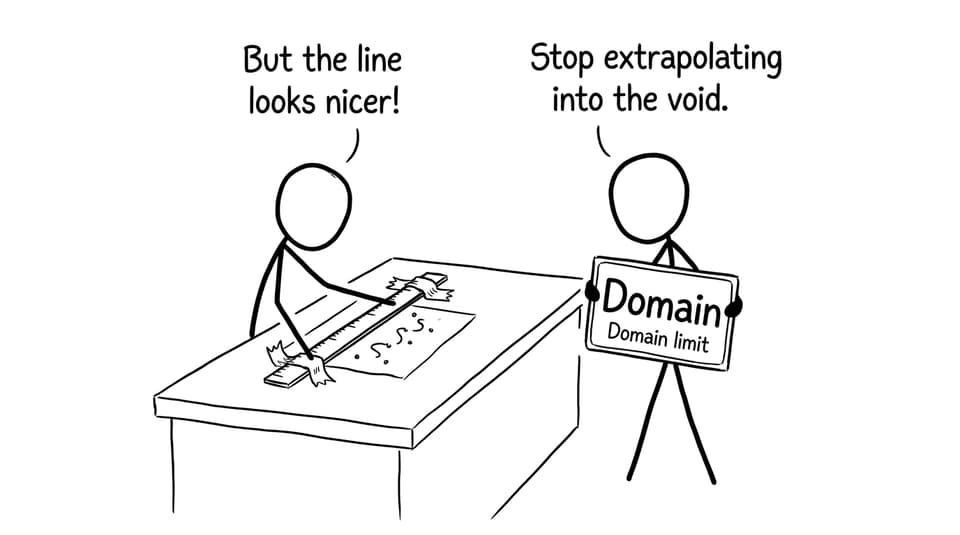
One of the fastest ways to lose marks in IB Math modelling is treating domain like a tiny footnote.
A function can be algebraically valid for all real numbers and still be nonsense in context. Domain is how you prove you understand the real-world limits of your model.
For a clear explanation (and examples of what examiners look for), see Why does domain matter more in real-world functions in IB Maths?
The takeaway (and how RevisionDojo helps)
Real-world functions rarely match textbook graphs because textbooks teach structure, while reality contains noise, missing variables, and changing conditions. In IB Math, your job isn’t to manufacture perfection; it’s to model thoughtfully, interpret cautiously, and communicate limitations like an examiner.
If you want that skill to feel automatic before exams, RevisionDojo is built for it: use the Study Notes to learn the model families, the Questionbank to practise exam-style prompts, Flashcards to lock in vocabulary, and AI Chat to sanity-check interpretations. Then level up with Grading tools, Mock Exams, and Predicted Papers for realistic timing and feedback (plus the Coursework Library and Tutors when you want a second set of expert eyes). Start with SL 2.6 Modelling skills notes and build from there.