



Why probability density functions feel unreal at first
In IB Math, probability usually starts with comforting objects: tables, lists, outcomes you can point at. You roll a die. You draw a card. You count. Then, almost quietly, the course swaps the world of countable outcomes for a smooth curve and says: now this is probability. If you’ve ever stared at a probability density function (PDF) and felt like it’s more art than math, you’re not behind. You’re just noticing the moment IB Math asks you to change how you think.
The awkwardness isn’t mainly about calculus. It’s about meaning. A PDF looks like a function you should be able to read directly. But the exam wants you to read it indirectly, through area and intervals.
The one-sentence mindset shift (quick checklist)
When PDFs feel abstract in IB Math, run this checklist before you calculate anything:
-
A PDF value f(x) is a density, not a probability.
-
Probability is area under the curve over an interval.
-
Total area over the domain must be 1.
-
Your biggest mark losses come from limits of integration, not integration skill.
-
Always respect the domain given in the question.
If you want the syllabus-aligned home base for this topic, start with Statistics & Probability for IB Math AA and keep it open while you practice.
What a probability density function is really telling you
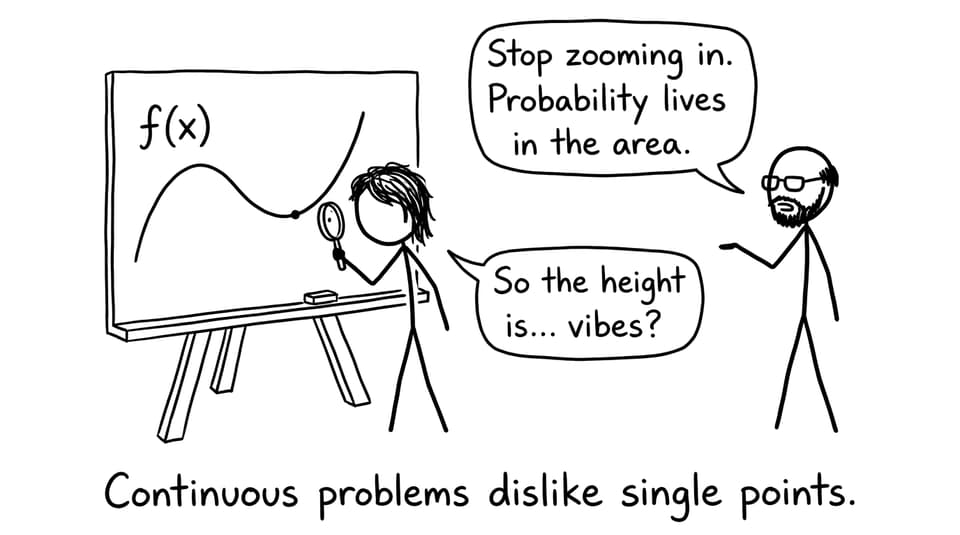
A probability density function in IB Math is like a heat map without the colors: it tells you where outcomes are more concentrated. High curve means “more crowded with probability nearby,” not “high probability at this exact x.”
That’s why PDFs feel abstract: the graph tempts you to read height as probability, because that’s how we read most graphs in school. But a PDF is closer to a distribution blueprint. You only get probability after you measure area.
A practical way to make it concrete is to sketch the interval you care about, shade under the curve, and treat the integral as “how much probability mass is in this slice.” This pairs naturally with RevisionDojo’s Statistics & Probability Notes, where the definition-and-interpretation pieces are kept close together.
Why “probability at a point” is always zero (and why that’s OK)
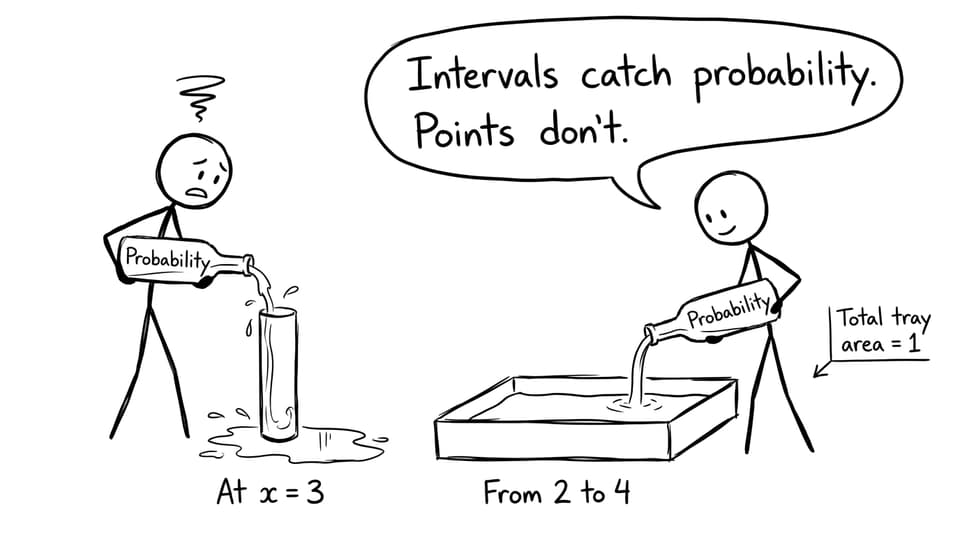
Students often hear: “For a continuous random variable, (P(X=a)=0).” In IB Math, that line can feel like a trick statement. But it’s actually a kindness: it forces you to stop thinking in single outcomes.
A single point has no width. No width means no area. And no area means no probability.
The part that’s subtle is this: zero probability does not mean “impossible.” It means “too small to measure as a chunk.” In a continuous model, outcomes are not counted one-by-one; they’re gathered by ranges.
Why integration shows up so suddenly in IB Math probability
Integration is the tool IB Math uses to turn “density” into “chance.” You’ll see the same core moves repeatedly:
-
Confirm a function is a valid PDF by checking (f(x)\ge 0) and total area equals 1.
-
Find a constant (k) (or (a)) by forcing the area to be 1.
-
Find (P(c \le X \le d)) using (\int_c^d f(x),dx).
If calculus feels fine but PDF questions still sting, it’s usually because the story in the question is telling you an interval and you’re translating it incorrectly.
To build that translation skill, it helps to alternate between concept review and targeted drills. RevisionDojo is built for that loop: use IB Math AA Calculus Notes for the integration mechanics, then switch to exam-style probability items in the AA question sets.
Limits of integration: where marks quietly disappear
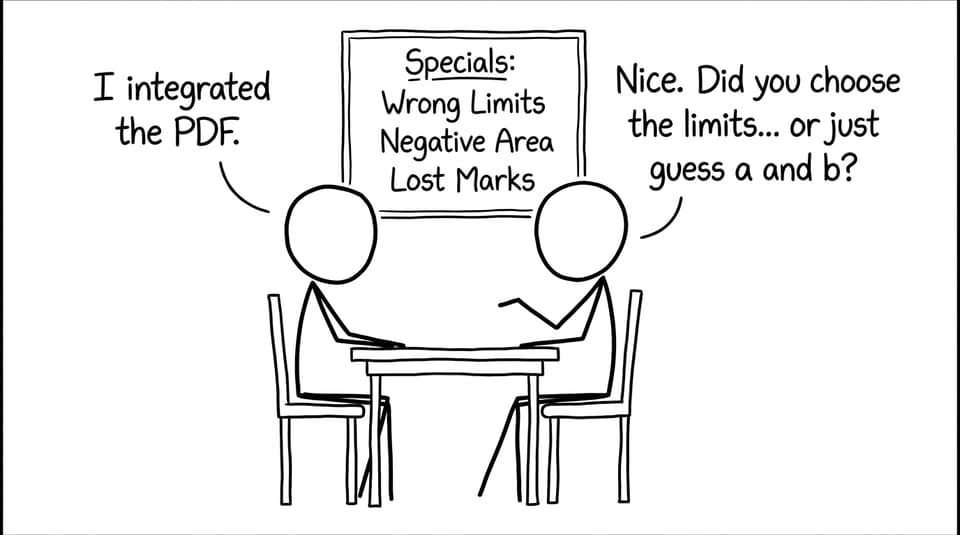
In IB Math, the integral is often the easy part. The limits are the real assessment.
A typical trap looks like this:
-
The PDF is defined on (), but the question describes a condition that shifts the interval.
-
The wording uses “at most,” “at least,” “between,” or “greater than,” and you rush.
-
A piecewise function changes form at a breakpoint, and you integrate only one piece.
To practice the exact skill of setting up probability intervals, use targeted tasks like Question Type 3: Finding the probability for a given PDF. For median-style setups, Question Type 4: Finding the median for a given PDF is a clean next step.
How IB Math tends to test PDFs
Most PDF questions in IB Math are variations of a few exam rhythms:
-
“Show that” a constant makes total probability 1.
-
Compute a probability over a stated interval.
-
Use a condition to find an unknown boundary (median, quartile, or a value (m)).
-
Connect the PDF to expectation/variance in a later part.
The fastest way to improve is not doing more random questions, but doing more similar questions until the setup becomes automatic. RevisionDojo’s AHL 4.14 Questionbank: discrete and continuous random variables is designed for exactly that kind of repetition with feedback.
Making PDFs feel less abstract (your next step)
If probability density functions feel abstract in IB Math, it’s usually because you’re trying to read a continuous model with discrete habits. Shift your attention from height to area. Shade intervals. Treat limits like the main event.
For a complete, exam-focused workflow, use RevisionDojo as your routine: learn the idea with Study Notes, lock in definitions with Flashcards, then sharpen setup and accuracy with the Questionbank, Mock Exams, Predicted Papers, and AI Chat. If you want feedback on written solutions, the Grading tools and Tutors can help you turn “I sort of get it” into consistent marks. Start with IB Mathematics Analysis and Approaches resources and make PDFs one of the easiest parts of your next revision cycle.