Piecewise functions don’t usually beat you with hard algebra. They beat you with a quiet switch.
One moment you’re doing normal IB Math: substitute, simplify, move on. The next moment, the same function asks you to pause, read a condition, and decide which “version” of it you’re allowed to use. That tiny decision feels awkward because it interrupts the flow your brain wants: one formula, one routine, one answer.
And that’s exactly why IB keeps using them.
The quick checklist that makes piecewise functions feel normal in IB Math
When a piecewise question shows up, run this mini-routine before you touch any algebra:
-
Identify the interval your input value belongs to
-
Rewrite the correct rule (just the one line you need)
-
Check the boundary point symbols: <, ≤, >, ≥
-
Only then substitute and simplify
-
If graphing, mark endpoints with clear open/closed circles
If you want a structured refresher on functions overall, keep a tab open for IB Mathematics Analysis and Approaches Functions while you practice.
What a piecewise function is really testing in IB Math
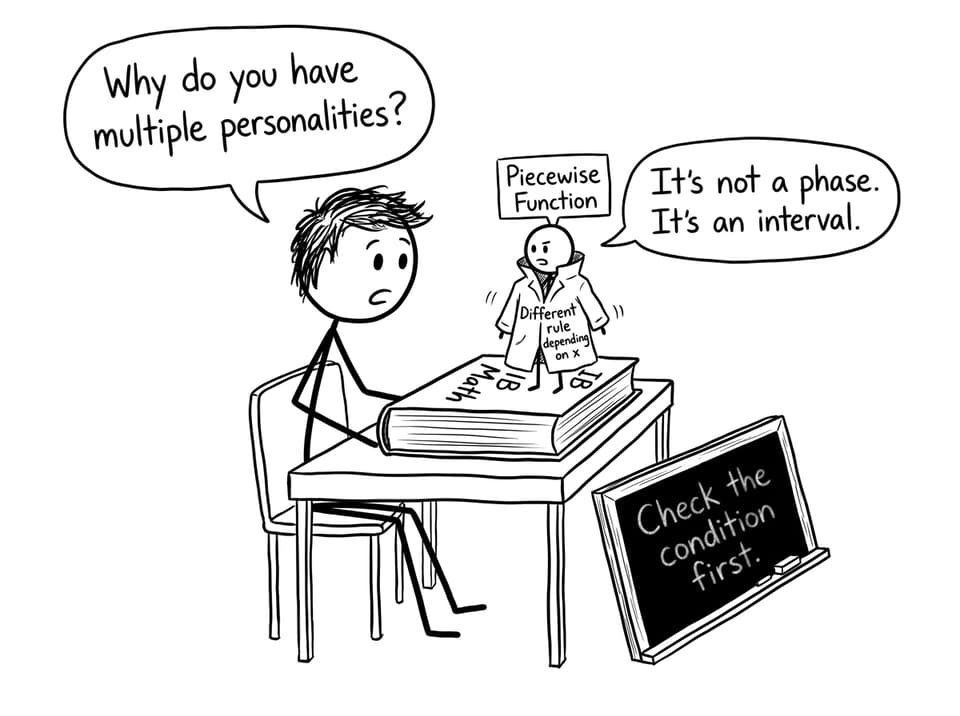
A piecewise function is just a function whose definition changes across its domain. That sounds fancy, but in IB Math it usually means: “Different rule, depending on x.”
The awkwardness comes from a mismatch between what students expect and what the function demands. Most of your earlier practice trains you to treat a function like a single machine. Piecewise functions act more like a building with multiple rooms: the output depends on which door you enter.
IB likes this because it reveals whether you actually understand domain, notation, and interpretation instead of only manipulation. If domain is already a sore spot, this companion read helps: Why Is Finding the Domain of a Function So Tricky in IB Maths?.
Why evaluation feels “fragmented” (and how marks get lost)
Most errors happen when students do the right substitution into the wrong rule.
That mistake isn’t stupidity. It’s momentum. Under time pressure, your brain sees an expression and wants to compute immediately. But piecewise evaluation in IB Math is a two-step task: decide, then compute.
A simple habit fixes most of it: write a one-line note like “Since (x= -1 < 0), use the first rule.” Examiners reward clarity, and you protect yourself from your own speed.
For targeted practice, RevisionDojo’s SL 2.2 Questionbank: functions, notation, domain, range, inverse is ideal because it repeats the decision-making step until it stops feeling special.
Graphing: the boundary-point “boss fight” in IB Math
Graphing piecewise functions feels awkward because you’re drawing multiple mini-graphs, and then you must be painfully honest about what happens at the edges.
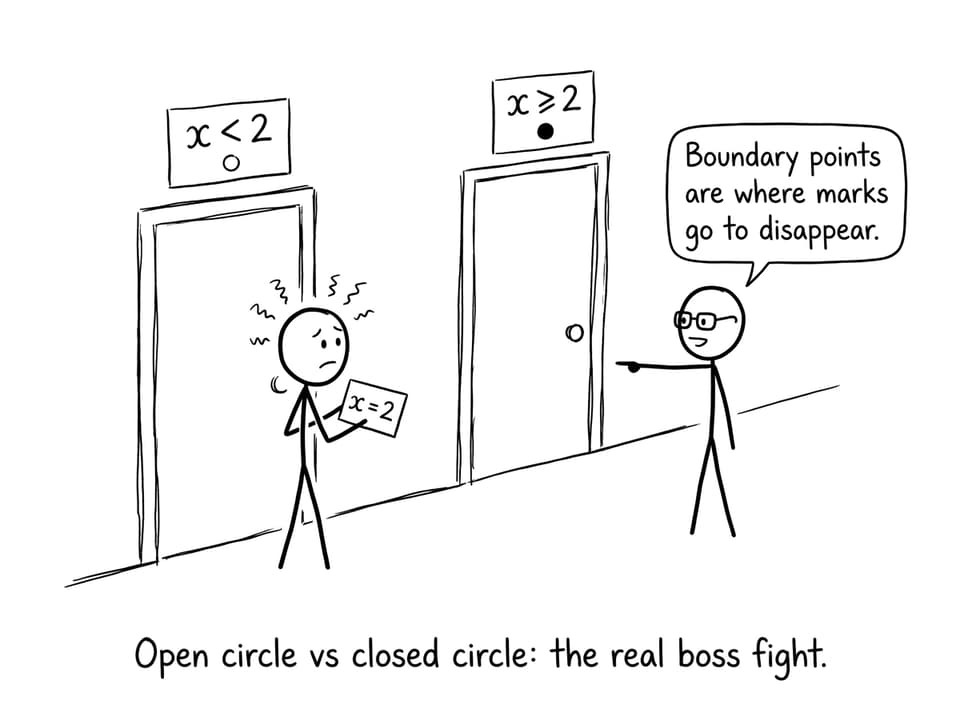
Boundary points are where students quietly donate marks.
-
If the interval includes the endpoint (≤ or ≥), use a closed dot.
-
If it excludes it (< or >), use an open dot.
-
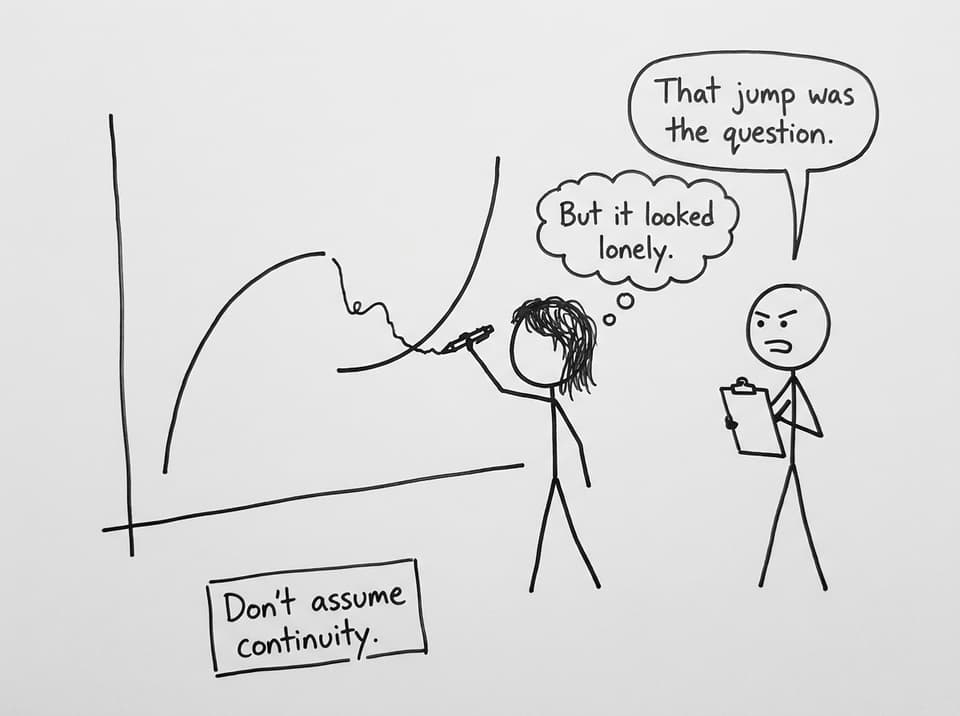
If the two pieces don’t meet, don’t “fix” it. The break may be the point.
If graphing is consistently costing you points, build the skill with the notes for SL 2.3 Graphing and then drill questions inside the Functions - IB Questionbank (Math AI) for extra variety.
Why IB Math uses piecewise functions so often
Piecewise functions show up because they model reality well: taxi fares change after a distance, tax rates change after an income threshold, and phone plans change after a data cap. But in exams, they also do something else.
They separate careful readers from fast calculators.
Piecewise questions naturally test:
-
interpreting conditions
-
domain restrictions and intervals
-
accuracy with endpoints
-
continuity vs discontinuity (especially near boundaries)
That’s why they connect nicely into later calculus thinking. If you’re revising AA, you’ll see the thread continue in places like the AA Calculus Questionbank.
Common IB Math mistakes (and the one fix that covers most of them)
Common mistakes:
-
choosing the wrong interval
-
ignoring what happens at the boundary
-
forgetting open vs closed circles
-
assuming continuity without checking
-
writing a correct graph but unclear endpoints
One fix covers most: treat the condition as part of the question, not decoration. Read it out loud in your head: “This rule is only true when…” That tiny pause makes piecewise functions feel less awkward in IB Math.
A calmer way to master awkward IB Math topics
Piecewise functions feel awkward in IB Math because they demand one extra habit: decide before you compute. The fastest students aren’t the ones who rush; they’re the ones who pause at the right moments.
If you want that pause to become automatic, use RevisionDojo as your training ground: the Questionbank for repetition, Study Notes for clarity, Flashcards for definitions, AI Chat for guided hints, and Grading tools to spot the exact step where you drift. Add Predicted Papers, Mock Exams, the Coursework Library, and Tutors when you want full exam readiness. Piecewise functions stop feeling awkward when you’ve seen enough of them, and RevisionDojo is built to get you there.