



Why Do Percentage Error Questions Feel Harder Than They Look in IB Maths?
The weird part about IB Math is that the questions that look “too easy to be worth marks” are often the ones that quietly drain your grade.
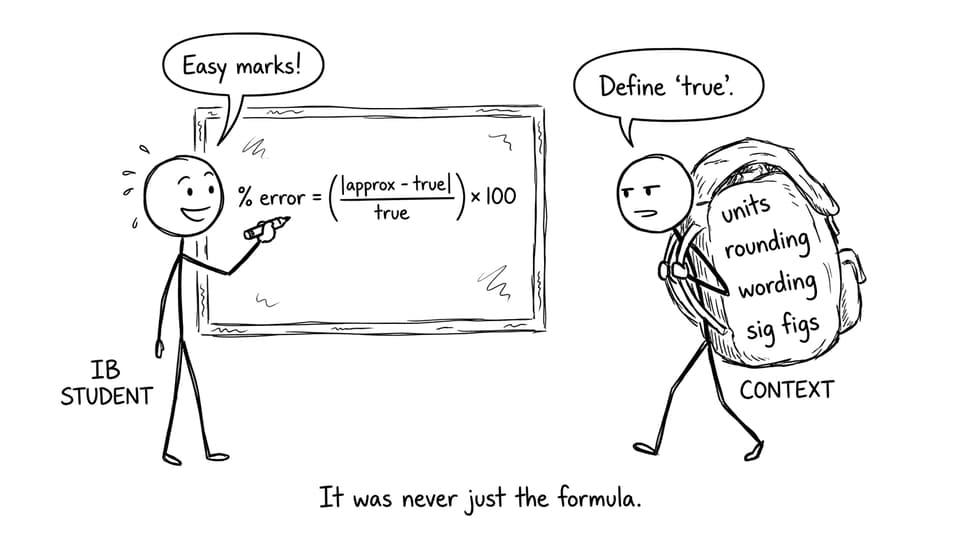
Percentage error is a perfect example. You know the formula. You can subtract. You can divide. And yet, in the exam, your brain freezes for half a second on one dangerous sentence: “the true value is…” or “an estimate is…” or “accurate to…”.
That half-second matters, because percentage error is rarely about arithmetic. In IB Math, it’s a test of interpretation: what counts as reality, what counts as an approximation, and whether your conclusion makes sense.
A quick checklist before you calculate (save marks fast)
Use this mini-routine every time a percentage error question shows up in IB Math:
-
Circle the true/accepted value (the reference).
-
Box the approximate/estimated/measured value (the attempt).
-
Write one line: “Error is measured relative to true.”
-
Only then use the formula.
-
Round at the end (unless the question forces earlier rounding).
-
Add one interpretation sentence if the question hints at “reasonable,” “reliable,” or “comment.”
If you want the official formula presentation, keep the IB Mathematics Applications & Interpretation Data Booklet open while you practise.
What percentage error is really measuring in IB Math
Percentage error measures the size of a mistake compared to the true value. That last part is the point.
In IB Math, the examiners are checking whether you understand relative accuracy. A difference of 2 is not always “small.” If the true value is 4, that’s massive. If the true value is 4000, it’s tiny. Same absolute error, totally different meaning.
This is why percentage error often appears alongside estimating, rounding, and modelling. If you’re revising the broader topic, start with SL 1.6 Approximating and estimating Questionbank and the matching SL 1.6 videos.
The “true vs measured” swap that costs the most marks
The most common error is painfully simple: dividing by the measured value.
Students do it because both numbers look equally “important,” and exam pressure makes you treat the formula like a reflex. But the structure is not arbitrary. You are measuring how far your approximation is from reality, and reality is the denominator.
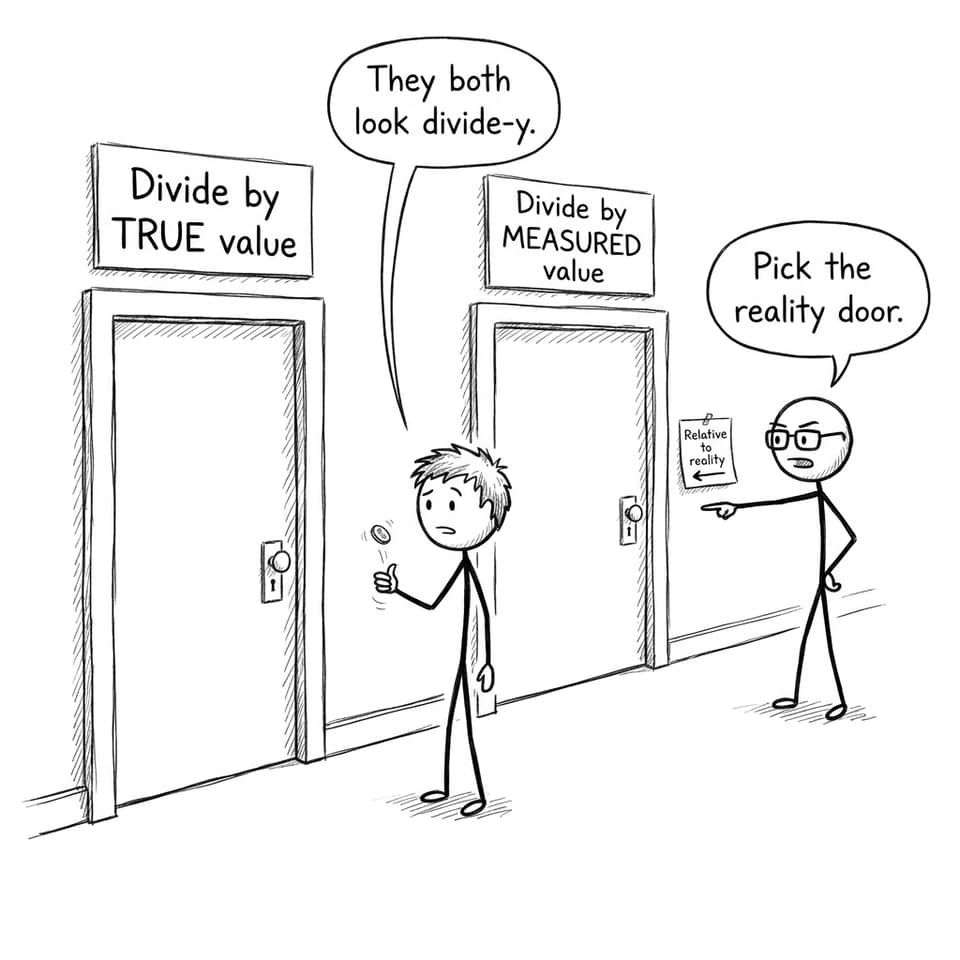
A good habit: rewrite the fraction in words before you compute.
“How big is the mistake, compared to the true value?”
That sentence alone fixes most percentage error slips in IB Math.
Why context makes percentage error feel harder than it is
Percentage error rarely arrives alone. It’s usually embedded inside something else: a geometry estimate, a technology output, a modelling assumption, or a multi-step calculation.
So the real challenge becomes reading.
In IB Math, you’re often doing two tasks:
-
Extract the two values from the story (true vs approximate).
-
Decide whether the final percentage error is acceptable in that context.
This is one reason students who are strong at manipulation still lose marks: they solved the wrong comparison perfectly.
To practise that “read then model” skill, do timed sets in the RevisionDojo IB Math AI hub and mix in interpretation-heavy topics like Trapezoid rule Questionbank, where percentage error often appears as a comparison between numerical and exact results.
Rounding turns an easy question into a trap
Another reason percentage error feels unfair in IB Math: rounding can change your final percentage more than you expect.
If you round the intermediate values too early, your percentage error becomes an error about your rounding, not about the estimate.
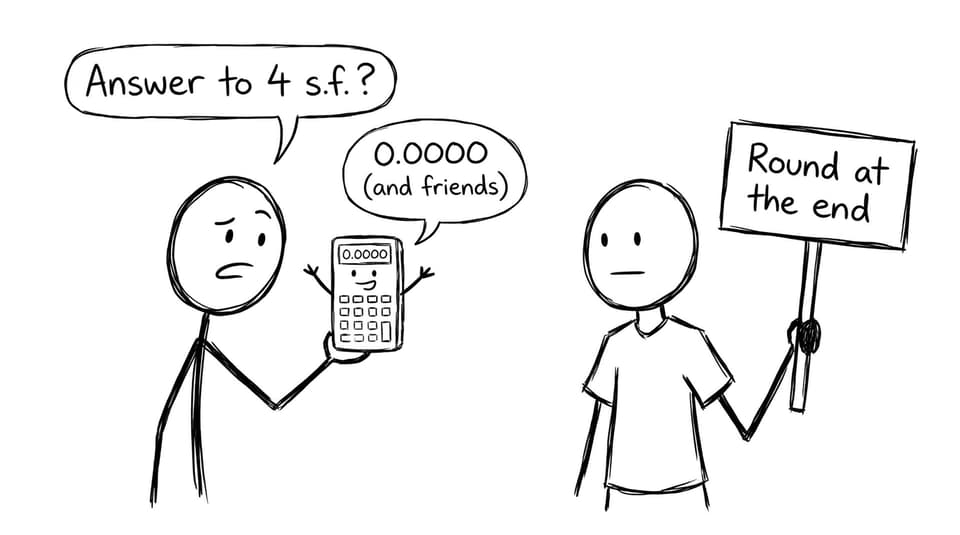
A useful cross-subject reminder comes from measurement thinking. RevisionDojo’s Uncertainties and errors notes explain why we delay rounding: you protect accuracy until the final step.
How to train percentage error the RevisionDojo way
Percentage error becomes easy when it becomes a habit.
A strong loop for IB Math exam prep:
-
Read one short explanation in Study Notes.
-
Do 10 targeted questions in the Questionbank.
-
Fix patterns using AI Chat (“Did I choose the correct reference value?”).
-
Re-test with a mini-timed set using Mock Exams or Predicted Papers.
-
Use Flashcards for the decision rules: “reference = true,” “round at the end,” “interpret in context.”
If you’re building overall exam confidence, pair this with Ace IB Math Applications and Interpretation Paper 2 and How to Use the Questionbank for Targeted Math Revision.
Conclusion: make percentage error boring again
Percentage error questions feel harder in IB Math because they test a hidden skill: choosing the correct comparison under pressure. Once you train that choice (true value as the reference, rounding at the end, one line of interpretation), the topic becomes pleasantly repetitive.
If you want that repetition done the smart way, RevisionDojo gives you the full system: exam-style Questionbank practice, calm Study Notes, rapid Flashcards, supportive AI Chat, and Grading tools that teach you how examiners award marks. Add Mock Exams, Predicted Papers, a Coursework Library, and Tutors when you need extra structure, and percentage error stops being a “trick” and becomes dependable marks in IB Math.