


Why optimization in IB Math feels like a trap
The first time an optimization question shows up, most IB Math students do the same thing: they reach for differentiation the way you reach for a calculator when you see scary numbers. It feels like the one solid tool in a foggy situation.
And then the fog wins.
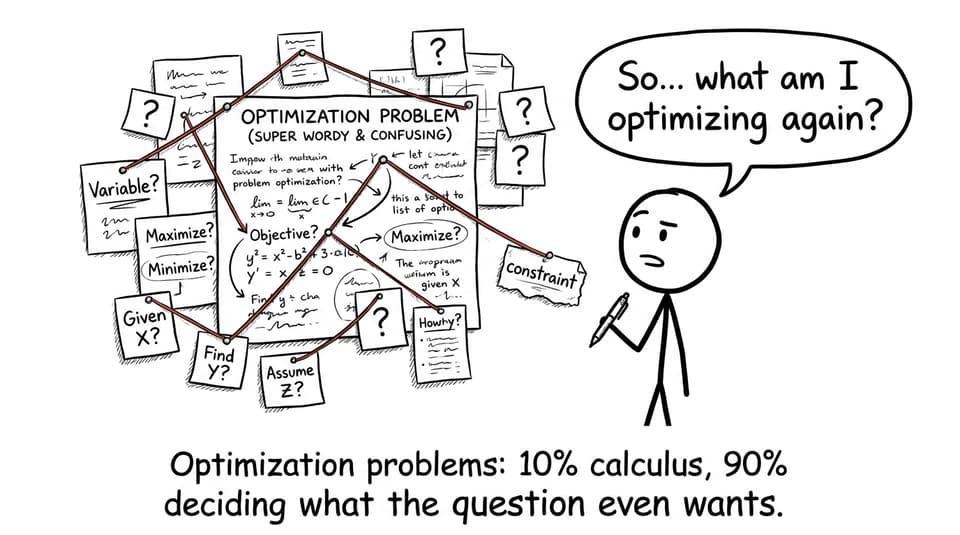
Because optimization is rarely testing your ability to differentiate. It’s testing whether you can decide what the question is actually asking, build a model that matches the story, and only then use calculus as the finishing move. The unpredictability comes from the choices you have to make before any algebra starts.
A quick IB Math optimization checklist (use this every time)
When an IB Math optimization problem feels unpredictable, use this short sequence to make it predictable:
-
Identify the quantity to optimize (area, volume, cost, distance, profit).
-
Define variables clearly and sketch a quick diagram.
-
Write the constraint equation(s).
-
Reduce the objective function to one variable.
-
Differentiate, solve for critical points, and test.
-
Interpret the answer in context (units, reasonableness, what the number means).
If you want structured practice that mirrors exam phrasing, start with RevisionDojo’s IB Math AA hub and then drill calculus modeling through the Calculus topic page.
What an optimization problem is really asking
In IB Math, an optimization problem asks for a maximum or minimum value under constraints. That sounds simple until you notice what the IB is really rewarding: the setup.
A routine differentiation question gives you the function. Optimization makes you build it. You must decide:
-
What quantity is the output you care about?
-
Which variable should drive the function?
-
Which relationships in the story are constraints?
That’s why these questions can feel “unfair.” They’re not random. They’re just more like real life: the math is clean, the translation is messy.
For a step-by-step method refresher, see How to Use Derivatives for Optimization Problems.
Why choosing the right variable is the hardest part
Most IB Math optimization problems start with two (or three) variables tied together by a condition: perimeter fixed, surface area fixed, distance constant, time limited.
Students often differentiate too early, while the function still has multiple variables. But examiners want to see you use the constraint to eliminate extras first.
A simple mental rule: if you can’t say “this is a function of x only,” you’re not ready to differentiate.
RevisionDojo’s Calculus Notes are useful here because they keep the algebra-to-calculus transition explicit, which is exactly where optimization errors happen.
Why modeling feels unfamiliar (even if your calculus is strong)
Optimization in IB Math is often wrapped in geometry, motion, packaging, or “real-world” business contexts. The diagrams are rarely complex, but the interpretation is.
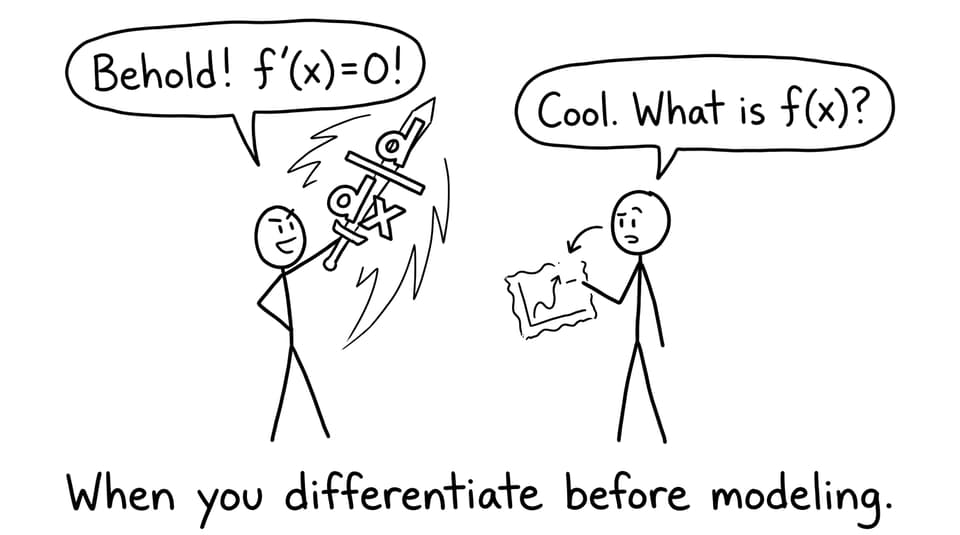
This is where strong students still lose marks: they do perfect calculus on the wrong model.
To make modeling less mysterious, practice the “translate, don’t guess” habit:
-
Rewrite the story as relationships.
-
Label everything.
-
State assumptions (even briefly).
-
Keep units consistent.
If you want a wider practice loop, combine RevisionDojo’s Questionbank practice with short review sessions from How to Review Complex Calculus Problems Systematically.
Why “maximum” and “minimum” aren’t always obvious
Another reason optimization feels unpredictable in IB Math: the objective isn’t always the first quantity mentioned.
IB questions frequently describe a situation with several tempting targets (area vs perimeter, distance vs time, profit vs revenue). If you rush, you can optimize the wrong thing while doing everything else correctly.
A calm fix: underline the command phrase and rewrite it as a sentence.
-
“Find the dimensions that maximize the area…” becomes: “My output is area.”
-
“Minimize the cost of materials…” becomes: “My output is cost.”
Why the final answer can feel unsatisfying
In IB Math, optimization answers often need justification and interpretation, not just a number.
The IB expects you to:
-
justify maximum/minimum (second derivative, endpoint check, or clear reasoning), and
-
interpret in context (dimensions, units, feasibility).
Stopping at “set f'(x)=0” is like stopping a story halfway through and asking for full credit.
Common optimization mistakes (and how to avoid them)
Most lost marks happen before differentiation:
-
Differentiating before reducing to one variable.
-
Writing a correct constraint but never substituting it.
-
Optimizing the wrong quantity.
-
Forgetting domain restrictions (lengths must be positive, angles realistic).
-
Not justifying why it’s a max/min.
RevisionDojo helps here because the platform isn’t just content. The AI Chat can diagnose where your setup went off-track, and the Grading tools help you practice writing the kind of justification that earns method marks.
Bring the unpredictability down to a system
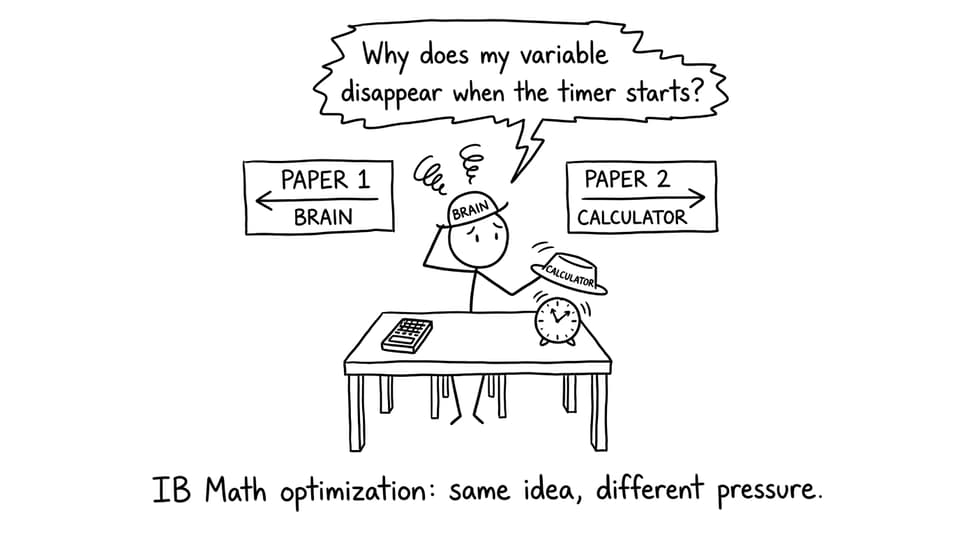
Optimization only feels unpredictable in IB Math when you treat it like a calculus problem. Treat it like a translation problem first: define, constrain, reduce, then differentiate.
If you want that system to become automatic, build a loop on RevisionDojo: read the relevant Study Notes, drill with the Questionbank, lock the patterns with Flashcards, ask AI Chat when your setup breaks, and test your timing with Mock Exams and Predicted Papers. When optimization stops being a surprise, it becomes one of the easiest places to pick up consistent method marks in IB Math.