


Logarithms have a special talent: they make smart IB students feel like they’ve forgotten how numbers work.
You can memorize the rules. You can press the right calculator buttons. And still, in IB Math, logs can feel like a trick question written by someone who enjoys watching confidence evaporate.
The real problem isn’t difficulty. It’s direction. Logarithms ask you to think in reverse, and most of your mathematical life has been spent moving forward.
A quick checklist for making logs feel less weird in IB Math
-
Translate every log into an exponential statement first.
-
Tie every log law to an exponent law (they’re the same story, different language).
-
Treat change of base as “same value, different measuring stick.”
-
In equations, check the domain after solving (but before boxing your answer).
-
Practice in exam format so the intuition holds under time pressure.
For targeted practice, the cleanest starting point is RevisionDojo’s IB Math hubs for Mathematics: Analysis and Approaches (AA) and its topic pages like Exponential and logarithmic functions (AA).
The “backwards question” that makes logarithms feel counterintuitive
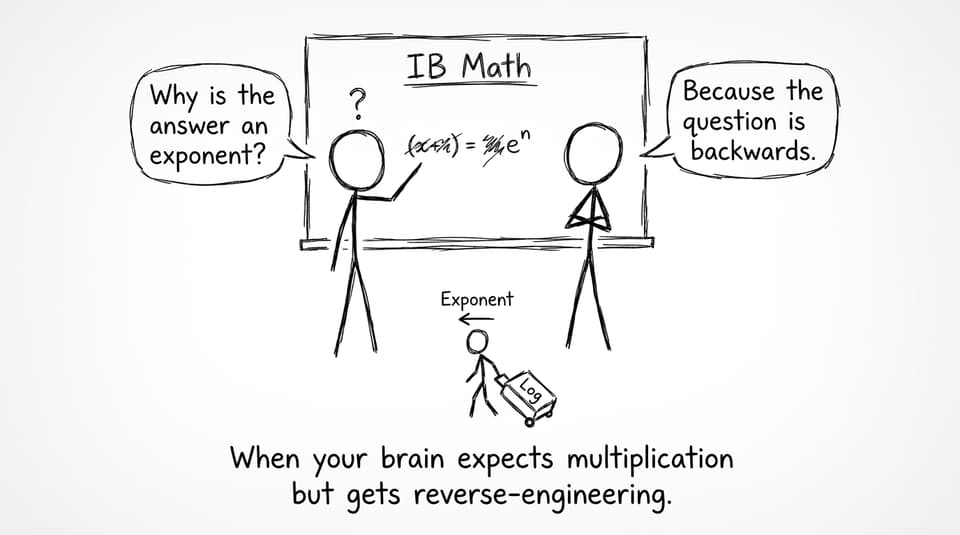
A logarithm is not asking, “What is the answer?” It’s asking, “What exponent would produce this answer?”
That subtle flip is why logs feel counterintuitive in IB Math.
When you see
your brain wants to compute something. But the log is really a translation:
So the log isn’t a new operation as much as a new viewpoint. It’s exponentiation seen from the other side of the mirror.
If you want a clean explanation plus examples you can copy into your notes, use Logarithms explained for IB Maths (AA SL & HL).
Why log rules feel like random “tricks” in IB Math
The product, quotient, and power rules feel like magic if you learn them as standalone moves.
But in IB Math, every log law is just an exponent law wearing a different coat.
-
Product rule comes from (a^{m} \cdot a^{n}=a^{m+n})
-
Quotient rule comes from (a^{m}/a^{n}=a^{m-n})
-
Power rule comes from ((a^{m})^{n}=a^{mn})
When you connect them back to indices, the rules stop being “steps to remember” and become “consequences you expect.” For a focused refresher, see Laws of exponents explained for IB Maths and Laws of logarithms explained for IB Maths.
RevisionDojo’s Flashcards are especially useful here: the goal isn’t rote memory, it’s fast recall of the exponent link when the exam clock is loud.
Why change of base feels pointless (until it isn’t)
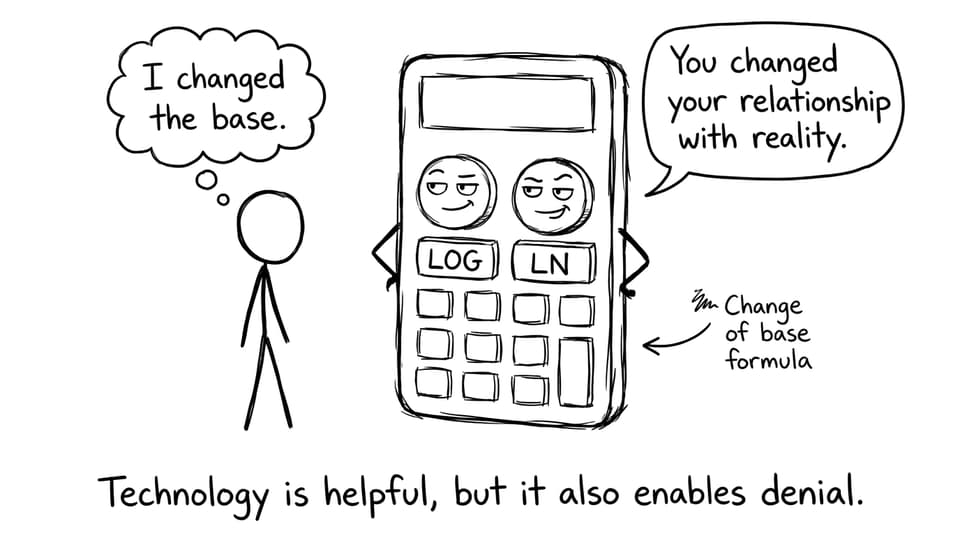
Change of base often gets treated like a formula you apply because the calculator insists.
But the deeper idea in IB Math is: the logarithm’s value doesn’t change when you change the base. Only the language changes.
You’re saying, “I can measure this exponent question using base 10 or base (e) if that’s what my tool supports.”
Use RevisionDojo’s breakdown here: Change of base formula explained for IB Maths.
The sneakiest reason you lose marks: the domain
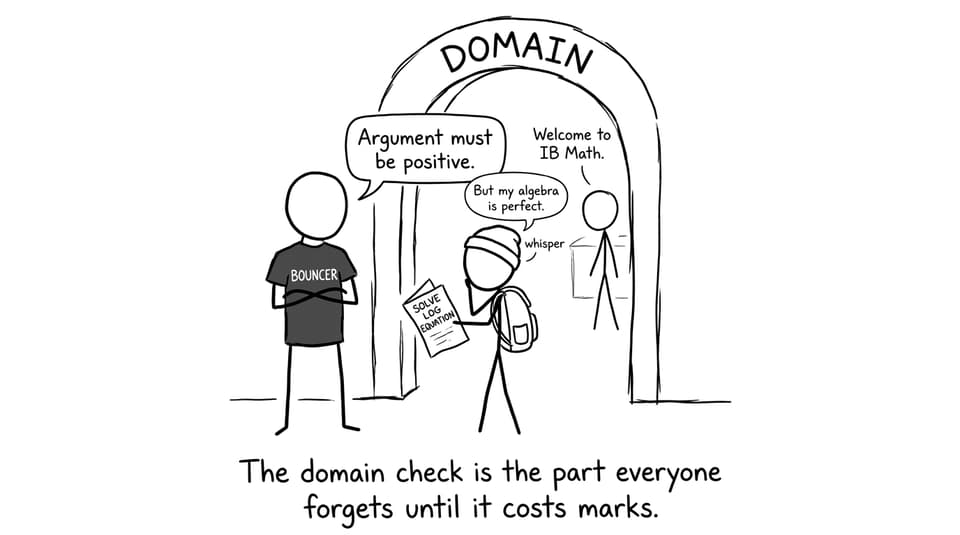
Logs don’t forgive.
If the argument isn’t positive, the expression isn’t defined (in the real-number IB Math world you’re examined in). That’s why “perfect algebra” can still earn a penalty: you solved an equation that secretly stopped making sense.
A reliable exam habit:
-
Solve.
-
Write the restriction(s) clearly.
-
Check each solution against the restriction.
Practice these in an exam-like format using the RevisionDojo Questionbank, such as AA SL 2.9 Exponential and logarithmic functions Questionbank or AA SL 1.5 Intro to logs Questionbank.
Bringing it together (and making it exam-ready)
Logarithms feel counterintuitive in IB Math because they ask a different kind of question: not “what is the result?” but “what exponent produced this result?” Once you translate that question, the rules, base changes, and domain checks stop being random hurdles and start becoming one connected system.
If you want that system to hold under exam pressure, build it the same way you’ll be assessed: with clear notes, spaced recall, and exam-style questions. RevisionDojo ties it all together with Study Notes, Flashcards, the Questionbank, AI Chat, Mock Exams, Predicted Papers, a Coursework Library, and Tutors when you want a human to check your thinking.
For more logarithm support, browse the IB Math blog tag and keep your practice anchored to the way IB Math actually asks questions.


