
Why IB Math questions don’t hand you finance formulas
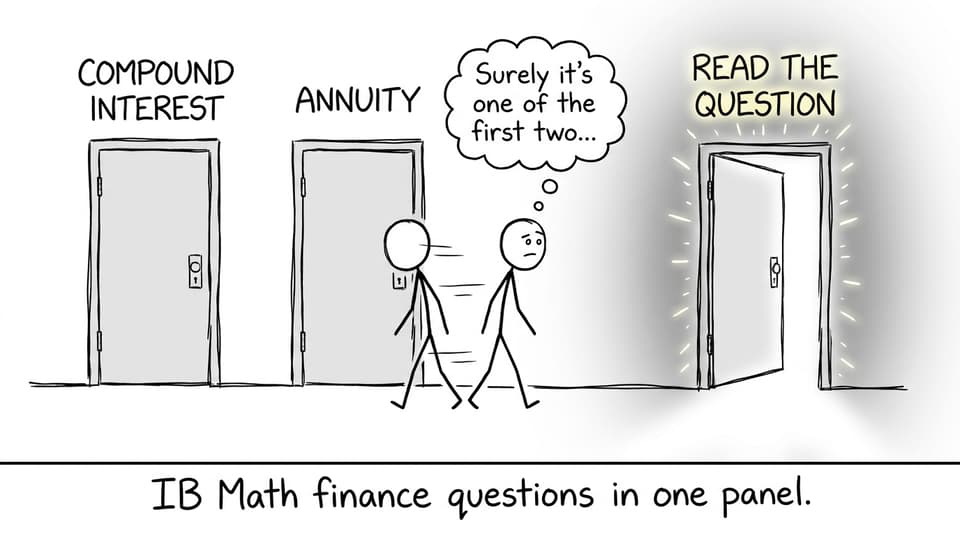
You’re halfway through a finance word problem, your calculator is ready, and your brain is waiting for the polite line that would make everything easy: “Use the compound interest formula.” It never arrives.
That absence can feel personal. But in IB Math, it’s purposeful. The exam isn’t trying to see whether you can recite a formula from memory. It’s trying to see whether you can read a messy real-world story, choose a model, and defend your choices like someone who actually understands money over time.

The quick checklist IB Math wants you to run
Before you touch any buttons, pause and check:
-
What is changing? Balance growing, shrinking, or being paid down?
-
Is money added regularly? (Deposits, repayments, fees.)
-
What’s the time unit? Months vs years is where marks disappear.
-
Is there context to interpret? “Better off,” “affordable,” “in real terms,” etc.
-
What tool fits best? Finance solver, recursion, geometric sequence, spreadsheet.
If you want structured practice with these decision points, start from the IB Mathematics Applications & Interpretation hub and build the habit with targeted questions.
Why IB Math avoids giving the formula directly
In real finance, problems don’t show up labeled as “annuity” or “loan amortization.” They show up as narratives: a savings plan, a mortgage offer, a car losing value, a retirement contribution with a changing rate. The hardest part is not computation. It’s recognising the structure.
That’s the heart of IB Math (especially Applications & Interpretation): modelling judgement.
When the exam withholds the formula, it forces you to demonstrate that you can:
-
identify the financial pattern from words,
-
choose a reasonable model,
-
use technology correctly,
-
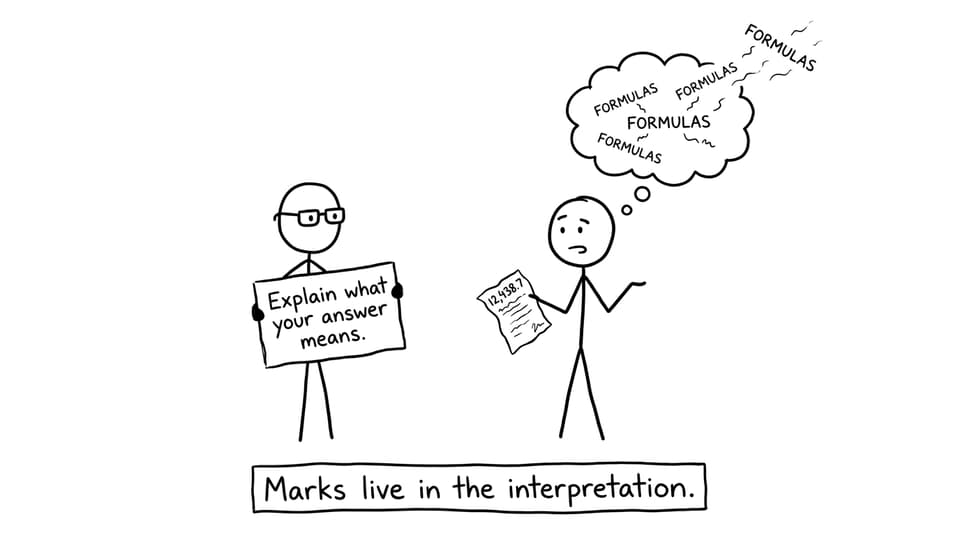
interpret what the answer actually means.
For a clear topic refresher, see Financial Mathematics in IB Math: A Clear Guide.
“But I memorised the formulas” (and why that can backfire)
Memorisation can create a dangerous kind of confidence: you feel fast, but only when the question matches the template in your head.
In IB Math, finance questions often change one small detail that flips the model:
-
interest is compounded monthly, but time is given in years,
-
payments are made at the beginning of each period, not the end,
-
inflation changes what “value” even means,
-
a balance both earns interest and receives deposits.
That’s why you’ll see students apply a correct-looking formula to the wrong situation. The work seems neat. The model is wrong.
Why technology is part of the assessment
IB expects you to use your calculator intelligently. In many cases, the “formula” is effectively embedded inside finance functions and numerical solvers. The skill being assessed is whether you can set it up, choose inputs that match the context, and then explain the output.
RevisionDojo is built around that exact loop:
-
Study Notes to learn the model, not just the algebra
-
Questionbank to practise recognition under pressure
-
AI Chat to ask “what model is this?” and get a guided explanation
-
Grading tools to check whether your interpretation earns marks
-
Flashcards to lock in key cues (payment timing, compounding frequency)
-
Mock Exams and Predicted Papers to rehearse realistic wording
-
Tutors when you need a human to debug your thinking
To support the formula side without turning it into a crutch, keep the IB Math AI Data Booklet bookmarked.
Common mistakes in IB Math finance questions
Most errors come from reading the story too quickly:
-
waiting for a formula prompt that never comes,
-
mixing time units (months vs years),
-
using a nominal rate when the question is about real value,
-
treating every scenario as compound interest,
-
giving a number but not an interpretation.
Inflation is a classic trap because it changes the meaning of “growth.” Use When Should Inflation Be Included in IB Financial Modelling Questions? to build a simple rule for when to include it.
How to train for formula-free finance questions
A calm method beats a clever one:
-
Rewrite the story as a cash-flow timeline (even quick bullet points).
-
Decide whether this is growth, decay, repayments, or repeated deposits.
-
Match rate and time period carefully.
-
Use calculator technology, but write one sentence explaining what you modelled.
-
Sanity check: does the direction of change make sense?
Then practise that method on repeat using Number and Algebra question practice for Math AI and the Functions questionbank, because many finance setups are really function models in disguise.
Conclusion: model first, compute second
The reason IB Math questions avoid giving financial formulas directly is simple: the formula is rarely the hard part. The hard part is recognising the model hiding inside the words, setting it up cleanly, and explaining what the answer means.
If you want that skill to feel automatic, build a repeatable routine on RevisionDojo: learn the model in Study Notes, drill it in the Questionbank, ask AI Chat when you’re unsure, and pressure-test yourself with Mock Exams and Predicted Papers. That’s how you walk into finance questions calm, even when the exam refuses to hold your hand.


