



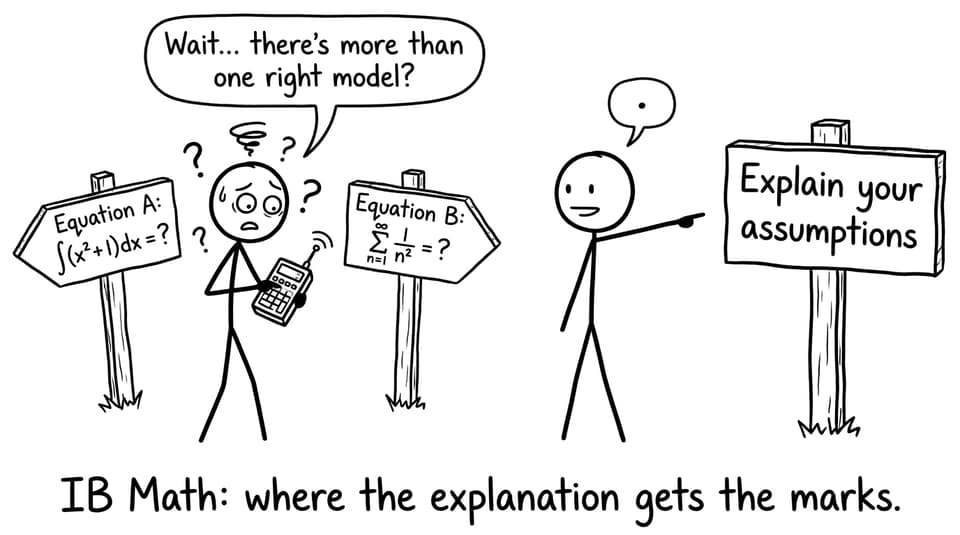
If you’ve ever finished an IB Math modelling question, compared answers with a friend, and discovered you both got full marks with different equations, you’re not imagining it. In fact, that moment is one of the most honest lessons the course can teach: the world rarely hands you a single perfect model. It hands you a situation, some data, and a deadline.
That’s why IB Math questions can accept multiple valid models. The exam isn’t a hunt for the one “secret” function. It’s a test of whether you can choose a reasonable approach, explain your assumptions, use the model consistently, and interpret the result like someone who understands what their maths is doing.
What “multiple valid models” means in IB Math
In IB Math, a “model” is your mathematical story for a real situation: the type of function you choose, how you estimate parameters, what you assume stays constant, and what you ignore.
Multiple valid models simply means there can be more than one mathematically defensible story.
Examples you’ll see often in IB Math AI:
-
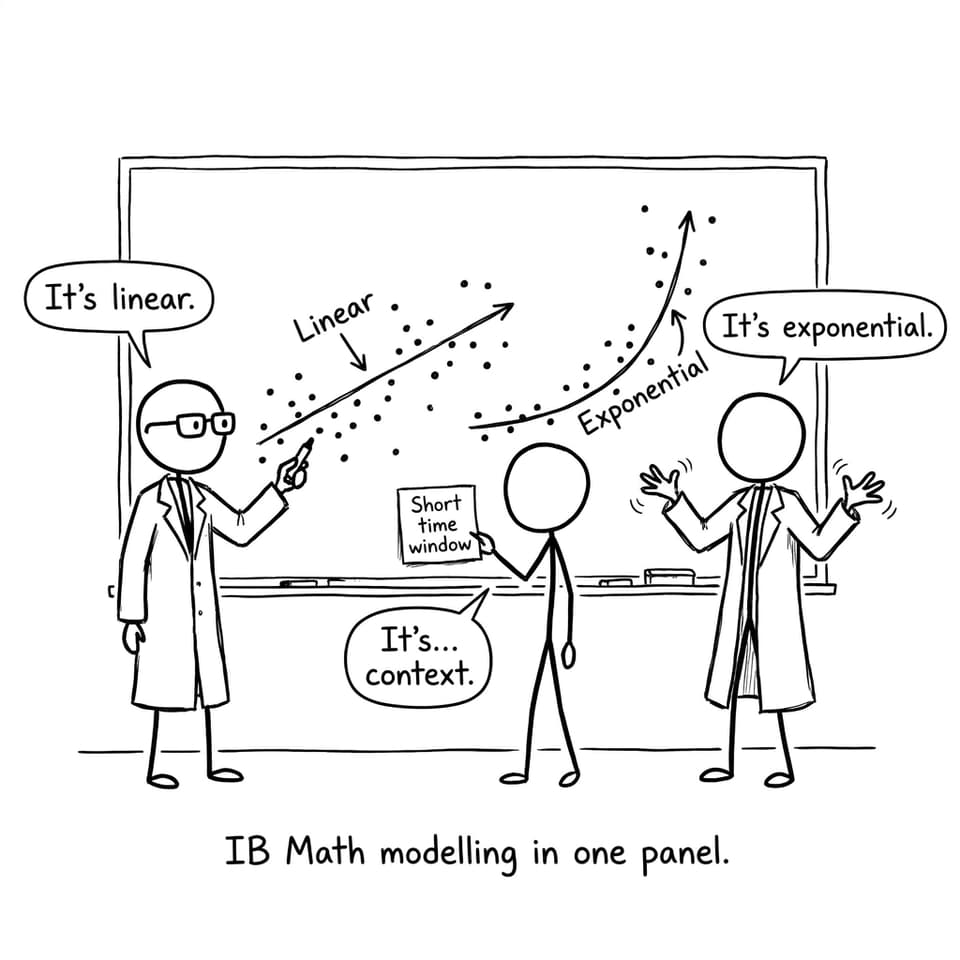
A linear vs exponential model over a short interval (both can look plausible).
-
Different regressions that fit a dataset similarly well.
-
Two models with different assumptions that still lead to sensible predictions.
The point isn’t perfection. The point is appropriateness.
To see how this shows up in the syllabus areas that repeatedly test modelling, start with the IB Mathematics Applications & Interpretation Resources.
Why real-world modelling rarely has one “correct” answer
Real data is noisy. Measurements are rounded. People behave inconsistently. Samples are small. Outliers exist.
So two different IB Math models can both be reasonable because they prioritise different truths:
-
One model may be simpler and easier to interpret.
-
Another may fit slightly better but require stronger assumptions.
-
A third might work only within a restricted domain (and that restriction is the key insight).
This is exactly why the course spends time on modelling skills. If you want a targeted place to practise those decision-making steps, drill them directly in SL 2.6 Modelling skills.
A quick checklist: how to earn marks when models differ
Use this checklist whenever an IB Math question feels “open-ended”:
-
Define variables clearly (with units).
-
Choose a model family (linear, exponential, quadratic, sinusoidal, etc.).
-
State 1-2 assumptions in plain language.
-
Use the model consistently (don’t swap halfway without explaining).
-
Interpret parameters and outputs in context.
-
Comment on limitations (outliers, domain, sample size, extrapolation).
That last bullet is where many students quietly lose marks.
What examiners actually look for in IB Math modelling
Examiners aren’t grading your personality. They’re grading evidence.
Across IB Math modelling questions, they tend to reward:
-
Logical consistency: your method matches your model.
-
Clear assumptions: you state what must be true for your model to work.
-
Reasonable interpretation: you explain what the numbers mean in context.
-
Awareness of limitations: you know where your model could break.
This is why regression questions in IB Math don’t end at “find the equation.” They often want evaluation. If regression has ever felt unsettling, read Why Do Regression Models Never Fit Perfectly in IB Maths? and pair it with Why Residual Analysis Is More Important Than the Regression Equation.
Why justification matters more than the model you pick
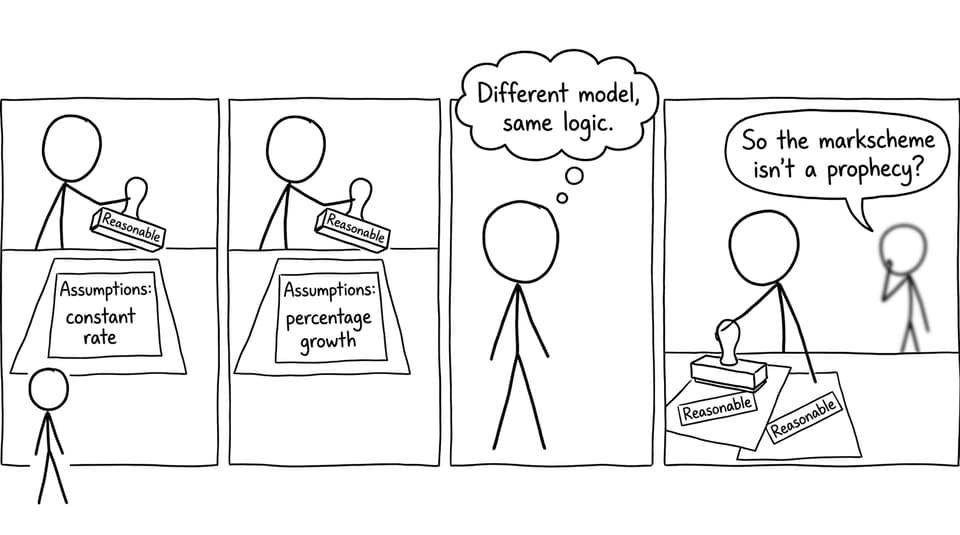
In IB Math, model choice alone rarely earns the big marks. The explanation does.
A single sentence can protect your solution:
“An exponential model is reasonable because the rate of change appears proportional to the current value over the observed interval.”
Or:
“A linear model is appropriate for this short time window because the data shows an approximately constant increase and extrapolation is not required.”
If you’re practising for Paper 2 and noticing how often interpretation marks decide your grade, this guide helps: Ace IB Math Applications and Interpretation Paper 2.
Common mistakes students make with IB Math model flexibility
Most mistakes aren’t “wrong maths.” They’re missing communication.
Common IB Math traps:
-
Treating the markscheme like a single sacred method.
-
Switching models mid-solution without saying why.
-
Writing no assumptions, then hoping the examiner reads your mind.
-
Overfitting because a high R² feels comforting.
-
Making big conclusions without mentioning limitations.
If you want structured practice that trains you to write what examiners want to see, use the loop in RevisionDojo: Study Notes to learn the method, Flashcards to keep the language sharp, and the Questionbank to practise under real exam-style prompts. For a clean starting point, use How to Use the Questionbank for Targeted Math Revision and then practise modelling-heavy sets in the Functions Questionbank.
Closing: turn “multiple models” into an advantage
The fastest way to feel calmer in IB Math is to stop treating modelling as a guessing game and start treating it as a short written argument: choice, assumptions, method, interpretation, limitations.
RevisionDojo is built for that exact skill. Use the AI Chat when you’re unsure how to justify a model in words, the Grading tools to check whether your explanation would earn communication marks, and the Mock Exams plus Predicted Papers to rehearse model decisions under time pressure (start at IB Predicted Papers by IB Examiners and the Math AI Predicted Papers hub). When you practise like this, “multiple valid models” stops feeling risky and starts feeling like extra room to score.