

In the middle of an IB Math exam, you finally get a sequence to behave. You set up the recursion, punch the calculator, and it spits out a number so long it looks like a password generator.
Then you notice the quiet sentence in the question: “Give your answer correct to 3 significant figures.”
If you’ve been trained to treat “exact” as “safe,” that instruction can feel like a trap. But in IB Math, approximation in sequences isn’t a loophole. It’s the point.
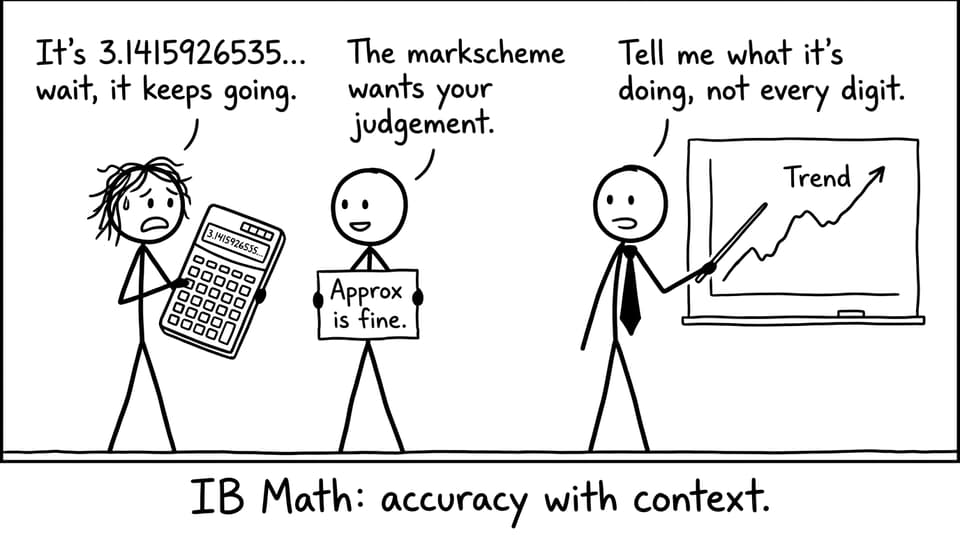
The quick checklist: what approximation is testing in IB Math
When IB Math lets you approximate in sequences, examiners are usually checking whether you can:
-
Identify long-term behaviour (growth, decay, convergence, divergence)
-
Interpret a model in context (money, population, iteration, error)
-
Use technology efficiently without worshipping every digit
-
Round reasonably and explain what the rounded value means
For targeted practice, use a topic hub like Mathematics Applications & Interpretation (AI) and drill sequences alongside interpretation-heavy questions.
Why IB Math cares more about behaviour than perfect arithmetic
Sequences are stories about change. Term-by-term change. Trend-by-trend change.
In real modelling, you rarely know inputs perfectly, and even if you did, the output can become meaningless if it’s too precise to interpret. IB Math uses approximation to pull you away from “calculator gymnastics” and toward the bigger question: what is this sequence doing?
That’s also why sequence skills are taught alongside sigma notation and modelling tools in SL 1.2: Sequences and Sigma Notation. The syllabus lives in patterns, not in digits.
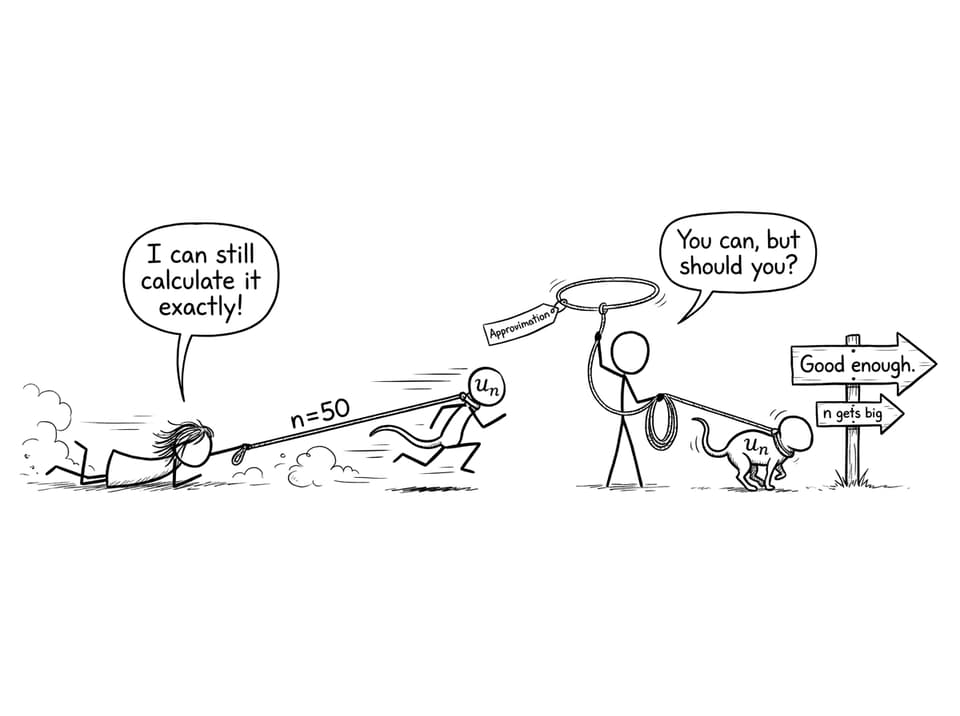
Why exact values become impractical in sequence questions
Some sequences behave politely for the first few terms and then explode. Others shrink so fast that terms become effectively zero. Either way, exactness can become a time sink.
In IB Math, the exam is designed around decisions under pressure. If a term like (u_{50}) is enormous, the examiner often doesn’t care about the exact integer. They care whether you can judge:
-
The scale (is it tens, thousands, or billions?)
-
The rate (linear vs exponential feel)
-
The reasonableness in context (does it match the model?)
If you want the underlying mechanics refreshed, pair practice with notes such as SL 1.2 Arithmetic sequences and series.
Why you see approximation more often in Applications & Interpretation
In IB Math AI, the course leans into realism: finance, data, iteration, technology, and decision-making. Approximation matches how analysts actually work.
That’s why you’ll see approximation appear naturally next to tools like formula-booklet thinking and model judgement. Keep the official formulas close using the IB Math AI Data Booklet, then focus your energy on interpretation.
And if sequences still feel abstract, this reflection helps: Why Do Sequences and Series Feel so Abstract in IB Maths?. It explains the mental shift from “compute” to “understand.”
The real risk: approximation without judgement
Approximation only becomes dangerous when it turns into guessing.
Common IB Math mistakes include:
-
Rounding too early, then compounding error across steps
-
Using inconsistent rounding (3 s.f. in one line, 1 d.p. in the next)
-
Forgetting units or context (“12.3” of what?)
-
Ignoring the instruction and giving an exact answer anyway
A good habit: keep full calculator precision during working, then round once at the end unless the question forces intermediate rounding.
For exam-style training, RevisionDojo’s Questionbank is built for this. You can practise sequences under time pressure, then use AI Chat to ask, “Where did my rounding start to drift?” and get markscheme-style feedback. Add Flashcards for rounding rules and modelling language, and your choices get calmer.
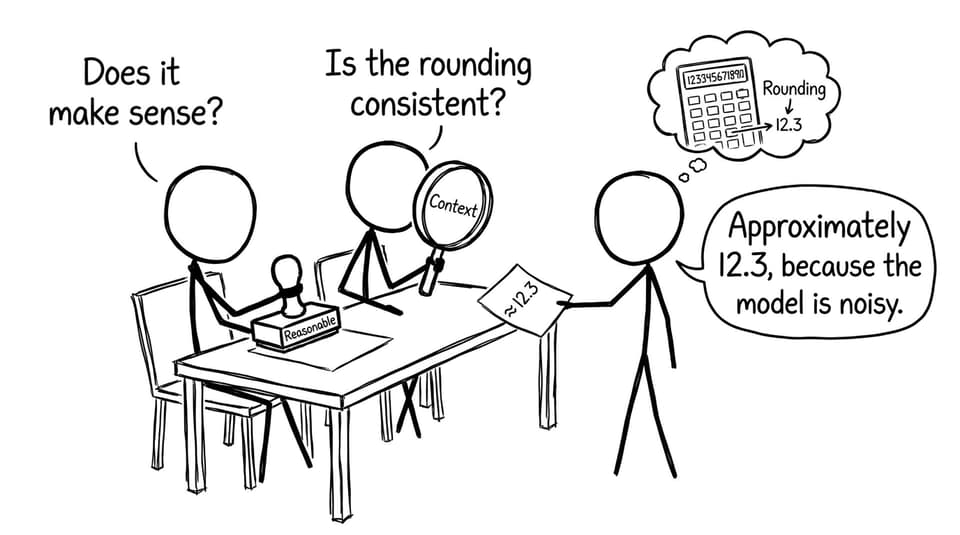
How examiners decide whether your approximation is acceptable
Examiners are not looking for one sacred decimal expansion. They’re checking whether your answer is consistent with:
-
The level of accuracy requested
-
The data quality implied by the context
-
Your method and intermediate steps
If your reasoning is solid, IB Math marking usually allows a tolerance window for approximations. That’s one reason timed practice matters: you learn what “reasonable” looks like.
To build that instinct, combine:
-
Topic practice from Number and Algebra Questionbank (AI)
-
Mixed exam rehearsal using AI Predicted Papers
-
Full simulations with Mock Exams and RevisionDojo’s Grading tools
A calm way to practise this skill on RevisionDojo
Approximation in IB Math is a modelling skill disguised as a rounding instruction.
To get confident fast, use RevisionDojo as your loop: practise sequences in the Questionbank, review the logic with Study Notes, lock in rules with Flashcards, then pressure-test with Mock Exams and Predicted Papers. If you want a human eye on your explanations, the Tutors and Grading tools help you write the kind of “approximately, therefore” reasoning examiners trust.
Approximation isn’t you doing maths wrong. In IB Math, it’s you doing maths like someone who expects the real world to be messy -- and still knows how to make it make sense.