


Why geometric series feel trickier than arithmetic series in IB Math
You can almost see the moment it happens in IB Math revision.
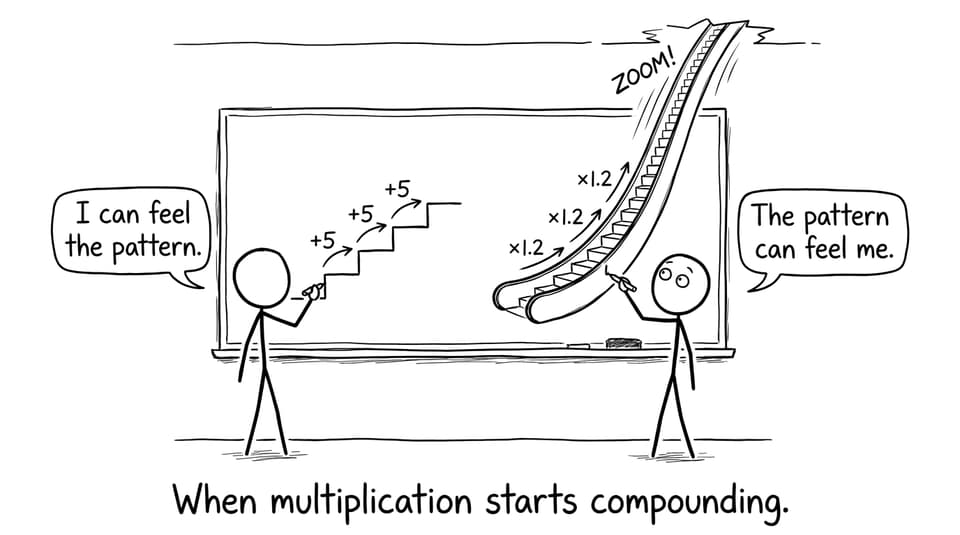
Arithmetic series feel like walking up a staircase: same step, same rhythm, predictable breath. Then geometric series shows up and quietly swaps the staircase for an escalator. Nothing looks scary at first. The first few terms even behave. And then the growth (or decay) starts compounding, and suddenly you are not “adding change” anymore; you are being changed by the multiplier.
That shift from additive thinking to multiplicative thinking is why geometric series feel harder in IB Math. It is not that the formulas are longer. It is that your intuition is trained on differences, not ratios.
A fast checklist before you choose a formula in IB Math
Use this 20-second filter in IB Math whenever you see a “sum” question:
-
Are you dealing with a sequence (an nth term) or a series (a total sum)?
-
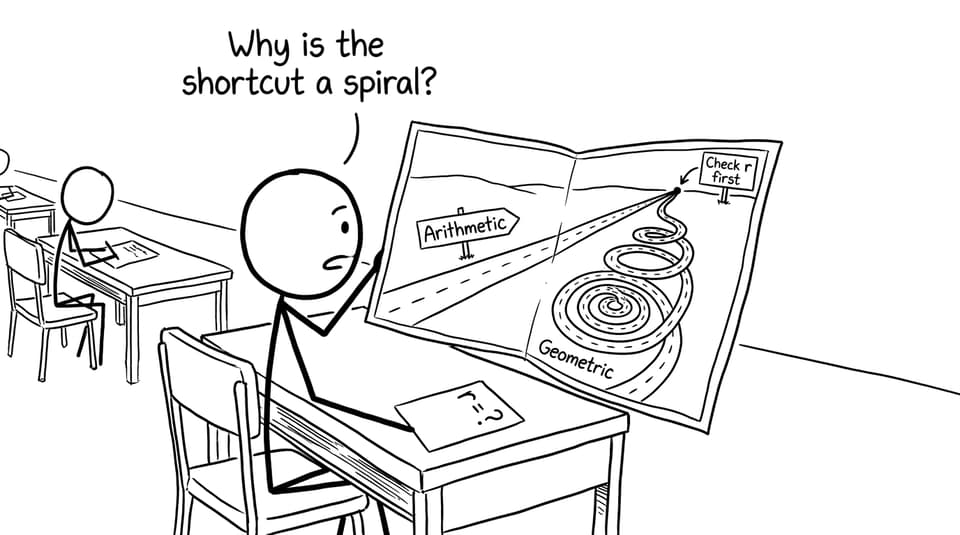
Check consecutive terms: difference constant (arithmetic) or ratio constant (geometric)?
-
Write down the first term (a), and either (d) or (r) explicitly.
-
Decide: finite ((n) terms) or infinite (sum to infinity)?
-
Only then pick the formula and substitute.
If you want structured practice for these exact moves, pair your revision with RevisionDojo’s SL 1.3 Geometric sequences and series hub and SL 1.2 Arithmetic sequences and series hub.
The real difference: arithmetic is linear, geometric is compounding
In IB Math, arithmetic sequences reward “steady-change” instincts: each term is the last term plus a constant difference. Your brain can track that.
Geometric sequences demand a different kind of tracking: each term depends on the previous term through multiplication. That creates exponential-style behavior, and exponentials are famously bad at looking harmless early on.
That is why geometric series problems can feel like they hide the pattern in plain sight. When the common ratio is not a neat integer, the structure becomes easier to miss and easier to misread.
For a clean refresher, keep these open while practicing:
Why ratios cause more mistakes than differences in IB Math
Differences are visible. Ratios are sneaky.
With arithmetic sequences, you can scan: “+3, +3, +3.” With geometric sequences, you must divide to confirm: (\frac{u_{n+1}}{u_n}=r). Under exam pressure, many IB Math students do not check, they guess.
IB-style questions often encourage that guess by choosing numbers that look “kind of linear” early on. The fix is boring but powerful: always compute at least two ratios before committing.
If you want exam-style drilling where the pattern is deliberately disguised, use RevisionDojo’s SL 1.3 Questionbank and compare with SL 1.2 Questionbank.
Why the geometric series formula is easy to misuse
Geometric sums are unforgiving in IB Math because everything depends on (r).
A small slip (using (r) instead of (r^n), mixing up (1-r) and (r-1), or grabbing the wrong first term) does not “slightly” damage the answer. It changes the entire scale.
A practical habit that wins method marks: write the template first, then substitute.
For step-by-step structure help, RevisionDojo’s Geometric Series Explained for IB Maths (AA SL & HL) and SL 1.3 Notes are solid anchors.
Word problems push you back into the wrong instinct
A lot of geometric series in IB Math arrive wearing real-life clothing: depreciation, growth, repeated percentage change.
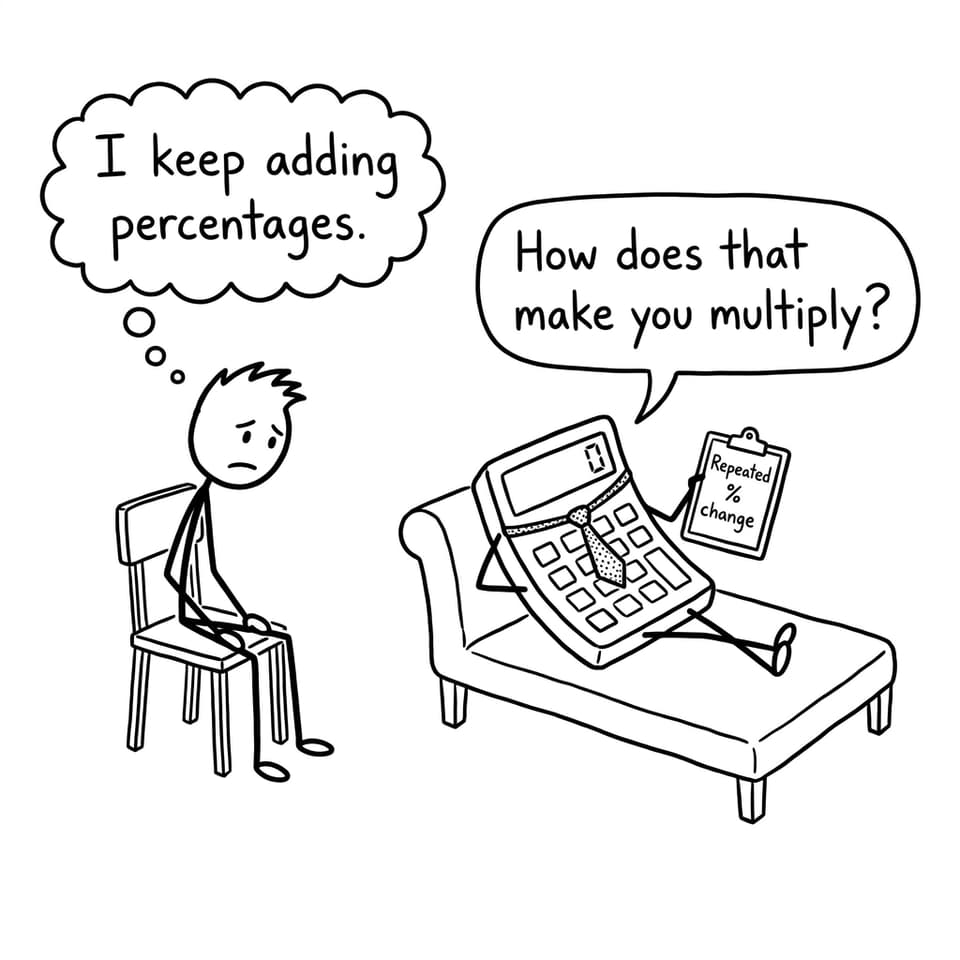
But humans talk about percentages in additive language (“it drops by 20% each year”), and students accidentally convert that into subtraction instead of multiplication.
A safe translation rule: repeated percentage change means “multiply by (1\pm p)” each step. If it repeats, it is geometric.
Finite vs infinite geometric series is the extra trap
The final layer that makes geometric series feel tougher in IB Math is deciding whether the sum stops.
If it is infinite, you must check convergence: (|r|<1). If it is finite, you use the sum to (n) terms.
Students often skip the decision and reach for the “sum to infinity” formula because it looks simpler. IB examiners love that trap.
If this is a weak spot, revise with Infinite Geometric Series Explained for IB Maths (AA SL & HL) and the syllabus note SL 1.8 Sum of infinite geo sequence notes.
Bringing it home: make IB Math geometric series predictable
Geometric series feel trickier than arithmetic series in IB Math because they ask for a different mental gear: ratios, compounding, and careful decisions about finiteness and convergence.
If you want that gear to become automatic, build a simple loop with RevisionDojo: learn the structure in the SL 1.3 Videos, drill mixed questions in the Questionbank, and reinforce the patterns with Sequences and series study strategies. Add Flashcards for quick recall, use AI Chat to check your setup, and finish with Mock Exams and Predicted Papers when you want timing pressure.
In IB Math, the students who score are rarely the ones who “know more formulas.” They are the ones who pause, identify the structure, and let the right tool do its job.